
The CMA framework from 2026: who regulates virtual assets outside Dubai now
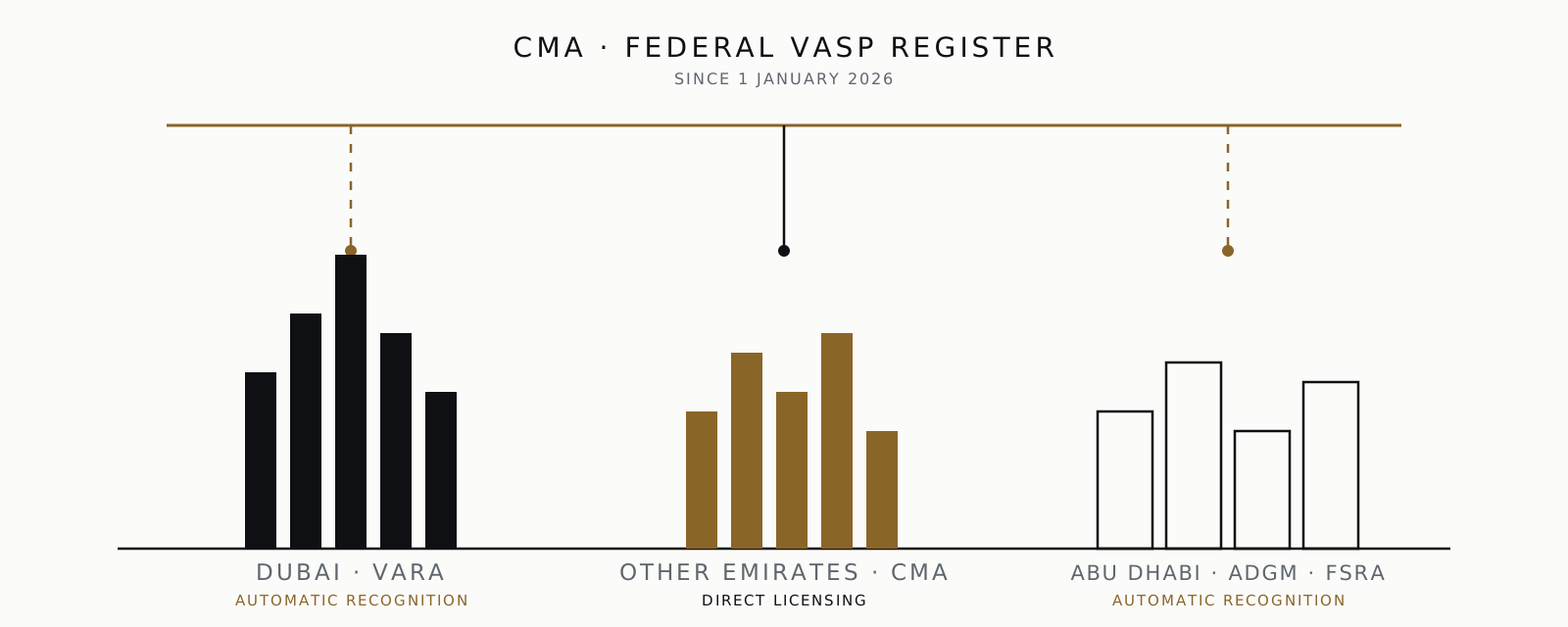
From 1 January 2026 the Capital Market Authority (CMA) — the renamed Securities and Commodities Authority — is the federal regulator for virtual-asset providers operating onshore outside Dubai and the financial free zones. Its Virtual Assets Framework, issued on 13 April 2026, sets five rule modules and eight licensable activities. A VARA licence is registered with the federal regulator by default for the wider UAE.
KEY FACTS
| Federal regulator | Capital Market Authority (CMA), formerly the SCA |
|---|---|
| Renamed and re-based | 1 January 2026 |
| Legal basis | Federal Decree-Laws No. 32 and No. 33 of 2025, in force 1 January 2026 |
| VASP licensing basis | CMA Virtual Assets Framework, issued 13 April 2026 — five modules, eight regulated activities |
| Federal VA remit since | Cabinet Decision No. 111 of 2022 (SCA), now exercised by the CMA |
| Dubai regulator | VARA, outside the DIFC |
| Abu Dhabi regulator | ADGM FSRA, inside the ADGM free zone |
| SCA–VARA agreement | Signed 5 September 2024: VARA licensees registered by default with the federal regulator for the wider UAE |
Source: CMA, VARA and ADGM FSRA public materials, as of September 2026.
What is the CMA and why did it replace the SCA?
The Capital Market Authority (CMA) is the direct legal successor to the Securities and Commodities Authority (SCA), renamed and re-based on 1 January 2026, when Federal Decree-Law No. 32 of 2025 on the Capital Market Authority and Federal Decree-Law No. 33 of 2025 on the regulation of capital markets took effect. It is the UAE's federal regulator for onshore capital markets and for virtual-asset service providers operating outside Dubai and the financial free zones.
The change altered the regulator's name and legal footing, not its onshore federal remit, which dates from Cabinet Decision No. 111 of 2022. On 13 April 2026 the CMA issued its Virtual Assets Framework: five core modules — General Requirements, Conduct of Business, Alternative Trading System, Anti-Money Laundering and Counter-Terrorist Financing, and Prudential Requirements — and eight regulated activities, up from three: dealing in virtual assets as principal or as agent, providing custody, arranging custody, arranging investment deals, investment advice, portfolio management and operating a multilateral trading facility.
Capital, conduct and AML requirements for each activity sit inside the framework's five modules — confirm specifics directly with the CMA rather than assume they mirror VARA's rulebooks.
Who does the CMA regulate for virtual assets?
The CMA regulates virtual-asset service providers and crypto sellers operating onshore anywhere in the UAE outside Dubai and outside the financial free zones — the DIFC and the ADGM. That covers Abu Dhabi mainland activity outside ADGM, and the whole of Sharjah, Ajman, Ras Al Khaimah, Fujairah and Umm Al Quwain.
For a resident or business in Sharjah or Ajman, there is no dedicated local virtual-asset authority — onshore crypto activity in those emirates falls to the federal CMA by default. A desk operating from any of these emirates, rather than through a VARA or ADGM licence, needs to hold a CMA authorisation.
This is a territorial split, not a client-facing one: it governs where a firm is licensed to operate from, not where its customers live.
How does the CMA relate to VARA and the ADGM FSRA?
The CMA sits alongside three other UAE crypto and financial regulators, each with its own territory: VARA in Dubai outside the DIFC, the DFSA inside the DIFC, and the FSRA inside Abu Dhabi's ADGM. For the fuller picture of how the Dubai and Abu Dhabi regimes differ day to day, see how crypto rules differ between Dubai and Abu Dhabi.
| Regulator | Territory | Covers | Framework basis |
|---|---|---|---|
| CMA | Onshore UAE, outside Dubai and the free zones | Securities; virtual-asset service providers | Federal Decree-Laws No. 32 and 33 of 2025; Virtual Assets Framework (13 April 2026) |
| VARA | Dubai, incl. free zones, excl. DIFC | Virtual assets and VASPs | Dubai Law No. 4 of 2022; VA Regulations 2023 |
| DFSA | DIFC only | Financial services; crypto tokens | DFSA Crypto Token regime |
| FSRA | ADGM only (Abu Dhabi) | Financial services; virtual assets | FSRA virtual asset framework |
The four regulators do not compete for the same firm: each licenses a distinct territory, and the 2024 SCA–VARA agreement stops the federal regulator and VARA licensing the same activity twice.
VARA and the SCA (now the CMA) signed a cooperation agreement on 5 September 2024: a VASP operating in or from Dubai must hold a VARA licence and is registered by default with the federal regulator to serve the wider UAE, while a VASP operating from any other emirate must be licensed federally. The agreement also covers mutual supervision, penalties, information exchange and training. The point is straightforward: a firm licensed in one zone is not re-licensed for the same activity in another.
What changed for sellers outside Dubai in 2026?
For a client selling crypto in Sharjah, Ajman or another emirate outside Dubai and ADGM, the practical change in 2026 is who signs off the licence, not the rules a licensed desk follows. Until the end of 2025 the onshore federal regulator was the SCA, working from Cabinet Decision No. 111 of 2022; since 1 January 2026 it is the CMA, and since 13 April 2026 the CMA's Virtual Assets Framework sets the licensing modules and activities.
If you already use a Dubai desk licensed by VARA, nothing changes for you: the 2024 agreement already registers a VARA licensee federally for the wider UAE, and did before the CMA existed under that name. The reconstitution mainly affects firms holding, or applying for, a federal onshore licence directly.
A firm still advertising only "SCA licensed", with no reference to the 2026 transition, is worth a direct question before you trade.
How do you verify a desk outside Dubai is legal?
Verifying a desk outside Dubai takes the same two steps as verifying one inside it: ask for the licence number and the issuing regulator, then check that number in the matching public register. Outside Dubai and ADGM, that register is the CMA's; a firm citing a VARA licence is also registered federally under the 2024 SCA–VARA agreement, provided the register entry resolves. A firm citing an ADGM FSRA licence is licensed for activity in or from ADGM — check the FSRA register and ask on what basis it serves you outside it.
- Ask which regulator issued the licence — CMA, VARA or the ADGM FSRA — and get the licence number in writing.
- Check the CMA's public register for a federal licence, or VARA's public register if the firm cites a Dubai licence.
- Expect the same federal AML rules everywhere: identity documents, source-of-funds checks and the same onboarding standard regardless of emirate.
- Expect own-name settlement only — a licensed desk pays into a bank account in your own name, in Sharjah, Ajman or Dubai alike.
IWGT operates from Dubai under VARA licence VL/24/12/002, listed in the licence section of our main page; under the 2024 SCA–VARA agreement that licence is registered federally to serve clients across the UAE, including Sharjah and Ajman, without a second licence for the same activity.
The bottom line on the CMA framework
The CMA is the federal successor to the SCA, regulating virtual-asset activity onshore outside Dubai and the financial free zones under the Virtual Assets Framework it issued on 13 April 2026. For a client, the practical protection has not moved: verify the licence in the register that matches the firm's claim, expect the same identity checks everywhere, and treat a resolving register entry — CMA, VARA or FSRA — as the baseline before you send anything. Questions on how this applies to your situation belong in our main FAQ section.
FAQ
Is selling crypto legal in Sharjah or Ajman?
Yes, when the counterparty is licensed. Sharjah, Ajman and the other emirates outside Dubai and ADGM have no local virtual-asset regulator; onshore activity there falls under the federal Capital Market Authority (CMA), and a VARA-licensed Dubai desk can also serve clients there because the 2024 SCA–VARA agreement registers it federally.
What happened to the SCA?
The Securities and Commodities Authority (SCA) was renamed the Capital Market Authority (CMA) on 1 January 2026, when Federal Decree-Laws No. 32 and No. 33 of 2025 took effect. The CMA is its direct legal successor and kept its onshore securities and virtual-asset remit.
Does a VARA licence let a Dubai desk serve clients outside Dubai?
Yes. Under the cooperation agreement signed on 5 September 2024, a VASP licensed by VARA in Dubai is registered by default with the federal regulator — then the SCA, now the CMA — to serve the wider UAE, so it is not licensed twice for the same activity.
Is onshore Abu Dhabi the same as ADGM for crypto rules?
No. ADGM is a financial free zone regulated by the FSRA. Abu Dhabi mainland activity outside ADGM falls under the federal CMA, the same regulator that covers Sharjah, Ajman and the other emirates outside Dubai.
How do I check whether a desk outside Dubai is legally licensed?
Ask for the licence number and issuing regulator, then check the matching public register: the CMA register for a federal licence, VARA's register for a Dubai licence, or the ADGM FSRA register for an ADGM licence. A VARA licence is also registered federally under the 2024 SCA–VARA agreement; for an ADGM licence, check the FSRA register and the firm's permitted scope.
Are identity checks different outside Dubai?
No. Anti-money-laundering and identity-verification rules are federal, so a licensed desk asks for the same passport, proof of address and source-of-funds documents whether you sell from Dubai, Sharjah or Abu Dhabi.
Trade through a VARA-licensed desk, recognised UAE-wide
IWGT is a VARA-licensed Broker-Dealer in Dubai, licence VL/24/12/002, registered federally under the 2024 SCA–VARA agreement. All-in spread 0.08–0.40% by size, published openly. AED by UAEFTS the same business day once your account is approved.
SOURCES
- Capital Market Authority — New CMA Law: Federal Decree-Laws No. 32 and No. 33 of 2025, in effect 1 January 2026, renaming the SCA as the CMA, accessed 21 September 2026.
- CMA — The CMA Issues the Virtual Assets Framework: five core modules and eight regulated activities (13 April 2026), accessed 21 September 2026.
- CMA (then SCA) — SCA and VARA set regulatory framework for the UAE's virtual assets sector (agreement signed 5 September 2024; default federal registration of VARA licensees), accessed 21 September 2026.
- VARA — Laws and Regulations: Dubai Law No. 4 of 2022, Cabinet Decisions No. 111 and 112 of 2022, Virtual Assets and Related Activities Regulations 2023, accessed 21 September 2026.
- VARA public register — Dubai licence status check, accessed 21 September 2026.
- ADGM FSRA public register — Abu Dhabi licence status check, accessed 21 September 2026.
This guide is informational and is not legal, tax or investment advice, nor an invitation to buy or sell any virtual asset. Rules and figures are as of September 2026 — re-check the sources before acting. Virtual assets may lose their value in full or in part and are subject to extreme volatility.