
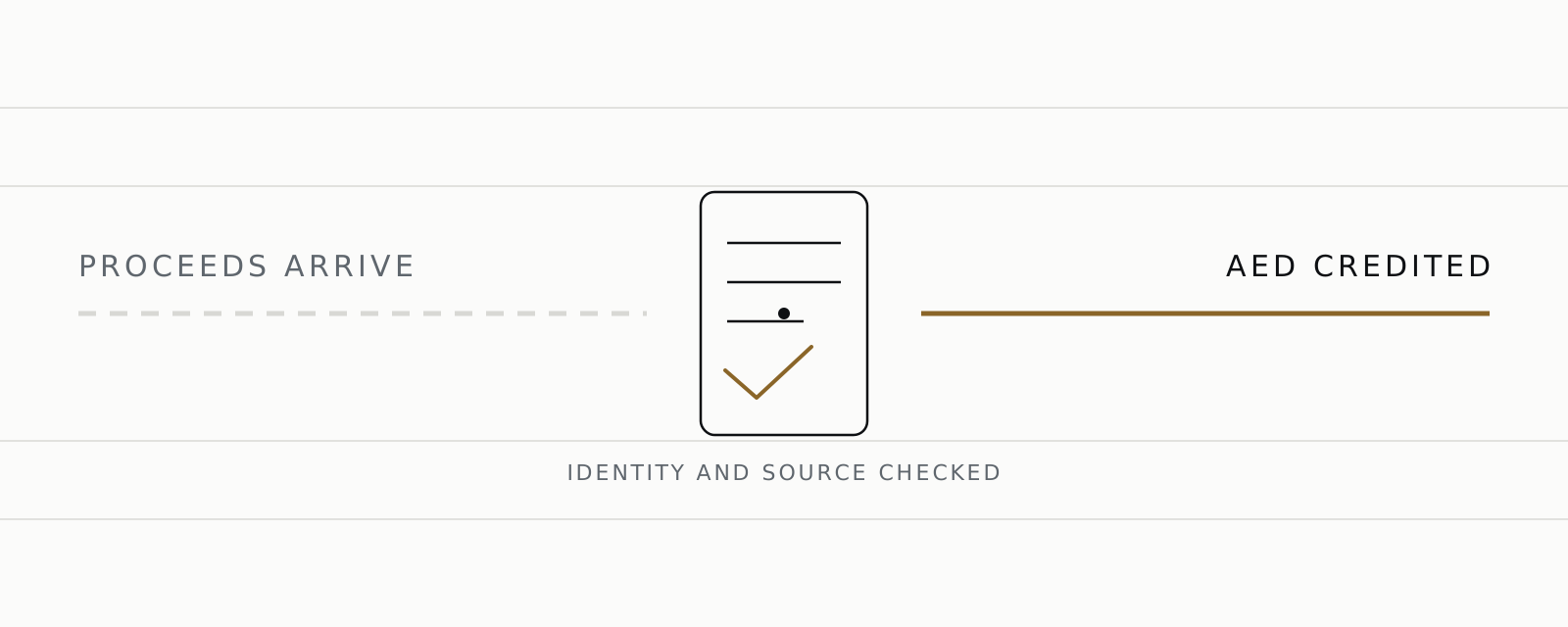
Receiving crypto-sale proceeds at ADCB: what the bank checks
Abu Dhabi Commercial Bank (ADCB) screens an incoming crypto-sale transfer the same way it screens any large wire: sender identity, whether the amount matches your declared income or business activity, and sanctions and AML checks under Central Bank of the UAE rules. Personal and business accounts face different document requests, and preparation before you sell shortens the review.
KEY FACTS
| Bank supervisor | Central Bank of the UAE (CBUAE) |
|---|---|
| Desk licensing | VARA (Dubai, outside the DIFC) |
| ADCB crypto-specific policy | Not publicly published — reviewed case by case |
| Clean settlement profile | Licensed desk, own-name account, documents on file |
| AED settlement rail | UAEFTS, same business day |
| USD settlement rail | SWIFT, 2–5 business days |
Source: CBUAE published payment-systems material and IWGT desk observation, as of September 2026.
What ADCB checks on an incoming crypto-sale settlement
Abu Dhabi Commercial Bank (ADCB), like every bank supervised by the Central Bank of the UAE (CBUAE), applies the anti-money-laundering (AML) and sanctions screening described in our guide to what UAE banks screen for in crypto inflows before crediting an account with a large or unusual sum. The review looks at who sent the money, whether the sender is a regulated entity, where the underlying funds came from, and whether the amount fits your declared income or account activity.
None of this is unique to one bank. A CBUAE-regulated bank must be able to explain, on file, why a large, non-standard credit landed in an account it holds, whichever bank issued the statement.
Personal account vs business account: what ADCB asks for
A personal ADCB account and a business ADCB account face different questions when crypto-sale proceeds arrive, because the bank measures each against a different baseline: personal income and history, or registered trade-licence activity.
| Check | Personal account | Business account |
|---|---|---|
| Source-of-funds evidence | Payslip, investment record or exchange trade history | Invoice, contract or board resolution tied to the transaction |
| Expected transfer size | Compared with salary or declared net worth | Compared with the trade licence's registered activity and turnover |
| Sender scrutiny | Identity and relationship to the account holder | Counterparty due diligence and name-matching to the contract |
| Typical extra document | Bank statement history from the source platform | Trade licence copy and authorised-signatory letter |
A business account with a matching invoice or contract usually clears faster than a personal account explaining the same amount from memory.
Documents to prepare before the settlement lands
Preparing documents before you sell shortens ADCB's review, because the bank receives a full narrative on day one instead of requesting it in stages. Keep a source-of-funds file ready alongside your trade confirmation and identification.
- Trade confirmation or settlement note from your OTC desk or exchange
- Source-of-funds file: wallet history, prior statement, or investment records
- Emirates ID or passport and visa page, for individuals
- Trade licence, MOA and authorised-signatory letter, for companies
- A recent ADCB statement showing your typical account activity
Assembling this pack once, before the day you need the money, is faster than rebuilding it after ADCB opens a query.
Why the sender name must match your own account name
Own-name settlement — the desk paying proceeds into an account held in the seller's own legal name — is the detail ADCB's compliance team checks before anything else on a crypto-sale credit. A desk offering to pay a third party, or an account under a different name, creates the exact mismatch that triggers a hold.
IWGT pays every settlement to the client's own name for this reason, with the trade reference written on the confirmation before the wire is sent, not fixed afterwards.
What speeds up the credit, and what can trigger a hold
What speeds up the credit
ADCB credits a crypto-sale transfer faster when the sender is named and licensed, the reference line is clear, and the amount matches your declared profile. Documents ready before the wire lands, rather than produced after a query, cut the review to hours rather than days.
What can trigger a hold
ADCB's review lengthens when the sender is unnamed, the transfer carries no reference, or a first deposit sits far above your normal account activity. Splitting one sale into several smaller transfers slows it further, since banks read that pattern as an attempt to dodge a reporting threshold, not as caution.
Larger or repeat conversions can move into a formal enhanced due diligence review for large crypto conversions, which adds documents and time rather than an automatic refusal. ADCB cannot confirm mid-review whether it has filed a report — tipping off a customer is an offence under UAE anti-money-laundering law. ADCB does not publish a hold threshold or a review turnaround, so treat any figure quoted elsewhere as unverified and ask the bank directly.
AED or USD: which settlement rail your proceeds use
AED and USD proceeds travel through different rails once ADCB receives your settlement, and choosing between AED and USD settlement affects both speed and cost. AED moves through UAEFTS the same business day; USD travels by SWIFT and takes two to five business days to land.
IWGT quotes both currencies against our published spread bands, from 0.08% on the largest tickets to 0.40% on the smallest, so you can compare the AED same-day route against the slower USD wire before you commit.
The bottom line on receiving crypto proceeds at ADCB
ADCB is not an obstacle to crypto-sale proceeds; an undocumented, mismatched or unexplained credit is the actual friction. Use a licensed counterparty, settle to your own name, and have the trade confirmation and source-of-funds file ready before the wire arrives. You can request a quote from a licensed desk once that pack is in place.
FAQ
Does ADCB have a published policy on crypto-sale proceeds?
No — ADCB has not published a crypto-specific settlement policy. It applies the same CBUAE anti-money-laundering and know-your-customer rules that cover any large, non-salary credit, on a case-by-case basis.
What documents should I have ready before the transfer arrives?
A trade confirmation from your OTC desk, a wallet or exchange statement showing where the USDT came from, and a short source-of-funds letter. Assembling this before the wire is sent is faster than producing it after the bank asks.
Does ADCB treat a personal account differently from a business account?
Yes. A personal account is measured against your salary and declared net worth, while a business account is measured against the trade licence's registered activity and turnover, with different supporting documents for each.
Can ADCB hold or query an incoming crypto-sale transfer?
Yes. Any CBUAE-regulated bank can hold, query or decline an inflow it cannot immediately explain. A wire from a licensed desk to an account in your own name, with documents ready, is the profile least likely to be held.
Does it matter whether the proceeds arrive by SWIFT or UAEFTS?
The rail affects speed, not the documents a compliance team wants: AED by UAEFTS lands the same business day, USD by SWIFT takes two to five business days. On both rails, the sender name and payment reference matter equally.
How long does a compliance review of the incoming wire take?
There is no published fixed timeframe. A complete document set submitted promptly typically closes a query in one round; missing or contradictory documents are what stretch a review.
Settle to ADCB with the paper trail already in place
IWGT is a VARA-licensed Broker-Dealer in Dubai (VL/24/12/002). All-in spread 0.08–0.40% by size, a written trade confirmation on every deal, AED by UAEFTS the same business day to an account in your own name.
SOURCES
- Central Bank of the UAE — payment systems (UAEFTS), accessed 17 September 2026.
- VARA public register — licence status check, accessed 17 September 2026.
- UAE Government portal — combatting money laundering (Federal Decree-Law No. 20 of 2018), accessed 17 September 2026.
- ADCB — personal banking (general terms and conditions; no published crypto-specific settlement policy identified), accessed 17 September 2026.
- IWGT desk observations on client settlement handling, September 2026.
This guide is informational and is not legal, tax or investment advice, nor an invitation to buy or sell any virtual asset. It is not a statement of ADCB's official policy, and IWGT is not affiliated with or endorsed by ADCB. Rules and figures are as of September 2026 — re-check the sources before acting. Virtual assets may lose their value in full or in part and are subject to extreme volatility.