
CARF explained: automatic crypto tax reporting from 2027 and how to prepare
CARF is the OECD's standard for automatically exchanging crypto tax data between countries, similar to CRS for bank accounts. The UAE signed the CARF multilateral agreement in July 2025 and expects to apply the framework from 1 January 2027, with the first exchange of data on 1 September 2028. UAE sellers should expect more KYC and tax-residency questions from licensed platforms.
KEY FACTS
| Framework | Crypto-Asset Reporting Framework (CARF) |
|---|---|
| Issued by | OECD (Organisation for Economic Co-operation and Development), 2022 |
| UAE commitment | Intent announced November 2024; CARF MCAA signed 21 July 2025; ratified by Federal Decree No. 60 of 2026 on 4 May 2026 |
| UAE start | Implementing decisions target 1 January 2027; first annual report due 30 June 2028, for the 2027 reporting period; first exchange 1 September 2028 |
| UAE reporting authority | Ministry of Finance — RCASPs report annually to the MoF |
| Reporting entities | RCASPs — licensed exchanges, brokers and other crypto-asset platforms |
Source: OECD; UAE Ministry of Finance, as of October 2026.
What is the Crypto-Asset Reporting Framework (CARF)?
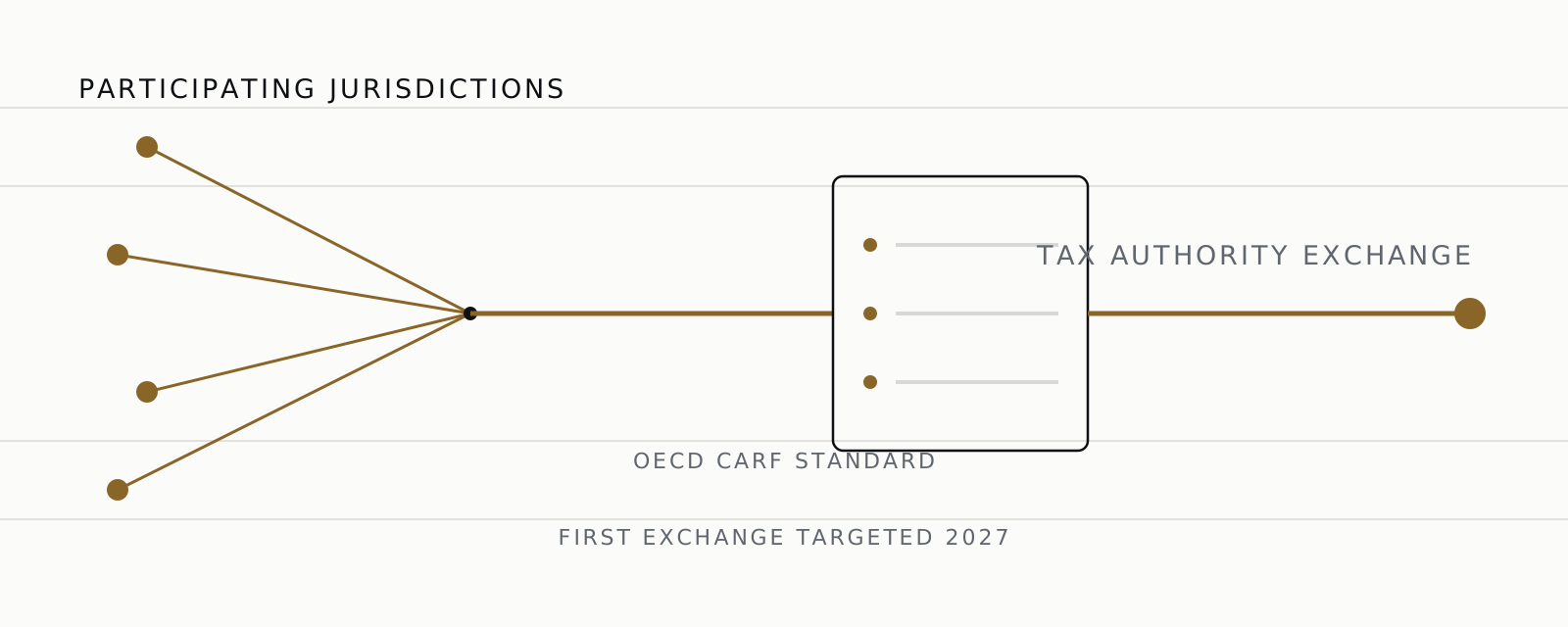
The Crypto-Asset Reporting Framework (CARF) is a global tax-transparency standard published by the OECD in 2022 that requires crypto-asset service providers to collect client and transaction data and report it to their local tax authority. That authority then exchanges the data automatically with the tax authorities of the client's countries of tax residence.
CARF sits alongside the UAE's existing tax rules rather than replacing them — UAE crypto tax treatment for individuals is unaffected, since the country charges no personal income tax on crypto gains. What CARF changes is what a foreign tax authority can learn about a UAE-based seller's activity, or what the UAE's authority can learn about a non-resident trading through a UAE platform.
The OECD built CARF as the crypto-specific counterpart to the Common Reporting Standard (CRS), which already covers bank and custody accounts. Crypto-assets sat outside CRS because many can be held and moved without a traditional financial intermediary, which is the gap CARF is designed to close.
How does CARF differ from the Common Reporting Standard (CRS)?
The Common Reporting Standard (CRS) is the OECD's existing standard for exchanging information on traditional financial accounts, applied by most participating jurisdictions since 2017; CARF extends the same logic to crypto-assets, which CRS does not cover. Both standards share one goal: replacing case-by-case information requests with automatic, scheduled exchange between tax authorities.
The practical difference matters for anyone selling crypto in size. CRS relies on banks and custodians, with decades of reporting infrastructure behind them; CARF relies on a newer, wider set of firms, many filing this kind of report for the first time. The table below sets out the main contrasts.
| Aspect | CRS | CARF |
|---|---|---|
| Asset scope | Bank accounts, custody accounts, some insurance products | Crypto-assets, incl. crypto-to-fiat and crypto-to-crypto exchanges |
| Reporting entity | Banks and other financial institutions | RCASPs — exchanges, brokers and other crypto-asset service providers |
| First exchanges | From 2017 in most participating jurisdictions | UAE: rules expected from 1 January 2027 (target date), first exchange on 1 September 2028; many other jurisdictions target 2027 |
| Published by | OECD, 2014 | OECD, 2022 |
| UAE status | Long-standing participant | CARF MCAA signed July 2025 and ratified May 2026; expected live from 1 January 2027 (target date) |
CARF applies the CRS model to providers most of which have never reported this kind of data before, so the process is newer on both the platform and the tax-authority side.
What must a Reporting Crypto-Asset Service Provider (RCASP) collect?
A Reporting Crypto-Asset Service Provider (RCASP) is the CARF term for a licensed exchange, broker or other platform required to identify its clients and report their crypto transactions. The category is defined by the activity performed rather than by where the firm is based, so a UAE-licensed platform can fall within it once CARF is implemented locally.
- Identity data — name, address, date of birth or incorporation, and tax identification number.
- Tax residency — every jurisdiction where the client is tax resident, self-certified and checked for plausibility.
- Transaction records — crypto-to-fiat exchanges, crypto-to-crypto exchanges and qualifying transfers, by asset type and value.
- Reportable crypto-assets — most tokens used for payment or investment; certain central bank digital currencies sit under separate rules.
This is an extension of checks a licensed platform already runs, not a new category of identity check. Anyone who has opened an account with a licensed desk has already supplied KYC documentation covering most of what an RCASP will later be asked to report.
When will a UAE platform ask you to self-certify?
From 1 January 2027, the expected start date, a new user of a UAE reporting platform gives a valid CARF self-certification when the relationship is established. For existing users, the platform must obtain one by 31 December 2027. The Ministry of Finance set these dates in its CARF Readiness Circular of October 2026.
A valid self-certification includes a taxpayer identification number (TIN) where one is required, and the platform must confirm that it is reasonable. For certain entity clients, the platform also collects the required self-certification information for the entity's controlling persons.
| Date | Milestone |
|---|---|
| By 31 December 2026 | RCASPs should finish operational preparations: policies, procedures and controls for due diligence, self-certification and record-keeping. |
| 1 January 2027 | Target effective date of the Cabinet Decision and Ministerial Decisions implementing CARF. New users self-certify at onboarding. |
| During 2027 | RCASPs register on the Ministry's Reporting System and disclose their type of UAE nexus, by a deadline the Ministry will confirm. |
| By 31 December 2027 | RCASPs must hold a valid self-certification for each pre-existing user, and reporting systems should be fully operational. |
| 30 June 2028 | First Annual CARF Report or Nil Return, for the 2027 reporting period. |
| 1 September 2028 | The UAE's first automatic exchange of CARF information with partner jurisdictions. |
As of October 2026, 1 January 2027 is a target effective date and the registration deadline is not yet set. Check the Ministry's CARF page before relying on either.
What changes for a UAE-based seller once CARF applies?
A UAE-based crypto seller does not gain a new UAE tax bill from CARF, since the UAE continues to charge no personal income tax on individual crypto gains. What changes is visibility: a large sale processed through a reporting platform may become known to the tax authority of the seller's own tax residency, even though the UAE itself does not tax the proceeds.
This matters most for people who moved to the UAE holding existing crypto wealth, or who still keep tax residency ties elsewhere. Anyone moving crypto wealth to the UAE should assume that, once CARF exchanges begin, a former home country's tax authority may eventually see transaction data reported by a UAE platform.
CARF reporting is separate from VARA's licensing rules, which govern who may operate as a licensed virtual-asset business in Dubai, not what gets reported to foreign tax authorities. A firm being VARA-licensed says nothing about whether CARF applies to it. That depends on the UAE's implementing decisions and on whether the firm falls within the RCASP definition.
How should a UAE seller prepare for CARF reporting?
The practical preparation for CARF is the file a UAE seller should already keep for a bank or OTC desk: clean records of source of funds and trade history, built before reporting obligations take effect.
-
STEP 1
Keep a source-of-funds file for every holding
Record how each token was acquired — salary, business proceeds, an earlier trade — and keep exchange or wallet statements to back it up. Our guide to a source-of-funds file for crypto proceeds covers the documents in more depth.
-
STEP 2
Confirm your tax residency status in writing
Know which country or countries currently treat you as tax resident, since that is the detail an RCASP will ask you to certify. Where residency is unclear — a recent move, or time split between countries — get this checked rather than guessing.
-
STEP 3
Keep trade confirmations from every platform you use
A written confirmation showing amount, rate and settlement account is the same evidence a bank asks for, and the evidence an RCASP will later hold on file. Our own onboarding process collects broadly the same information before a first trade.
-
STEP 4
Talk to a tax adviser in your country of residence
CARF changes what a foreign tax authority can see, not what you owe — that answer depends on your home country's rules, which sit outside the scope of this guide. A licensed tax adviser is the right source for anything specific to your situation.
The bottom line on CARF for UAE crypto sellers
CARF does not change UAE tax law or add a local tax bill; it changes who can see transaction data. In the UAE, platforms are expected to start collecting CARF information from 1 January 2027 (target date) and file the first annual report by 30 June 2028. The UAE's first exchange of data is on 1 September 2028, as of October 2026.
Treat CARF as a reason to keep clean records rather than a new compliance burden: the source-of-funds and trade-confirmation file a careful seller already keeps for a bank covers most of what an RCASP will eventually ask for too.
FAQ
When does CARF reporting start?
In the UAE, platforms must apply CARF due diligence from 1 January 2027, the target effective date. They file the first annual report, for 2027, by 30 June 2028. The UAE's first automatic exchange with partner jurisdictions is on 1 September 2028, as of October 2026.
Has the UAE committed to implementing CARF?
Yes. The UAE announced its intent in November 2024, signed the CARF Multilateral Competent Authority Agreement on 21 July 2025 and ratified it by Federal Decree No. 60 of 2026 on 4 May 2026. Its implementing decisions target 1 January 2027, as of October 2026.
Does CARF replace or change VARA licensing?
No. CARF is a tax-transparency reporting standard; VARA licensing governs who may operate a virtual-asset business in Dubai. A platform can be VARA-licensed and separately required to report under CARF once it takes effect.
Will I owe UAE tax because of CARF reporting?
No. The UAE has no personal income tax, and CARF does not create one. CARF only governs how transaction data is shared with the tax authority of your own tax residency, which may then apply its own rules.
What information will a reporting platform ask me for under CARF?
Expect requests for your tax residency, identifying details and transaction records. New users of a UAE platform self-certify, with a TIN where required, at onboarding from 1 January 2027, the target date. Platforms must obtain a self-certification from existing users by 31 December 2027, as of October 2026.
Is CARF the same as CRS?
No. CRS covers traditional financial accounts; CARF is a parallel standard built specifically for crypto-assets and the service providers that handle them. Both feed the same international tax-transparency network.
Keep clean records with a licensed dealing desk
IWGT is a VARA-licensed Broker-Dealer in Dubai (licence VL/24/12/002). Every trade comes with a written confirmation, and our onboarding collects the same source-of-funds evidence a bank — or, in time, an RCASP — will ask for.
SOURCES
- UAE Ministry of Finance — Automatic Exchange of Information (AEOI): Crypto-Asset Reporting Framework (CARF) (UAE commitment, CARF MCAA of 21 July 2025, Federal Decree No. 60 of 2026, effect from 1 January 2027, first exchange 2028), accessed 12 October 2026.
- UAE Ministry of Finance: CARF Readiness Circular (PDF, October 2026) (ratification on 4 May 2026, RCASP readiness by 31 December 2026, self-certification timelines, first Annual CARF Report by 30 June 2028, first exchange on 1 September 2028), accessed 12 October 2026.
- OECD — Crypto-Asset Reporting Framework (CARF), accessed 17 September 2026.
- OECD — joint statement on CARF implementation, 10 November 2023, accessed 17 September 2026.
- VARA — official website, accessed 17 September 2026.
- IWGT published onboarding and documentation requirements — this site, September 2026.
This guide is informational and is not legal, tax or investment advice, nor an invitation to buy or sell any virtual asset; it is not tax advice. Confirm CARF implementation timing and reporting scope for your case with a licensed tax adviser. Rules and figures are as of October 2026. Re-check the sources before acting. Virtual assets may lose their value in full or in part and are subject to extreme volatility.