
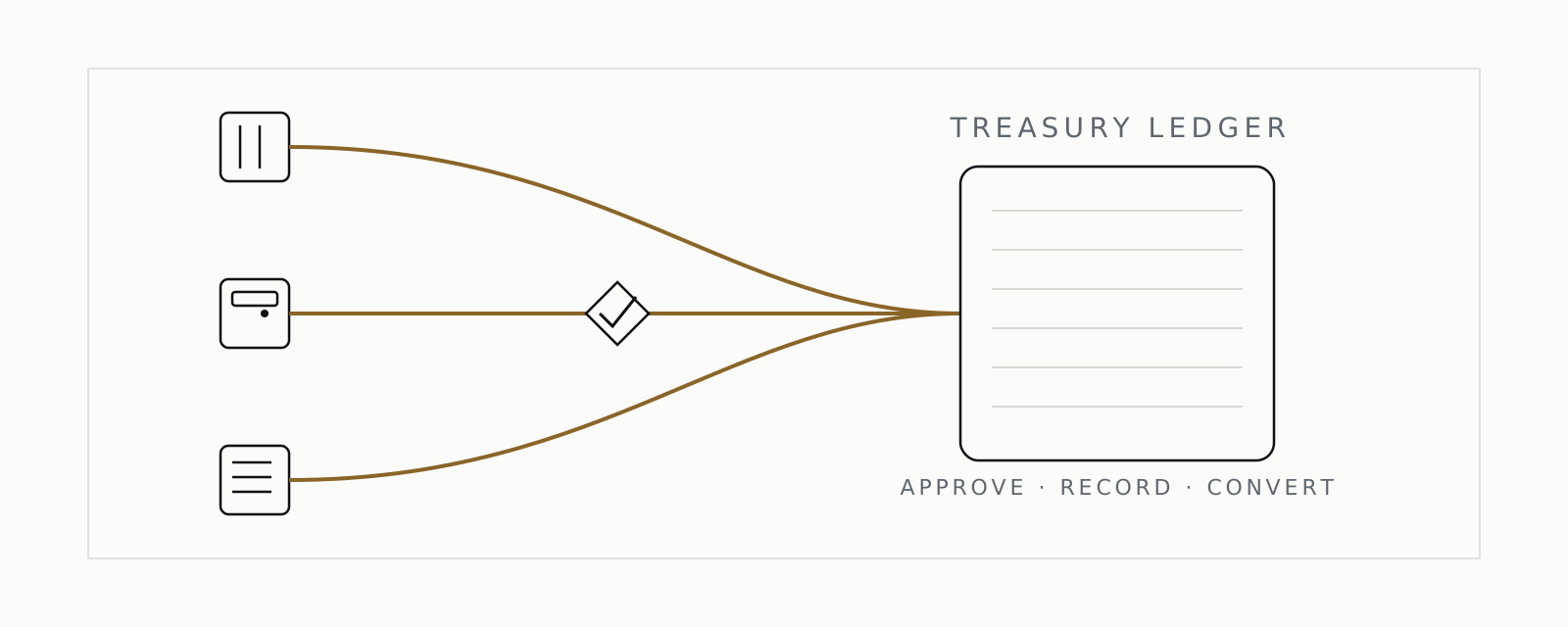
Holding and converting crypto in a UAE company treasury
A UAE company treasury holds crypto through a corporate bank account plus a custodial or self-custody wallet held in the company's own name, not an employee's. Finance keeps a transaction ledger for cost and fair-value accounting, applies segregation-of-duties controls on conversions, and treats gains as part of taxable profit above the AED 375,000 Corporate Tax threshold.
KEY FACTS
| Regulator(s) | FTA (Corporate Tax, VAT) · VARA (virtual asset dealing, Dubai) |
|---|---|
| Corporate Tax rate | 9% on taxable profit above AED 375,000 (0% below) |
| VAT standard rate | 5% — transfer and conversion of virtual assets are exempt financial services (VAT Executive Regulation, Art. 42, as amended 2024) |
| Typical OTC desk minimum | From around 100,000 USDT |
| IWGT spread | 0.08%–0.40%, by ticket size |
| AED settlement | Same business day (UAEFTS) |
Source: Federal Tax Authority (Corporate Tax; VAT Executive Regulation), VARA; desk spread and settlement terms per the pricing table on the main page, as of September 2026.
KEY TAKEAWAYS
- Hold treasury crypto in an account or wallet titled in the company's own name, never an employee's.
- Keep a transaction ledger with cost, fair value at conversion, and AED/USD movement for the auditor.
- Split duties: one person requests a conversion, a second approves it, within a written transaction limit.
- Crypto gains sit inside ordinary taxable profit for Corporate Tax; VAT treatment differs by transaction type.
- An OTC desk settles to the company's own account after one onboarding check; an exchange repeats checks per withdrawal.
What account or wallet does a UAE company need to hold crypto?
A UAE company holding crypto in treasury needs two things: a corporate bank account at a UAE bank, and a wallet — custodial or self-custody — held in the company's own legal name, matching the trade licence used when selling crypto from a company account. Mainland or free zone status changes which bank onboards it, not the requirement itself.
Every conversion back to AED or USD must land in that same corporate account. Own-name settlement — the desk paying only the legal entity that sold the crypto, never a third party — is the standard a UAE bank expects.
A UAE-regulated bank will ask questions before crediting crypto-linked inflows, especially on the first deposit — a written explanation of where the funds came from, sometimes the wallet's transaction history. See how UAE banks treat crypto-related inflows. Self-custody keeps control in-house but puts key-management risk on staff; a custodial provider shifts that risk for a fee — either way, title the wallet to the company, not a director.
What records does a UAE company need to keep for crypto in treasury?
A UAE company should keep a transaction-level record for every crypto holding and conversion in its treasury: date, quantity, counterparty, cost basis, and the AED or USD value at the transaction date. This is the file an auditor asks for first, and the file that supports the Corporate Tax return.
Most UAE companies carry crypto at cost with impairment, or at fair value where their reporting standard permits it; either basis needs the AED value on the day of each transaction, not a month-end approximation. Two figures move independently — the crypto's own price and the AED/USD rate at settlement — so the ledger should show both. Reconcile against the wallet and bank statement on a fixed schedule, not only at year end; a gap found in month nine is a correction, the same gap found at audit is a qualification risk.
What internal controls does a crypto treasury need?
A crypto treasury needs the same internal controls as any cash position, adapted for wallets: segregation of duties, a per-transaction limit, an approved counterparty list, and independent reconciliation. None of this is unique to crypto.
| Control | Purpose | Typical owner |
|---|---|---|
| Segregation of duties | Separates the requester from the approver | Finance lead + a second signatory |
| Multi-sig or maker-checker wallet | No single person can move funds alone | Treasury + CFO or director |
| Per-transaction limit | Caps what moves without extra sign-off | Board or written treasury policy |
| Approved counterparty list | Restricts trades to vetted banks and desks | Finance and compliance |
| Transaction log | Records date, amount, rate, counterparty | Finance and accounting |
| Independent reconciliation | Checks wallet and bank balances against the ledger | Auditor or a second reviewer |
No single control substitutes for the others — a transaction limit without segregation of duties still lets one person structure a transfer below the cap.
How does UAE Corporate Tax apply to crypto held in a company treasury?
UAE Corporate Tax treats a gain or loss on crypto held in a company treasury as part of ordinary taxable profit, taxed at 9% above the AED 375,000 threshold and at 0% below it. There is no separate crypto tax regime.
The detail that decides the exact figure — realised versus unrealised gains, the accounting policy elected, and Qualifying Free Zone Person rules — is covered in full in our guide to crypto taxation in the UAE; this is a general rule, not advice on your company's facts, and a free zone structure or group arrangement can change the outcome. Confirm the position with your tax adviser or auditor before filing.
Does VAT apply when a company converts crypto in its treasury?
UAE VAT, at a standard rate of 5%, does not apply to the transfer of ownership or the conversion of virtual assets: Article 42 of the VAT Executive Regulation, as amended by Cabinet Decision No. 100 of 2024, lists both as exempt financial services, and the exemption covers services supplied on or after 1 January 2018, as of September 2026. Two limits matter for a treasury. Keeping and managing virtual assets for an explicit fee remains a taxable financial service under the same article, and paying a supplier directly in crypto still raises ordinary VAT questions about the underlying goods or services. Converting treasury USDT to AED through a desk is the exempt case; treat this as a starting point, not a ruling on your transaction — confirm the current position with FTA guidance and your tax adviser before relying on it.
Why convert treasury crypto through an OTC desk instead of an exchange?
A UAE company converting treasury crypto through a licensed OTC desk completes KYB (know-your-business) and enhanced due diligence once, at onboarding, then settles directly into its own bank account on every trade after — instead of repeating exchange withdrawal checks each time.
Own-name settlement means the desk pays only the legal entity that sold the crypto — the same protection a bank wants to see. Preparing a source-of-funds file once, at the account approval covered in our onboarding requirements, is the main reason a desk suits a treasury doing repeat conversions better than an exchange does.
Above roughly 100,000 USDT — the typical desk minimum ticket — IWGT's spread runs 0.08% to 0.40% by size, set out in our published pricing bands. Converting a larger balance in one block also avoids the withdrawal limits and per-transaction fees an exchange applies. IWGT operates under Broker-Dealer licence VARA VL/24/12/002, which covers this kind of company-to-company settlement.
Worked example: converting 300,000 USDT from a company treasury
A Dubai trading company holds USDT in its treasury from crypto-denominated customer receipts. Its finance manager requests a conversion of 300,000 USDT to AED for a payroll run; under the company's written treasury policy, any conversion above AED 200,000 needs a second sign-off, so the CFO approves the request first.
The company requests a quote through IWGT's quote request form. At 300,000 USDT the ticket sits in the 100,000 USDT tier — below the 500,000 USDT threshold where the spread steps down — so the spread is 0.40%. At the 3.6725 peg, the gross value is AED 1,101,750; the spread cost is AED 4,407; the company receives AED 1,097,343 in its own account the same business day. Finance logs the conversion — date, amount, counterparty, AED value, cost basis — so the gain or loss is identifiable for the Corporate Tax computation.
FAQ
Does a UAE company need a VARA licence just to hold crypto in its treasury?
No. Holding crypto as a treasury asset differs from operating a virtual-asset business — a trading or services company does not usually need a VARA licence to hold USDT or Bitcoin on its balance sheet. A licence is required only where dealing in crypto is the business itself.
What accounting basis applies to crypto held in a UAE company treasury?
There is no single UAE-specific rule — the company's chosen financial reporting standard, often IFRS, decides whether crypto sits at cost with impairment or at fair value. Confirm which basis your entity uses with your auditor.
Do UAE banks accept deposits from converting company crypto holdings?
Most UAE banks will credit a corporate account from a licensed counterparty, but expect a source-of-funds request on the first transfer and sometimes later large ones. A settlement from a licensed OTC desk, with a documented trail, is easier to accept than an unexplained wallet transfer.
Is converting treasury crypto through an OTC desk reported anywhere?
A licensed desk runs the same AML checks as a bank and keeps records it must produce to its regulator on request. Reporting on the company's own accounts and tax position happens separately, through its tax filings and its bank.
Convert treasury crypto with same-day AED settlement
IWGT is a VARA-licensed Broker-Dealer settling into your company's own account. Spread 0.08–0.40% by size, published openly, onboarding done once.
SOURCES
- Federal Tax Authority — Corporate Tax, accessed 18 September 2026.
- Federal Tax Authority — VAT, accessed 18 September 2026.
- Federal Tax Authority — Executive Regulation of Federal Decree-Law No. 8 of 2017 on VAT (consolidated, Cabinet Decision No. 52 of 2017 as amended by Cabinet Decision No. 100 of 2024) — Article 42(2)(k)–(m) and 42(3)(e): transfer and conversion of virtual assets exempt, effective for supplies from 1 January 2018, accessed 21 September 2026.
- VARA public register — licence status check, accessed 18 September 2026.
- IWGT published pricing bands and onboarding requirements — IWGT published pricing bands, September 2026.
This guide is informational and is not legal, tax or investment advice, nor an invitation to buy or sell any virtual asset. Rules and figures are as of September 2026 — re-check the sources before acting. Virtual assets may lose their value in full or in part and are subject to extreme volatility.