
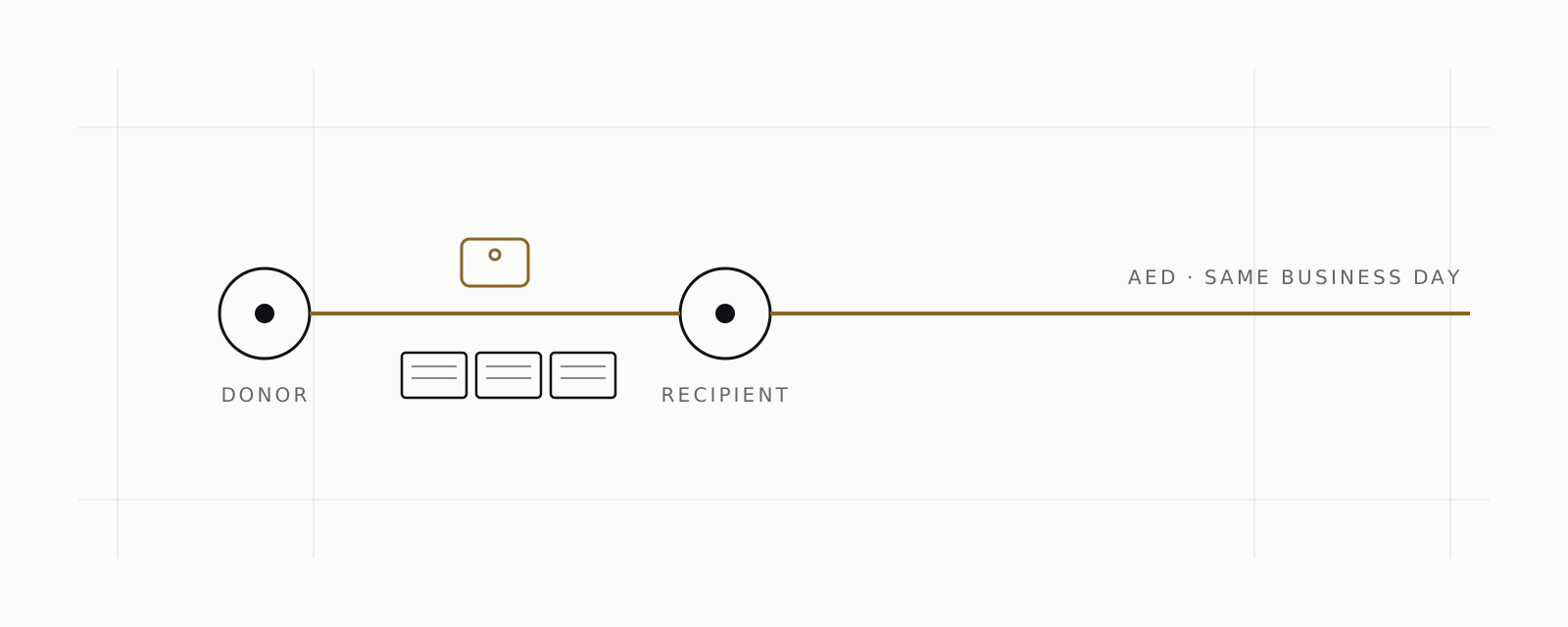
Crypto received as a gift or family transfer: proving the source before you sell
Crypto you received as a gift from a parent, spouse or relative can be sold through a VARA-licensed desk once you can show where it came from: a signed gift declaration, the donor's own ownership history before the transfer, and the on-chain record between the two wallets — the same source-of-funds test applied to any large sale.
KEY FACTS
| What this covers | A lifetime transfer between two named people — not an inheritance, not an airdrop |
|---|---|
| Compliance documents | Gift declaration, donor's pre-transfer ownership history, on-chain transfer record |
| Legal basis for the check | FATF Recommendation 10 (customer due diligence); CBUAE rules for licensed VASPs |
| IWGT spread | 0.08%–0.40%, by ticket size |
| Settlement | AED same business day (UAEFTS); USD 2–5 business days (SWIFT) |
Source: FATF Recommendation 10 and IWGT published pricing bands, as of September 2026.
Is it legal to sell crypto you received as a gift in the UAE?
Yes. Crypto handed over by a parent, spouse or relative while both of you are alive is a lawful gift under UAE property rules, and selling it afterwards through a VARA-licensed provider is a regulated, lawful activity. The gift itself needs no licence; the conversion to AED or USD does, because that step is where a Broker-Dealer takes custody of your coins and pays out from its own settlement account.
The desk, not the gift, is what needs checking. Ask for a licence number and confirm it in VARA's public register; IWGT's own licence sits in the licence section of the main page. A provider willing to trade a gifted position without asking who sent it is skipping a check every licensed desk in Dubai must run.
How is a lifetime gift different from crypto inheritance?
A gift and an inheritance move crypto for opposite reasons. A gift happens because the donor chooses to hand assets over while both people are alive; an inheritance happens because the previous owner has died and a will or succession order directs where the assets go next. Our guide to crypto inheritance in the UAE covers that death-triggered process — probate, succession orders, and access when only the deceased held the keys. None of that applies to a gift: a living donor simply confirms the transfer in writing.
The compliance question differs too: an heir proves who is legally entitled to inherit, while a gift recipient proves who sent the coins and that the sender owned them lawfully first. Both end at the same check — where the assets came from — but the paperwork is not interchangeable.
How is a family transfer different from a token airdrop?
A family transfer and a project airdrop both add coins to a wallet without a purchase, but the resemblance stops there. A gift comes from one named person you have a relationship with, moved wallet-to-wallet in a transfer you can both describe. An airdrop comes from a protocol distributing tokens to many addresses at once, based on a snapshot rule the recipient did not negotiate — there is no personal counterparty to name and no relationship to document.
That distinction changes the paperwork: a gift's file centres on a person — identity, ownership history, reason for sending the coins — while an airdrop's file centres on the protocol's own distribution terms, because no donor exists to ask.
What documents does a licensed desk ask for on a gifted crypto sale?
A licensed desk reviewing a gifted crypto sale asks for three things: a written declaration from the donor, evidence the donor owned the coins lawfully before the transfer, and the public record of the transfer itself.
| Document | What it shows | Typical source |
|---|---|---|
| Gift declaration or letter | Donor's name, relationship, date, amount and transaction reference | Written and signed by the donor |
| Donor's ownership history | The donor held the asset lawfully before handing it over | Exchange purchase records or a documented holding period |
| On-chain transfer record | A public match to the letter's date, amount and addresses | Block explorer for the network used (for example TRC20 or ERC20) |
The declaration names the relationship, the donor's history shows lawful ownership, and the block explorer confirms the two line up — a desk wants all three before it trades a gifted position of any size.
The source-of-funds definition UAE banks and desks use applies without modification: a reviewer traces money hop by hop, and a gift is one hop with a named counterparty instead of an exchange. Our wider guide to source of funds for crypto in the UAE covers the same document types for non-gift sales, and a proof-of-funds letter from the donor's own bank or exchange can stand in for part of the ownership-history evidence.
What makes a family transfer draw closer compliance attention?
FATF's core customer due diligence standard, Recommendation 10, directs financial institutions to understand the purpose of a transaction and, where the relationship carries more risk, to establish the source of funds behind it. VARA-licensed desks and UAE banks apply that same risk-based approach to a gifted transfer — not a separate rulebook written just for gifts.
Two patterns sit inside that ordinary AML framework, not as anything specific to crypto: a transfer from someone the recipient cannot clearly explain a relationship with, and a transfer that lands shortly before a large planned sale. Neither makes a sale impossible — both usually mean more questions and a request for the donor's own records, which is exactly what enhanced due diligence on a large conversion resolves.
How do you put together a gift file before you sell?
A gift file assembled before you approach a desk moves faster than one built while a review is already under way.
-
STEP 1
Ask for the declaration before you sell, not after
A gift letter written once a desk has asked for one looks reconstructed. Ask the donor to confirm the transfer in writing close to when it happens: name, relationship, date, amount and transaction hash.
-
STEP 2
Collect the donor's own ownership records
Bank or exchange statements showing how the donor first acquired the asset are the strongest evidence. A long, quiet holding history on one wallet works too, if the donor can point to roughly when it began.
-
STEP 3
Export the on-chain record of the transfer
A block-explorer export of the transfer, timestamped and matching the letter's amount and addresses, is what a reviewer checks first. Save it as a PDF before the address history gets harder to trace.
-
STEP 4
Open your own account and submit the file with onboarding
The account must be in your name, matching the bank account that will receive the proceeds. The gift file goes in alongside the standard onboarding documents; approval takes about one business day once everything is in.
How does the sale itself work once the file is ready?
Selling gifted crypto is otherwise a standard OTC trade: accept one written quote, send the crypto on the agreed network, and receive a bank wire in your own name. Our spread runs 0.08% to 0.40% by ticket size, published in the pricing bands on the main page; AED settles the same business day by UAEFTS, USD in 2 to 5 business days by SWIFT.
Family transfers large enough to justify structured custody rather than a single wallet are covered separately in our guide to family offices and crypto in the UAE, which looks at governance once a file-per-gift approach stops scaling.
FAQ
Do I need a written gift letter to sell crypto a family member sent me?
A written declaration is not a legal requirement in itself, but a licensed desk needs some way to confirm who sent the coins and why. A signed letter with the date, amount and transaction reference is the fastest way to satisfy that check.
Is a crypto gift treated the same as an inheritance for compliance purposes?
No. An inheritance is triggered by death and documented with a succession order or will; a gift is a transfer between two living people, documented with a declaration and the donor's ownership history. See our separate guide to crypto inheritance for the death-triggered process.
What if the donor bought the crypto years ago and cannot find the exchange records?
A long, continuously held wallet history is acceptable on its own if it predates the transfer and the donor can show roughly when it began. A wallet with no history before the gift date looks identical to newly acquired, unexplained funds.
Can a desk accept crypto gifted from someone I am not related to by blood or marriage?
Yes. A transfer does not have to come from a blood relative to be reviewed as a gift. What matters is that the relationship and the reason for the transfer can be explained and evidenced, not the exact family tie.
Does receiving crypto as a gift change the cost or settlement time of selling it?
No. Once the gift file clears review, the sale runs on the same terms as any other trade: the published spread by ticket size, AED the same business day by UAEFTS, and USD in 2 to 5 business days by SWIFT.
Sell gifted crypto through a licensed desk
IWGT is a VARA-licensed Broker-Dealer in Dubai. Bring the donor's declaration and ownership history — spread 0.08–0.40% by size, AED the same business day once you are approved.
SOURCES
- VARA public register — licence status check, accessed 22 September 2026.
- FATF — Updated Guidance for a Risk-Based Approach to Virtual Assets and VASPs, accessed 22 September 2026.
- CBUAE Rulebook — Part 4, Virtual Asset Service Providers (customer due diligence obligations), accessed 22 September 2026.
- IWGT published pricing bands and onboarding requirements — IWGT published pricing bands, September 2026.
This guide is informational and is not legal, tax or investment advice, nor an invitation to buy or sell any virtual asset. It does not cover the tax treatment of gifts. Rules and figures are as of September 2026 — re-check the sources before acting. Virtual assets may lose their value in full or in part and are subject to extreme volatility.