
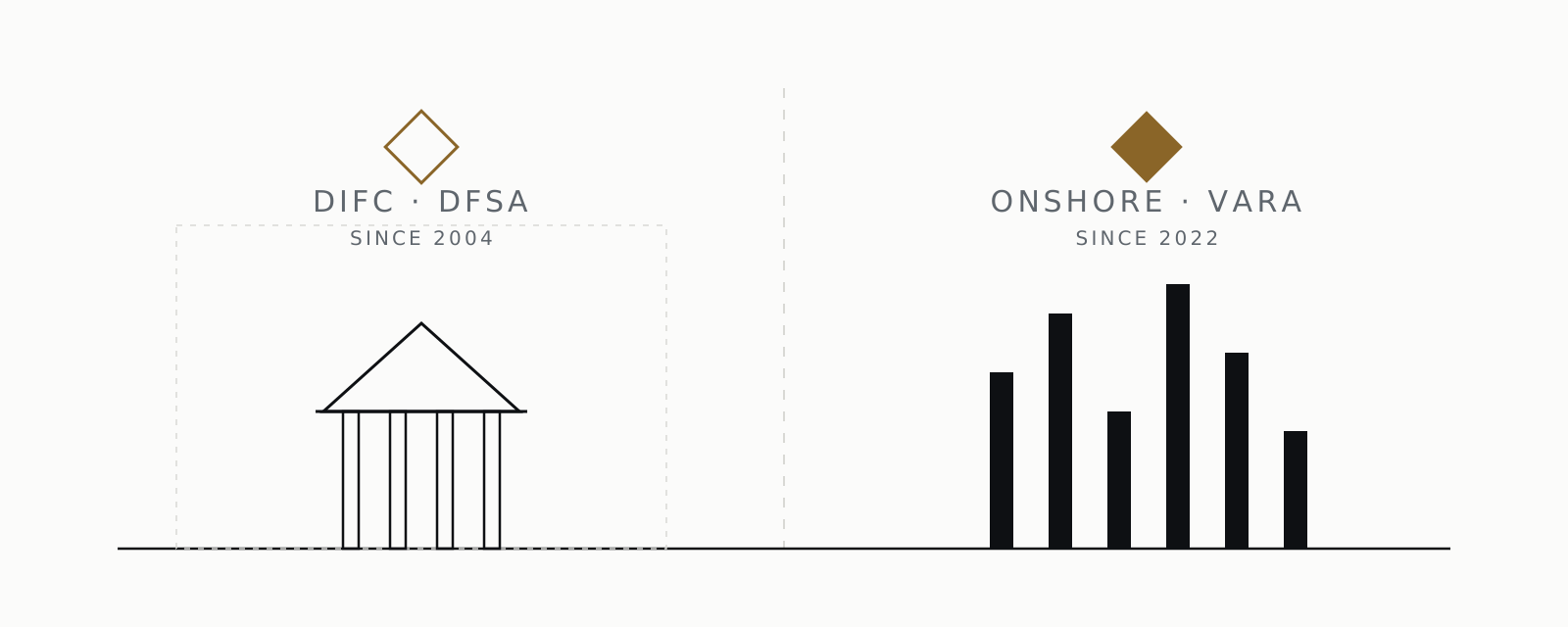
DIFC vs onshore Dubai: how the crypto rules differ
DIFC and onshore Dubai run two separate regulatory perimeters for crypto activity. Inside the DIFC, the DFSA licenses financial firms under English common law and the DIFC Courts. Everywhere else in Dubai, VARA licenses virtual-asset activity under UAE civil law and onshore courts. The two licences are not interchangeable — check the matching register before you sell USDT.
KEY FACTS
| DIFC regulator | DFSA — zone founded 2004; crypto token regime since November 2022 |
|---|---|
| Onshore Dubai regulator | VARA — created by Dubai Law No. 4 of 2022 |
| Legal system | DIFC: English common law, DIFC Courts. Onshore Dubai: UAE civil law, Dubai courts |
| Federal layer | SCA/CMA — outside Dubai and the financial free zones |
| Licence check | DFSA public register (DIFC); VARA public register (onshore Dubai) |
| IWGT | VARA-licensed, onshore Dubai — not DIFC-based |
Source: DIFC, DFSA and VARA public materials, as of September 2026.
What is the DIFC, and who regulates it?
The DIFC — the Dubai International Financial Centre — is a financial free zone in central Dubai, founded in 2004 under Dubai Law No. 9 of 2004. It runs its own civil and commercial codes, modelled on English common law, and its own courts, separate from the rest of the emirate. How that split compares with the wider UAE picture is set out in our guide to Dubai's rules against Abu Dhabi's.
Financial firms inside the DIFC answer to the Dubai Financial Services Authority (DFSA), the zone's dedicated regulator. The DFSA has run a dedicated regime for crypto tokens since November 2022, authorising named firms for specific token activities rather than issuing one general crypto licence.
A dispute involving a DIFC firm is heard by the DIFC Courts, in English, under common-law procedure. That is a different forum from the one that hears a dispute involving an onshore Dubai firm — a distinction that matters far more when something goes wrong than it does day to day.
Who regulates crypto onshore in Dubai?
Onshore Dubai — everywhere in the emirate outside the DIFC boundary — is regulated for virtual assets by the Virtual Assets Regulatory Authority (VARA), created under Dubai Law No. 4 of 2022. VARA licenses defined activities: advisory, broker-dealer, custody, exchange, lending and borrowing, management and investment, and transfer and settlement, each under its own rulebook.
Onshore Dubai runs under UAE civil law, not the DIFC's common-law codes. A dispute with a VARA-licensed firm is heard in Dubai's onshore courts. The mechanics of VARA's licensing model are set out in full in our guide to how VARA's framework works.
IWGT holds VARA licence VL/24/12/002 and operates onshore, not from inside the DIFC. Any onshore firm's status can be checked in VARA's public register, and ours is linked from the licence section of the main page.
DIFC vs onshore Dubai: the licences compared
The DIFC and onshore Dubai run two separate, non-overlapping regimes for financial and virtual-asset activity. The table sets out the differences that actually reach a client.
| Aspect | DIFC | Onshore Dubai |
|---|---|---|
| Dedicated regulator | DFSA — zone founded 2004; crypto token regime since November 2022 | VARA, established 2022 |
| Where it applies | Inside the DIFC financial free zone | All of Dubai outside the DIFC |
| Licence model | Authorisation per financial activity, extended to crypto tokens | Licence per virtual-asset activity, with dedicated rulebooks |
| Legal system and courts | English common law; DIFC Courts | UAE civil law; Dubai onshore courts |
| Licence check | DFSA public register | VARA public register |
Both regimes licence and supervise the firms inside their perimeter; what differs is which perimeter, which legal system, and which register actually confirms a claim.
Why the boundary matters before you sell USDT
A DFSA licence and a VARA licence cover different perimeters, and neither substitutes for the other. A firm authorised by the DFSA inside the DIFC cannot rely on that authorisation to deal in USDT onshore in Dubai, and a VARA-licensed firm cannot rely on its licence to operate inside the DIFC.
Ask a provider which regulator issued its licence, then verify the claim in the matching register. Checking a VARA licence takes under a minute, and the DFSA's public register works the same way for a DIFC-based firm. A claim that resolves in neither register is a reason to stop.
This is not a judgement on which regime serves a client better — both sit on established legal frameworks with real supervision. It is a question of which perimeter a specific firm's licence actually covers, and whether that matches where the firm says it operates.
What sits above the DIFC and onshore Dubai?
A federal layer sits above both. The Securities and Commodities Authority (SCA) — now operating as the Capital Market Authority (CMA), as of September 2026 — licenses virtual-asset activity in the parts of the UAE outside Dubai and the financial free zones, including the DIFC and ADGM.
This federal layer sits beside the Dubai regimes, not instead of them. VARA and the SCA agreed in September 2024 a mutual-recognition arrangement so a VARA-licensed firm is not licensed twice for the same virtual-asset activity across the wider UAE. That arrangement runs between VARA and the federal regulator; the DIFC keeps its own DFSA regime, so it changes nothing about which register you check for a DIFC firm.
Worked example: comparing a DIFC firm and an onshore desk
Worked example, as of September 2026: a client compares two quotes for selling 500,000 USDT — one from a firm registered inside the DIFC, one from an onshore desk licensed by VARA. Before sending anything, the client checks each firm's licence in the matching register: the DFSA's for the DIFC firm, VARA's for the onshore desk.
The onshore desk quotes an all-in spread of 0.25% for that ticket size, inside IWGT's published spread bands. At the 3.6725 peg, 500,000 USDT gross to AED 1,836,250; the spread removes about AED 4,591, for net proceeds of roughly AED 1,831,659.
The dirhams reach the client's own UAE bank account by UAEFTS the same business day, regardless of which regulator licensed the provider. What would differ, had the client instead traded with the DIFC-based firm under a DFSA authorisation, is the forum for any dispute — the DIFC Courts rather than Dubai's onshore courts — not the settlement rail itself.
What this means for you as a client
In practice, the DIFC-versus-onshore split changes less than the labels suggest. You can hold an account, live or register a company in either perimeter, and still trade through a licensed provider based in the other.
- Ask for the licence number and the issuing regulator in writing — DFSA or VARA.
- Check the claim in the matching register before you send anything.
- Expect own-name settlement only: a licensed desk pays into a bank account in your own name.
- Expect full identity checks either way — anti-money-laundering rules are federal and apply inside and outside the DIFC.
A provider that offers to skip identity checks is not applying "DIFC rules" or "onshore rules" loosely — federal AML law leaves no such gap in either perimeter. Ask before you commit size, and treat a vague answer about licensing as a reason to walk away. Document requirements for an onshore account are set out in the onboarding section of the main page.
The bottom line on DIFC vs onshore Dubai
The DIFC and onshore Dubai are not two flavours of the same rule book. They are separate jurisdictions, with separate regulators, separate courts and separate licences. Your protection comes from matching the licence to the perimeter, not from assuming either label guarantees the other.
IWGT operates onshore in Dubai under VARA licence VL/24/12/002, not from inside the DIFC, with AED settlement the same business day to your own account. The full four-step sequence for selling USDT in Dubai is set out separately.
FAQ
Is the DIFC part of Dubai?
Geographically yes, and UAE federal criminal law applies there in full. For civil and commercial matters, including most financial regulation, the DIFC runs its own common-law codes and its own courts, separate from onshore Dubai.
Can a VARA-licensed desk serve a client registered in the DIFC?
Yes. A VARA licence governs where the desk itself operates, not where the client is registered. A DIFC company can trade through an onshore, VARA-licensed desk, and settlement reaches its UAE bank account the same way as any other client.
Is a DFSA licence valid for selling USDT onshore in Dubai?
No. A DFSA licence authorises activity inside the DIFC perimeter only. A firm selling USDT anywhere else in Dubai needs a VARA licence — check the number in VARA's public register before you trade.
Which courts hear a dispute — DIFC or onshore Dubai?
It depends on which regulator licensed the firm you dealt with. Disputes involving a DIFC-based firm go to the DIFC Courts under common-law procedure; disputes involving an onshore, VARA-licensed firm go to Dubai's onshore courts under UAE civil law.
Is DIFC regulation stricter than VARA regulation?
Neither is a soft option. Both the DFSA and VARA license and supervise specific activities, can fine or withdraw a licence, and sit on established legal frameworks. The difference is jurisdiction and legal system, not enforcement strength.
Trade through a VARA-licensed desk, onshore in Dubai
IWGT is a VARA-licensed Broker-Dealer, licence VL/24/12/002, operating onshore in Dubai rather than inside the DIFC. All-in spread 0.08–0.40% by size, published openly. AED by UAEFTS the same business day once your account is approved.
SOURCES
- Dubai International Financial Centre — official portal, accessed 18 September 2026.
- Dubai Financial Services Authority — crypto token regime, accessed 18 September 2026.
- VARA public register — onshore Dubai licence status check, accessed 18 September 2026.
- Dubai Legal Portal — Law No. 9 of 2004 (DIFC) and Law No. 4 of 2022 (VARA), accessed 18 September 2026.
- SCA (now CMA) — SCA and VARA set regulatory framework for the UAE’s virtual assets sector (5 September 2024), accessed 21 September 2026.
- Capital Market Authority — news: “The CMA Issues the Virtual Assets Framework, Establishing an Integrated Regulatory Regime Comprising Five Core Modules and Eight Regulated Activities” (13 April 2026), accessed 21 September 2026.
This guide is informational and is not legal, tax or investment advice, nor an invitation to buy or sell any virtual asset. Rules and figures are as of September 2026 — re-check the sources before acting. Virtual assets may lose their value in full or in part and are subject to extreme volatility.