
What is CDD? Customer due diligence and how it differs from EDD
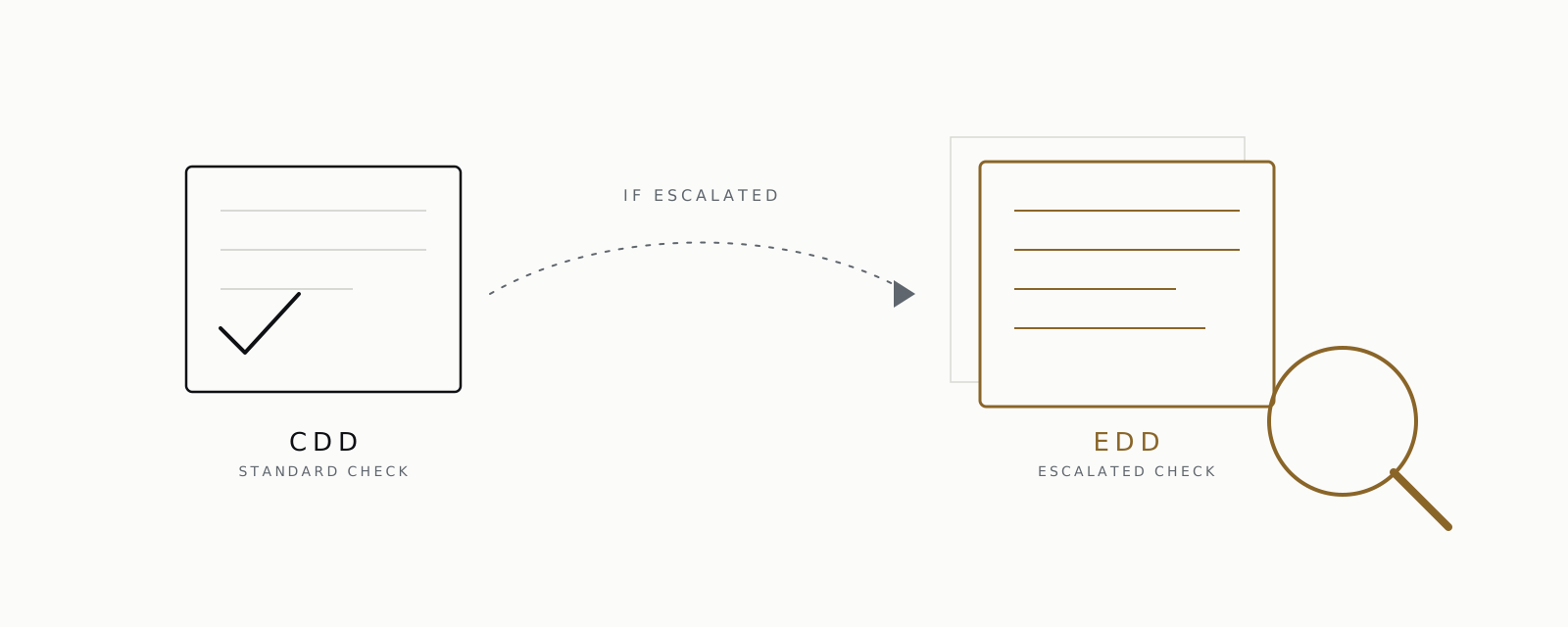
Customer due diligence (CDD) is the identity check, relationship review and risk rating that every regulated UAE provider must complete on a customer before doing business, and refresh afterwards. It is the baseline layer of KYC; enhanced due diligence (EDD) is the deeper review only higher-risk files trigger.
What customer due diligence covers
CDD has three parts. The provider verifies who the customer is — passport or Emirates ID; for a company, the trade licence and the ultimate beneficial owner (UBO). It records the purpose of the relationship, such as selling USDT for AED. It then assigns a risk rating and screens the name against sanctions and politically exposed person (PEP) lists. The file is refreshed periodically, and sooner if the profile changes.
CDD in the UAE: who requires it
The obligation comes from Federal Decree-Law No. 10 of 2025 on anti-money laundering, terrorist financing and proliferation financing, which replaced the 2018 decree-law, and from each supervisor's rulebook. The Central Bank of the UAE applies it to banks; VARA applies it to virtual-asset firms in Dubai outside the DIFC, including a Broker-Dealer such as IWGT (licence VL/24/12/002, listed in the licence section); the Capital Market Authority (CMA, the renamed SCA since 1 January 2026) supervises onshore firms elsewhere. A provider that never asks for identity documents is showing which rules it ignores.
How CDD differs from EDD
CDD applies to every customer; EDD is added only when size, PEP status, an unusual pattern or a higher-risk jurisdiction crosses the provider's internal trigger. EDD asks the questions CDD does not: where the funds came from, how the wealth was built, and why this size now. The full document list is in the how-to on what documents you need to sell USDT in the UAE.
Illustrative example
An individual opens an account to sell 100,000 USDT. Standard CDD — passport, stated purpose, risk rating — is completed and the client can request a quote under the published pricing bands. A company selling 2,000,000 USDT passes the same CDD step, but the size escalates the file to EDD: the desk also asks for exchange statements, wallet history and one source-of-wealth document before pricing. Both files start identically; only the larger one gains the extra layer.
Related terms
- KYC — the wider policy that CDD carries out.
- Source of funds — the money trail EDD asks for.
FAQ
Is CDD the same as KYC?
No. KYC is the overall policy of knowing who a customer is; CDD is the specific process — identity verification, purpose of the relationship and a risk rating — that carries KYC out at onboarding and on refresh.
What makes a file escalate from CDD to EDD?
Size, politically exposed person status, an unusual pattern, or a higher-risk jurisdiction or product. There is no single public threshold — each licensed provider sets its own internal triggers.
How long does customer due diligence take at IWGT?
Onboarding takes one business day once the passport or Emirates ID — and, for a company, the trade licence and UBO details — are submitted in full, as published in the onboarding section.
Onboard once, trade with the file already cleared
IWGT is a VARA-licensed Broker-Dealer in Dubai. Onboarding is one business day with complete documents, and any EDD escalation is scoped up front so a large sale settles without repeat document requests.
SOURCES
- U.ae — Combatting money laundering: Federal Decree-Law No. 10 of 2025, accessed 21 September 2026.
- Central Bank of the UAE rulebook — AML/CFT guidelines for financial institutions, accessed 21 September 2026.
- VARA rulebooks — compliance and risk management requirements for licensed VASPs, accessed 21 September 2026.
- FATF Recommendations — Recommendation 10, customer due diligence, accessed 21 September 2026.
- VARA public register — licence status check, accessed 21 September 2026.
- Capital Market Authority — Federal Decree-Laws No. 32 and No. 33 of 2025 — renaming of the Securities and Commodities Authority as the Capital Market Authority, in effect 1 January 2026, accessed 21 September 2026.
This guide is informational and is not legal, tax or investment advice, nor an invitation to buy or sell any virtual asset. Rules and figures are as of September 2026 — re-check the sources before acting. Virtual assets may lose their value in full or in part and are subject to extreme volatility.