
What is a UBO?
A UBO (ultimate beneficial owner) is the natural person, or persons, who ultimately own or control a legal entity, typically at 25% of shares, voting rights or capital under UAE anti-money-laundering law. A UAE OTC desk or bank asks a company client to name its UBOs before approving an account or clearing a large USDT sale.
KEY FACTS
| Full term | Ultimate beneficial owner (UBO); UAE law calls it "real beneficiary" |
|---|---|
| UAE ownership rule | Cabinet Decision No. 109 of 2023 on Regulating the Beneficial Owner Procedures, Article 5 (replaced Cabinet Decision No. 58 of 2020) |
| Underlying AML law | Federal Decree-Law No. 10 of 2025 on AML-CFT (repealed Decree-Law No. 20 of 2018) |
| Ownership/control threshold | 25% of shares, voting rights or capital, or control by other means |
| Who must ask for it | Banks, VARA-licensed VASPs and other DNFBPs |
| Applies to | UAE mainland and most free zone companies (DIFC/ADGM keep separate regimes) |
Source: UAE Cabinet Decision No. 109 of 2023; Federal Decree-Law No. 10 of 2025 on AML-CFT, as of September 2026.
What is a UBO in the UAE?
UAE law uses the term "beneficial owner" (earlier texts said "real beneficiary"), defined in Article 5 of Cabinet Decision No. 109 of 2023, which replaced Cabinet Decision No. 58 of 2020. A natural person who owns or controls 25% or more of a company's shares, voting rights or capital, directly or through a chain of entities, is a UBO. Control by other means, such as the power to appoint most of the board, can qualify below that figure. Where no individual meets either test, the senior managing official is declared instead.
An individual client has no UBO chain to declare. A company traces ownership upward to every natural person crossing the threshold, as when a client sells USDT through a company account. A trust or foundation declares settlor, trustees, protector and beneficiaries. Evidence: Memorandum of Association, current shareholder register, an ownership chart for layered structures, and a passport or Emirates ID per declared UBO.
Why it matters when selling USDT in the UAE
Federal anti-money-laundering law requires a desk or bank to identify the real person behind every corporate account before approval, as part of the KYC check on your company during onboarding. On larger USDT sales the same declaration feeds into enhanced due diligence and source-of-funds checks.
Illustrative example
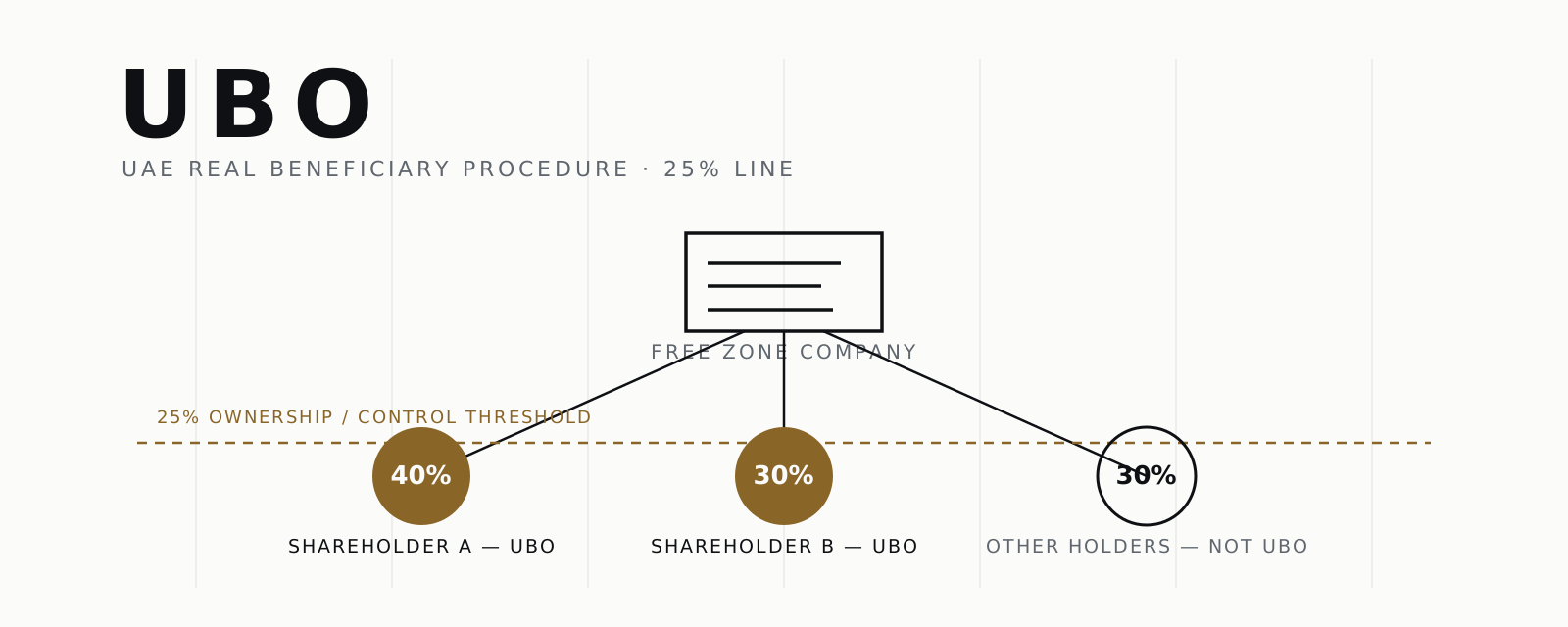
A Dubai free zone company plans to sell 500,000 USDT. Its register shows Shareholder A at 40%, Shareholder B at 30%, and 30% split across small minority investors. A and B each cross 25% on their own stake and are both declared as UBOs; the minority investors are not, because none reaches 25% alone or exercises separate control.
FAQ
What ownership percentage makes someone a UBO in the UAE?
A natural person who owns or controls 25% or more of a company's shares, voting rights or capital counts as a UBO under Article 5 of UAE Cabinet Decision No. 109 of 2023, which replaced Cabinet Decision No. 58 of 2020, as of September 2026. Control through other means, such as appointing most directors, also qualifies below that figure.
Does a UBO have to hold shares directly?
No. A UBO is identified by tracing ownership through any chain of holding companies until a natural person is reached, not only from the direct shareholder register. Indirect ownership above the threshold counts the same as direct ownership.
What happens if no shareholder reaches the 25% threshold?
When no natural person meets the ownership or control test, UAE Real Beneficiary rules fall back to identifying the senior managing official who directs the company, and that person is declared as UBO instead.
Do individual clients need to declare a UBO?
No. An individual client has no UBO chain, because they are already the natural person behind the account. A desk verifies them directly through a passport and Emirates ID, not a corporate ownership trace.
Can a nominee shareholder be the UBO instead of the real owner?
No. A nominee arrangement changes who is named on the share register, not who benefits from and controls the shares. The person behind the nominee must still be disclosed as the UBO.
Sell USDT through a desk that verifies who it deals with
IWGT is a VARA-licensed Broker-Dealer in Dubai (VL/24/12/002). Company clients complete their UBO and source-of-funds checks once at onboarding, then settle in AED the same day by UAEFTS.
SOURCES
- FATF — Beneficial ownership of legal persons, Recommendation 24, accessed 19 September 2026.
- CBUAE Rulebook — Cabinet Decision No. (109) of 2023 on Regulating the Beneficial Owner Procedures (Article 5: 25% ownership or voting threshold; Article 22 abrogates Cabinet Decision No. 58 of 2020), accessed 21 September 2026.
- CBUAE Rulebook — Federal Decree-Law No. (10) of 2025 on Anti-Money Laundering and Combating the Financing of Terrorism, accessed 21 September 2026.
- IWGT onboarding and UBO declaration requirements, September 2026.
This guide is informational and is not legal, tax or investment advice, nor an invitation to buy or sell any virtual asset. Rules and figures are as of September 2026 — re-check the sources before acting. Virtual assets may lose their value in full or in part and are subject to extreme volatility.