
Segregated client account: a VARA rule
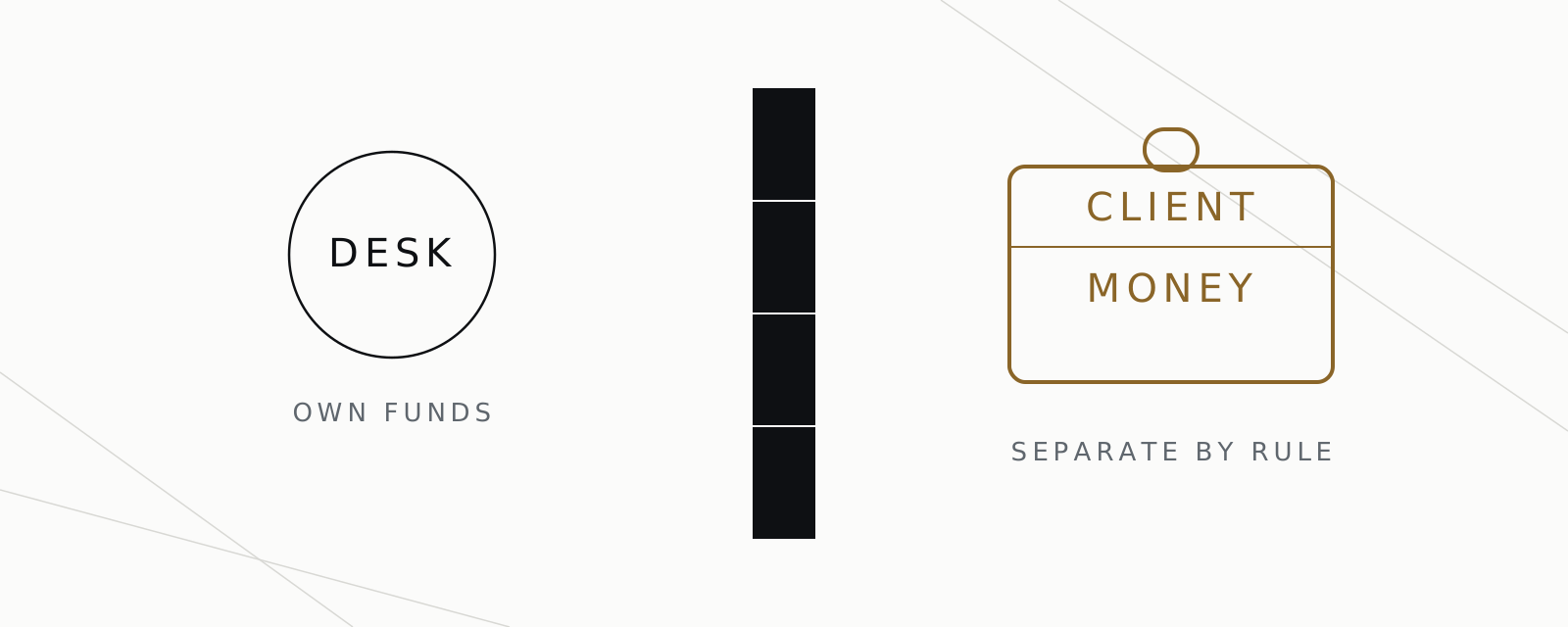
A segregated client account is a bank account in which a licensed provider keeps client money apart from its own operating funds. Your dirhams never become the desk's money: they are held for you, identifiable and returnable. It is a custody arrangement, not insurance and not a guarantee against losses.
KEY FACTS
| Term | Segregated client account |
|---|---|
| Meaning | Client money held apart from the provider's own funds |
| Not the same as | Deposit insurance or a guarantee against losses |
| Required in Dubai | Yes: VARA rulebooks, for licensed providers |
| IWGT licence | VARA VL/24/12/002 |
Source: VARA rulebooks and the VARA public register, as of September 2026.
How account segregation works in the UAE
VARA's Compliance and Risk Management Rulebook requires a licensed provider to hold client money in accounts separate from its own funds (Part IV, Client Money Rules) and client virtual assets in wallets separate from its own holdings (Part V, Client Virtual Assets Rules), as of September 2026. In practice the desk opens a designated client account at a UAE bank, flagged as holding client funds, which never mixes with the account it pays its own bills from; client USDT sits in wallets designated for client holdings. The DIFC (DFSA), ADGM (FSRA) and the federal SCA run their own regimes on the same principle.
What segregation does not do
It is not deposit insurance: VARA's rulebooks provide no compensation fund for clients of a failed provider. It does not protect value: if USDT falls, the account holds the same asset at the lower price. And it is not proof of good behaviour, only a structure that makes bad behaviour easier to detect, so a segregation claim is worth something only behind a licence that resolves in VARA's public register; ours is linked from the licence section.
Why it matters when selling USDT in the UAE
Between sending USDT and receiving dirhams there is a window, longer for USD by SWIFT (2 to 5 business days) than for same-day AED, during which the desk holds client value; segregation keeps that value legally yours, and own-name payouts are what make it enforceable. The trade sequence is in the guide to selling USDT in Dubai; four checks test a desk's claims: licence in the register, named client-account bank, own-name payouts only, written quote with a validity window.
FAQ
Is a segregated client account the same as deposit insurance?
No. Deposit insurance is a state scheme that pays out when a bank fails; the UAE has no such scheme covering funds at a virtual-asset desk. Segregation only keeps your money legally separate, so it can be identified and returned.
Does segregation protect me if USDT loses its dollar peg?
No. Segregation protects where your funds sit and whose they are, not what they are worth. A fall in USDT's price is market risk and stays with you, in a segregated account or anywhere else.
Do VARA-licensed desks have to segregate client money?
Yes. VARA's rulebooks require licensed providers to keep client money and client virtual assets separate from their own, as of September 2026. Segregation is a condition of holding the licence, not an optional feature.
Can a licensed desk pay my proceeds to a third-party account?
No. A licensed desk settles only to an account in your own name; offering to pay any account you like is a red flag. Own-name settlement is what makes segregation enforceable in practice.
Sell USDT with segregated client settlement
IWGT is a VARA-licensed Broker-Dealer in Dubai. All-in spread 0.08–0.40% by size, published openly. AED by UAEFTS the same business day, paid only to your own account, once your onboarding is approved.
SOURCES
- VARA rulebooks — client money and client asset requirements, accessed 10 September 2026.
- VARA public register — licence status check, accessed 10 September 2026.
- Central Bank of the UAE — payment systems (UAEFTS), accessed 10 September 2026.
- IWGT licence record and published spread bands, September 2026.
- VARA Compliance and Risk Management Rulebook (19 May 2025) — Part IV Client Money Rules — Rule IV.B.2 (Client Money held in a Client Account, outside the VASP's estate) and IV.B.9.b (no VASP money in a Client Account), accessed 14 September 2026.
- VARA Compliance and Risk Management Rulebook — Part V Client Virtual Assets Rules — Client VAs held on a one-to-one basis, accessed 14 September 2026.
This guide is informational and is not legal, tax or investment advice, nor an invitation to buy or sell any virtual asset. Rules and figures are as of September 2026 — re-check the sources before acting. Virtual assets may lose their value in full or in part and are subject to extreme volatility.