
What is slippage?
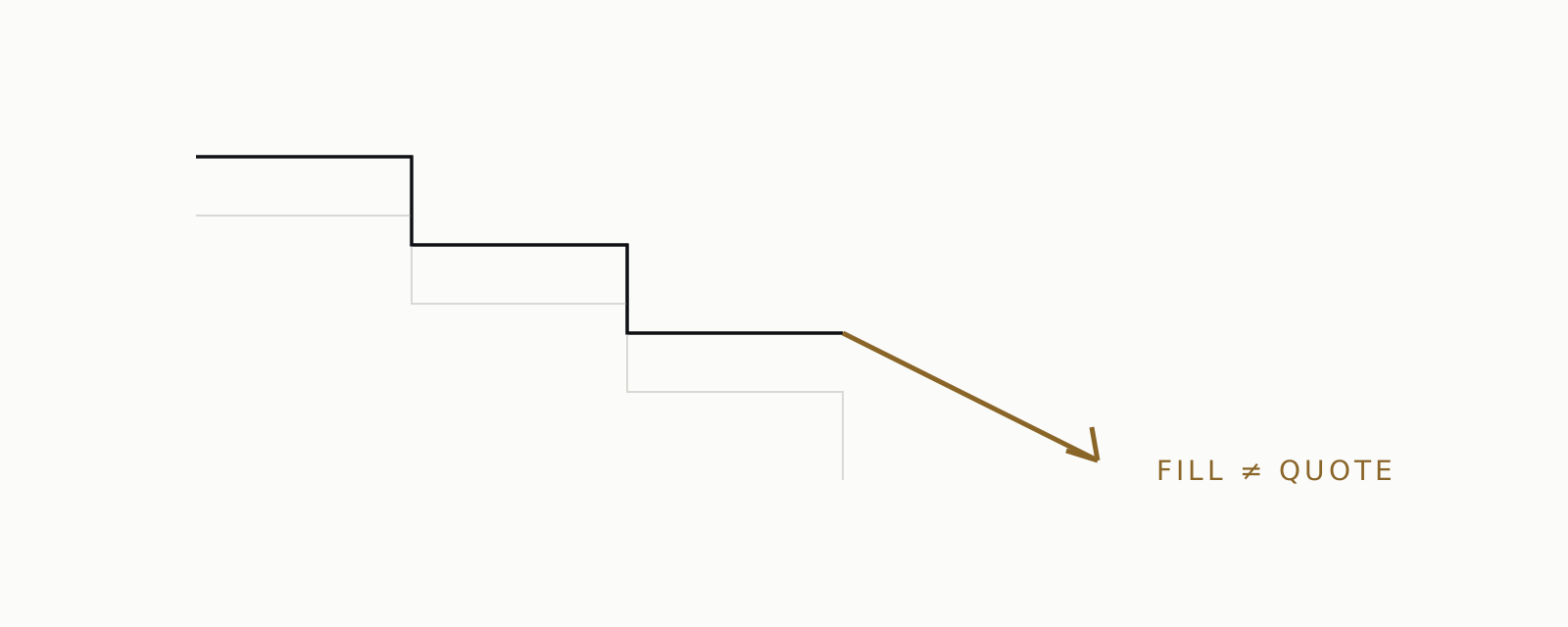
Slippage is the difference between the price you expect when you place a trade and the price you actually get. On an exchange it comes from thin order books and fast markets; at an OTC desk the quoted price is the executed price, so slippage does not occur.
KEY FACTS
| Definition | Expected price minus the price you actually get |
|---|---|
| Where it appears | Exchange order books, thin or fast-moving markets |
| At an OTC desk | None: one quoted price covers the whole ticket |
| Worked example below | AED 10,100 slippage on a 2,000,000 USDT market sale |
| IWGT spread | 0.08% to 0.40% by ticket size, as of September 2026 |
Source: IWGT published pricing bands; the worked example is illustrative, as of September 2026.
Where slippage comes from
On an exchange a market order larger than the top of the book walks down it, each level filling worse than the last; the market can also move before the fill, and a large order can be executed in parts minutes apart. A fee is disclosed up front; slippage shows only after the fills print.
Illustrative example: selling 2,000,000 USDT
| Book level (USDT) | Fill price (AED) | AED received |
|---|---|---|
| 500,000 | 3.6700 | 1,835,000 |
| 600,000 | 3.6670 | 2,200,200 |
| 500,000 | 3.6630 | 1,831,500 |
| 400,000 | 3.6580 | 1,463,200 |
| Total 2,000,000 | avg 3.66495 | 7,329,900 |
Had the whole ticket filled at the top price of 3.6700, the seller would receive AED 7,340,000; the book pays AED 7,329,900, AED 10,100 of slippage (about 0.14%), before any fee.
Why an OTC quote has no slippage
At a desk there is no order book on your side. You state the amount; the desk answers with one number for the whole ticket, say 3.6645 (a 0.15% spread) for the full 2,000,000 USDT, held in writing for a defined window. Accept it and AED 7,329,000 is the fill. Market moves while the desk hedges are the desk's risk, priced once into the published spread: slippage moves to the desk's side, the tax on liquidity you cannot see.
Why it matters when selling USDT in the UAE
The gap scales with size. Compare total cost: exchange fee plus slippage plus withdrawal charges and bank timing, against one quoted spread with same-day AED by UAEFTS. From six figures up a licensed desk usually wins; a Dubai desk's licence should resolve in the VARA register (ours: licence section).
FAQ
Is slippage the same as a fee?
No. A fee is a published charge you see before you trade; slippage is the unpriced gap between the price you expect and the price you get. Fees are certain, slippage is only known after the fill.
How much slippage is normal for a large USDT sale?
There is no fixed normal: it depends on order-book depth and how fast the market is moving. On a seven-figure USDT ticket, even 0.1% is thousands of dirhams, which is why size moves to desks.
Can a limit order prevent slippage?
A limit order caps the price you accept, but it may fill only in part or not at all. You swap price risk for execution risk, and the unfilled remainder still faces the market.
Does slippage exist at an OTC desk?
No. A desk quotes one all-in price for the full amount and holds it in writing for a defined window. Accept within the window and that price is your fill, whatever the market does meanwhile.
One price for the whole ticket
IWGT is a VARA-licensed Broker-Dealer in Dubai. All-in spread 0.08–0.40% by size, quoted in writing and held for a defined window — no slippage, no partial fills. AED by UAEFTS the same business day once your account is approved.
SOURCES
- VARA public register — licence status check, accessed 10 September 2026.
- Central Bank of the UAE — payment systems (UAEFTS), accessed 10 September 2026.
- IWGT published pricing bands and onboarding requirements, September 2026.
This guide is informational and is not legal, tax or investment advice, nor an invitation to buy or sell any virtual asset. Rules and figures are as of September 2026 — re-check the sources before acting. Virtual assets may lose their value in full or in part and are subject to extreme volatility.