
What it really costs to sell USDT in the UAE: spread, network fee and bank charges
Selling USDT in the UAE has three cost layers: the desk's spread, the blockchain network fee to move USDT off your wallet, and any bank charge on the payout. AED settlement via UAEFTS has no bank deduction; USD wires via SWIFT can lose a small amount to correspondent banks en route.
KEY FACTS
| Spread tiers | 0.40% at 100,000 USDT, down to 0.08% at 10,000,000 USDT+ |
|---|---|
| Network fee | Paid by the sender; TRC20 small and fixed, ERC20 variable (gas-based) |
| AED vs USD settlement | AED via UAEFTS: no bank deduction, same business day. USD via SWIFT: correspondent banks may deduct fees, 2–5 business days |
| Source | IWGT published pricing; CBUAE payment systems page, September 2026 |
Source: IWGT published pricing bands; Central Bank of the UAE, payment systems, as of September 2026.
What are the three cost components of selling USDT in the UAE?
Selling USDT in the UAE involves three cost components: the desk's spread, the network fee, and a possible bank charge. Each one is charged by a different party, for a different reason. None is optional, and together they decide what lands in your bank account.
Our wider guide to selling USDT in Dubai covers the legal routes, documents and providers. This page isolates the cost side only, with a worked example further down.
| Cost component | What it is | Typical size | Who charges it |
|---|---|---|---|
| Desk spread | The margin built into the quoted USDT/AED price | 0.08%–0.40% of ticket value | The OTC desk or exchange |
| Network fee | The blockchain fee to move USDT to the desk | Small and mostly fixed on TRC20; variable on ERC20 | The network; paid by the sender |
| Correspondent bank fee | A deduction a bank on a SWIFT route may take en route | A flat amount per bank in the chain, not a percentage | Correspondent banks (USD wires only) |
| AED settlement | Domestic payout via UAEFTS | None | Not charged |
The spread is usually the largest line item, but the network fee and any correspondent-bank deduction are real costs too — and the spread is the only one that shrinks with ticket size.
How much is the desk spread when you sell USDT?
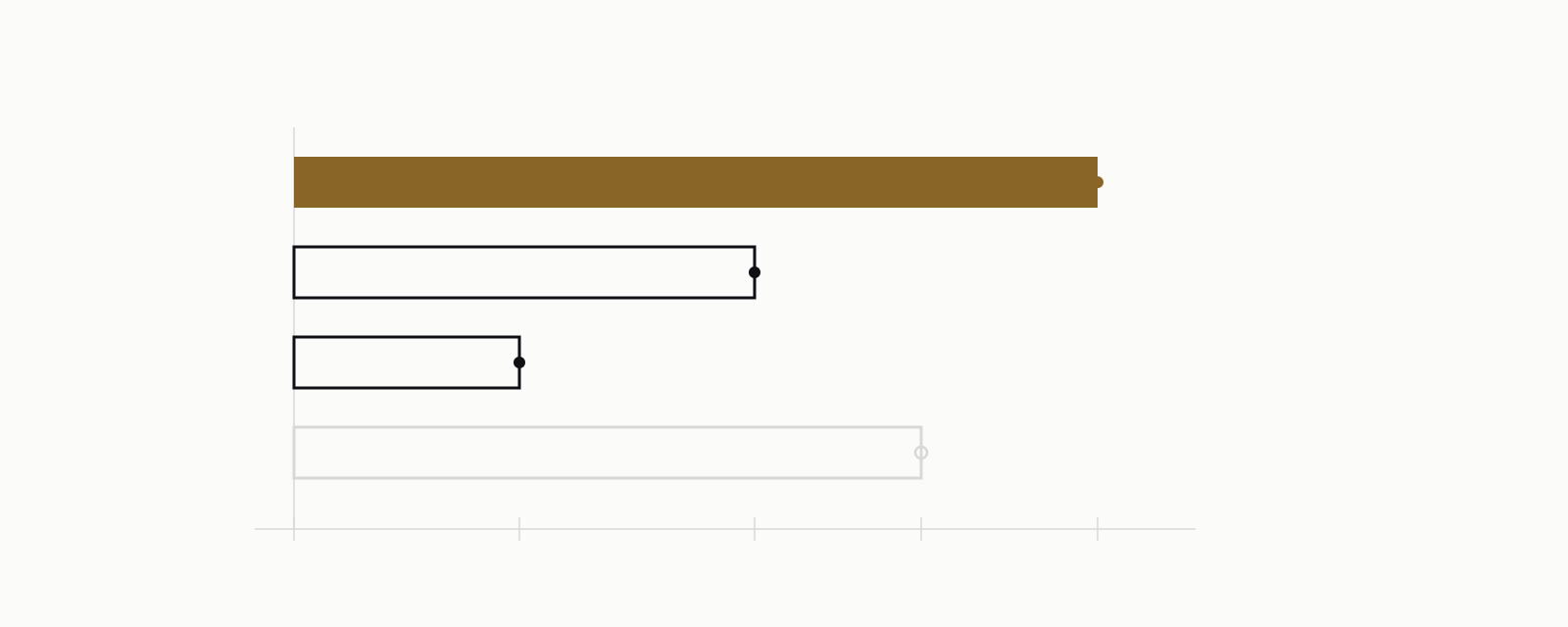
The desk spread is the margin an OTC desk or exchange builds into the price it quotes against the 3.6725 USD/AED peg. IWGT's spread runs from 0.40% on tickets from 100,000 USDT down to 0.08% on tickets of 10 million USDT or more, published openly in our pricing bands. Larger tickets pay a smaller percentage because a desk's operating cost per trade barely changes with size.
| Ticket size (USDT) | Spread |
|---|---|
| 100,000 | 0.40% |
| 500,000 | 0.25% |
| 2,000,000 | 0.15% |
| 10,000,000+ | 0.08% |
The spread roughly halves at each tier, all the way down to 0.08% at 10 million USDT and above.
Why does the network fee depend on TRC20 or ERC20?
The network fee is what the blockchain itself charges to move USDT from your wallet to the desk, and it depends on which network carries the transfer. TRC20, the Tron-based version of USDT, is the common choice for UAE clients because its fee is small and largely fixed.
ERC20, the Ethereum-based version, works everywhere too, but its fee floats with Ethereum gas prices and is typically several times higher than TRC20's. Our comparison of TRC20 versus ERC20 for USDT covers the technical difference in full.
You pay the network fee, not the desk, because it is deducted when you send USDT from your own wallet before the trade settles. Choosing TRC20 over ERC20, where your wallet supports it, is the simplest saving available on a sale of any size.
Does selling USDT for AED avoid bank charges?
AED settlement avoids the bank charges that show up on cross-border wires, because it moves through UAEFTS, the Central Bank of the UAE's domestic transfer system. A desk pays AED into your own bank account the same business day it trades, with the full amount arriving intact. No correspondent bank sits inside a UAEFTS payment, so there is nothing for a third bank to deduct.
Why can a USD payout lose money to correspondent banks?
A USD payout can lose money to correspondent banks because international wires often pass through one or more intermediary banks before reaching your account. Each correspondent bank in the chain is entitled to deduct its own handling fee from the amount in transit — a long-standing SWIFT mechanic, not a charge from the sending desk. The deduction is not published in advance and varies by bank and route.
USD settlement also takes longer: 2 to 5 business days through SWIFT, against the same business day for AED through UAEFTS. If you can accept AED, you avoid the correspondent-bank deduction and the multi-day wait together.
Worked example: what does selling 250,000 USDT actually cost?
Selling 250,000 USDT in the UAE at IWGT's published pricing works out as follows, using the USDT/AED peg of 3.6725. The gross value before any deduction is AED 918,125. At this size the ticket sits in the 0.40% spread tier, since the next tier only starts at 500,000 USDT, so the spread costs AED 3,673.
If the same ticket settled in USD by SWIFT instead, the gross figure would be close to the same, but the payout would take 2 to 5 business days and could arrive short of a correspondent bank's deduction. AED settlement is why the net figure above is exact rather than an estimate.
How can you reduce the total cost of selling USDT?
You reduce the total cost of selling USDT in the UAE by controlling the three components separately. A larger ticket moves you into a lower spread tier, and our guide to settlement times by network explains how network choice affects both cost and speed together.
Settling in AED instead of USD removes the correspondent-bank deduction entirely, since UAEFTS carries no intermediary bank. Request a quote before you commit, so you see the exact all-in numbers for your size and settlement currency rather than an estimate.
The bottom line on what it costs to sell USDT in the UAE
The cost of selling USDT in the UAE is never just the spread. Add the network fee you pay to send the coins and, on a USD payout, whatever a correspondent bank deducts along the way. Choose AED settlement and TRC20 where you can, and ask for the all-in number in writing before you send anything.
FAQ
What is the cheapest network to send USDT on?
TRC20 is usually the cheapest network to send USDT on in the UAE, because its fee is small and largely fixed, compared with ERC20's variable, gas-driven fee.
Does IWGT charge a fee on top of the spread?
No. IWGT's spread is all-in — there is no separate commission, and AED settlement via UAEFTS carries no additional bank charge.
Why is there no bank charge on AED settlement but there can be on USD?
AED settlement moves through UAEFTS, a domestic system with no correspondent bank in the chain. USD settlement uses SWIFT, where one or more correspondent banks can each deduct a handling fee before the payment arrives.
Who pays the blockchain network fee when you sell USDT?
You pay the network fee, because it is deducted when you send USDT from your own wallet to the desk, before the trade itself settles.
Does the spread stay the same regardless of ticket size?
No. IWGT's spread runs from 0.40% on tickets from 100,000 USDT down to 0.08% on tickets of 10 million USDT or more, tightening as size increases.
How long does it take to receive money after selling USDT?
AED arrives the same business day via UAEFTS once your account is approved. USD takes 2 to 5 business days via SWIFT.
See the exact cost for your ticket size
IWGT publishes its spread openly and settles AED the same business day with no bank deduction. Request a quote to see the spread, the network fee guidance and your net payout for your exact size.
SOURCES
- VARA public register — licence status check, accessed 16 September 2026.
- Central Bank of the UAE — payment systems (UAEFTS), accessed 16 September 2026.
- IWGT published pricing bands — IWGT published pricing bands, September 2026.
This guide is informational and is not legal, tax or investment advice, nor an invitation to buy or sell any virtual asset. Rules and figures are as of September 2026 — re-check the sources before acting. Virtual assets may lose their value in full or in part and are subject to extreme volatility.