
Selling USDT for cash in Dubai: why a licensed desk pays to a bank, not in notes
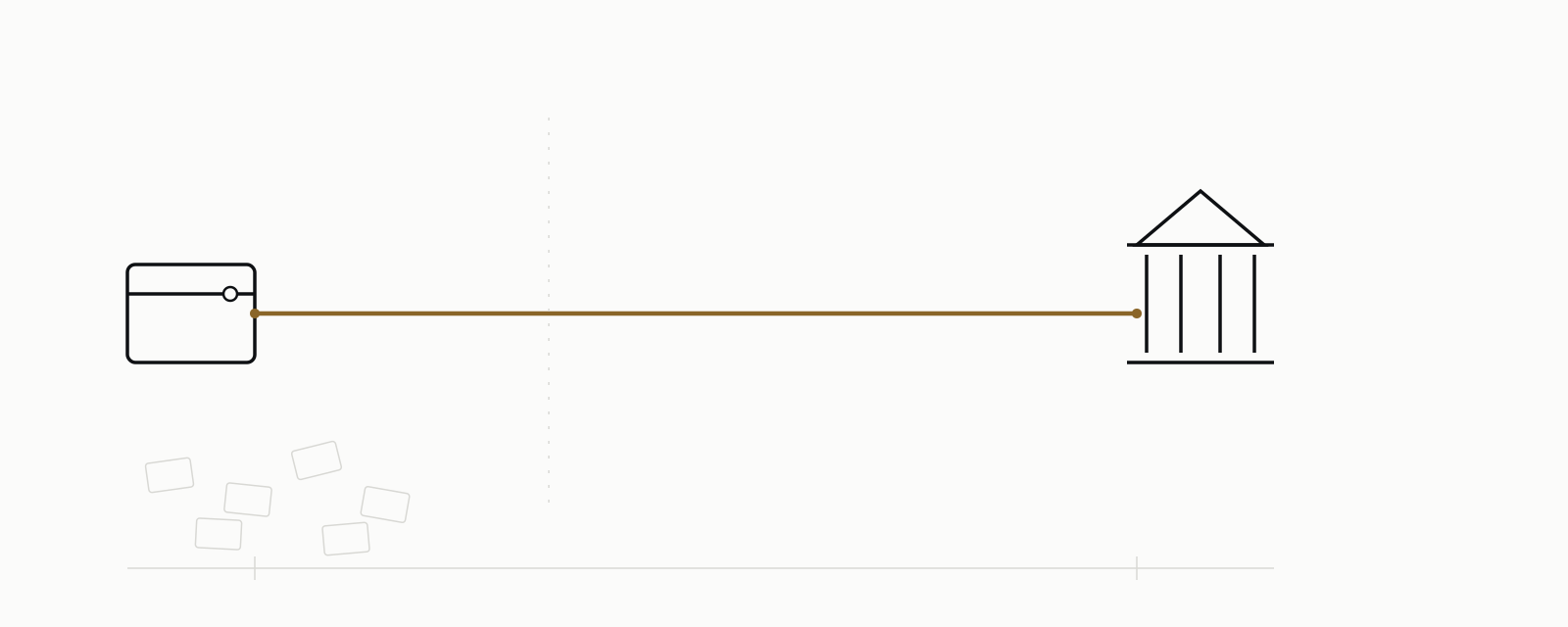
Licensed VARA desks settle USDT sales by bank wire to your own named account, never in cash. Bank wires create an audit trail that satisfies AML and KYC obligations; cash does not. A large cash deposit routinely triggers source-of-funds queries at UAE banks and can put your own account relationship at risk.
KEY FACTS
| IWGT settlement method | Bank wire to the client's own named account — never cash |
|---|---|
| AED settlement time | Same business day, via UAEFTS |
| Licence type distinction | VARA VL/24/12/002 (virtual asset dealing) vs a money-service/exchange-house licence (fiat exchange only) |
| Typical bank scrutiny trigger | A large or unexplained cash deposit |
| Source | IWGT published onboarding; CBUAE AML/CFT guidance |
Source: IWGT published onboarding requirements; Central Bank of the UAE AML/CFT guidance, as of September 2026.
Why does a licensed OTC desk in Dubai settle by bank wire, not cash?
A licensed OTC desk in Dubai settles USDT sales by bank wire to the client's own named bank account, never in physical cash. IWGT pays AED the same business day through UAEFTS and USD within two to five business days through SWIFT, as set out in the full wallet-to-bank-account settlement route. Own-name settlement means the receiving account must belong to the same person or company that opened the trading account.
This rule is not a preference; it follows directly from anti-money-laundering (AML) and know-your-customer (KYC) duties a licensed dealer carries. A firm dealing in virtual assets under a VARA licence must be able to show, for every trade, who sent the funds and where they went. A bank wire produces that record automatically; a cash handover does not.
What is a cash desk, and is it licensed to deal in virtual assets?
A cash desk is an operator that offers to buy USDT or other crypto for physical banknotes, usually promising speed and no paperwork. Many of these operators hold no VARA licence at all, and some that do hold a licence carry only a narrower money-service or exchange-house authorisation for fiat currency exchange, not for dealing in virtual assets. Fiat exchange and virtual asset dealing are two distinct regulated activities in the UAE, supervised differently, and a firm licensed for one is not automatically permitted to carry out the other.
Ask any cash desk for its VARA licence number and the specific activity it covers, then check both against the VARA public register. A firm that cannot show a dealing-in-virtual-assets licence is operating that part of its business outside the regulated perimeter, whatever its exchange-house paperwork says.
Our own desk verification checklist sets out the full set of checks worth running before sending anything to any counterparty.
What audit trail does a bank wire create that cash cannot?
A bank wire creates a matched, timestamped record at both ends of the transfer: the sending bank, the receiving bank, the amount, the reference and both account holders' identities. A cash handover creates none of this independently, only whatever notes either side chooses to keep. Regulators and banks rely on that matched record to reconstruct where money came from and where it went, which is the entire purpose of AML controls.
Under the Central Bank of the UAE's anti-money-laundering framework, regulated entities must maintain transaction records that identify the parties and the source of funds (CBUAE AML/CFT guidance, checked September 2026). A bank wire satisfies that requirement without extra effort from either side. Cash requires the receiving bank to reconstruct the same information after the fact, if it can at all.
What happens when you deposit a large amount of cash into a UAE bank account?
A large cash deposit into a UAE bank account routinely draws closer scrutiny from the bank's own compliance systems, regardless of where the cash came from. Banks apply enhanced checks to cash deposits above their own internal thresholds, which vary by bank and are not usually published — the Central Bank's AML framework sets the duty to know the source of funds, not a single public cash figure. The practical result is similar across UAE banks: a source-of-funds query, and sometimes a temporary hold, before the funds are released for normal use.
This scrutiny falls on the account holder, not on whoever handed over the cash. A client who receives banknotes from a cash desk still has to explain that deposit to their own bank, often without the paperwork a licensed trade would have produced. Repeated unexplained cash deposits are a common reason UAE banks review or close a personal account.
What is the risk to the seller, not just the buyer, in a cash trade?
The seller carries most of the practical risk in a cash-for-crypto trade, not the cash desk. Once the desk hands over banknotes it has no further exposure; the seller is left holding cash that still has to enter the banking system, and answer for its origin at that point. A desk that skips identity checks at the point of trade is not protecting the seller from anything — it is moving the paperwork problem downstream.
Keeping a clean source-of-funds record from the original wallet through to the bank deposit is the seller's own protection, and a cash transaction breaks that chain at its weakest point. None of this means a cash handover is automatically unlawful; it means the compliance burden and the account risk sit with the person banking the cash, not with the desk that paid it out.
How does IWGT settle every trade?
IWGT settles every trade by bank wire to the client's own named account, with no exceptions and no cash option. Account approval takes one business day once the documents are complete, and every trade is paid through UAEFTS or SWIFT so both sides hold a matching bank record from the moment of settlement. The desk's VARA licence, VL/24/12/002, covers dealing in virtual assets specifically, not a narrower fiat exchange activity, and is verifiable in the public register.
This is not a judgement on clients who might prefer cash; it describes what a licence to deal in virtual assets requires. A bank wire is slower to hand over than banknotes, but it settles into an account the client controls, with a record that answers a compliance query before one is even raised.
Bank wire vs cash: how the two compare
The table below sets out how bank-wire settlement from a licensed desk compares with a cash handover, across the four factors that matter most to a seller.
| Settlement method | Paper trail | AML compliance | Bank relationship risk | Speed |
|---|---|---|---|---|
| Bank wire (licensed desk) | Full — sender, receiver, amount and date recorded by both banks | Meets standard AML/KYC expectations for virtual asset dealing | Low — matches a normal salary or business deposit pattern | Same business day (AED), 2–5 days (USD) |
| Cash handover | Little to none — no independent record of the handover itself | Falls outside standard AML/KYC controls for virtual asset dealing | High — large or repeated cash deposits often draw scrutiny | Immediate handover, but the bank deposit can be delayed or queried |
A bank wire looks slower on the day of the trade, but a cash handover only moves the delay to the moment you try to bank it.
FAQ
Why doesn't IWGT settle trades in cash?
IWGT settles only by bank wire to the client's own named account because AML and KYC obligations under its VARA licence require a verifiable, auditable record of every trade. Cash payments cannot produce that record at the point of handover.
Is a cash desk in Dubai licensed to deal in virtual assets?
Not always. Many cash operators hold no VARA licence, and some hold only a money-service or exchange-house licence for fiat currency exchange, which does not cover dealing in virtual assets.
Can a large cash deposit freeze my UAE bank account?
A large, unexplained cash deposit routinely triggers a source-of-funds query from the receiving bank and can lead to an account review or a temporary hold while the bank checks where the money came from.
What audit trail does a bank wire leave that cash does not?
A bank wire records the sending bank, receiving bank, amount, reference and both account holders' identities automatically. A cash handover leaves no equivalent independent record unless one side creates it separately.
Who carries the risk in a cash-for-crypto trade, the buyer or the seller?
The seller carries most of the practical risk. Once cash changes hands the desk has no further exposure, while the seller still has to deposit the cash and explain its origin to their own bank.
Sell USDT with a settlement record your bank never questions
IWGT is a VARA-licensed Broker-Dealer in Dubai. Every trade settles by bank wire to your own named account — AED the same business day, USD within two to five days.
SOURCES
- VARA public register — licence status check, accessed 16 September 2026.
- Central Bank of the UAE — AML/CFT, accessed 16 September 2026.
- IWGT published onboarding requirements — IWGT onboarding section, September 2026.
This guide is informational and is not legal, tax or investment advice, nor an invitation to buy or sell any virtual asset. Rules and figures are as of September 2026 — re-check the sources before acting. Virtual assets may lose their value in full or in part and are subject to extreme volatility.