
Selling USDT received from P2P trades: how to document its origin
USDT built up through dozens of P2P trades on Binance P2P or similar platforms has no single clean origin — each trade is a separate counterparty and a separate payment. A licensed OTC desk needs the platform's trade history plus a matching bank record for every credit before it will settle the balance to your UAE bank account.
KEY FACTS
| Legal basis | Federal Decree-Law No. 10 of 2025 (AML/CFT/CPF); Cabinet Resolution No. 134 of 2025 (Executive Regulations) |
|---|---|
| Due diligence threshold | AED 55,000 — one occasional transaction or several that appear linked (Cabinet Resolution No. 134 of 2025) |
| Desk minimum ticket | From around 100,000 USDT (published on the main page) |
| Evidence usually requested | Full P2P order history plus a matching bank record for every credit |
| Onboarding once the file is complete | One business day, per the published onboarding steps |
Source: Federal Decree-Law No. 10 of 2025 and Cabinet Resolution No. 134 of 2025 (CBUAE rulebook), VARA rulebooks; desk minimum and onboarding time per the main-page onboarding section, as of September 2026.
Why does USDT from P2P trades have no single clean origin?
USDT built up through peer-to-peer (P2P) trading has no single origin, because every trade pairs you with a different counterparty. A salary credit traces to one employer; a P2P balance traces to dozens of people, each paying from their own account at a rate they set. That is why verifying source-of-funds evidence for crypto is harder for a P2P history than for a single payslip.
Each P2P trade needs its own record, because no employer or exchange statement can vouch for it the way a payslip does. The counterparty's name, the payment method and the timestamp must all line up, and one unexplained hop can stall a settlement even at an unremarkable amount.
What P2P trading patterns draw extra scrutiny?
Many small P2P trades with many one-time counterparties draw more compliance attention than a handful of larger trades with repeat counterparties. The reason is not the total amount — it is how hard that total is to trace to real payments.
- Dozens of trades under a few hundred dollars each, with a different counterparty every time.
- Payments arriving from someone other than the counterparty named on the platform order.
- A payment method that changes trade to trade — cash, then a card app, then a bank transfer.
- Completed orders the platform shows with no matching bank or wallet credit.
- A sudden cluster of P2P trades just before a large withdrawal, with little history before it.
P2P trading itself breaks no rule. A history built from many small, mismatched trades can still resemble the structuring pattern behind splitting a large sale into small tickets, which is why documentation matters as the counterparty count rises.
What documents prove the origin of USDT bought through P2P trades?
USDT bought through a P2P trade is documented with two matching records: the platform's trade record and a bank-side or wallet-side payment record. One alone is a claim; both together are proof.
| Payment method | Platform evidence to keep | Matching bank-side evidence | Common gap |
|---|---|---|---|
| Bank transfer | Order ID, counterparty ID and the trade receipt | Bank statement line, same amount, date and reference | Counterparty's bank name doesn't match their masked platform display name |
| Card or instant-payment app | Exported transaction reference and timestamp | App or bank transaction ID inside the same payment window | Timestamps that fall outside the platform's release window |
| Cash deposit | Order confirmation showing cash as the payment method | Deposit slip or teller receipt naming the depositor, if issued | An unnamed cash deposit cannot be tied to a counterparty |
| Payment from a third party | Support correspondence noting the payer mismatch | — | Desks generally exclude these trades rather than accept them |
A trade only counts as documented when the platform record and the payment record agree on amount, date and counterparty; one without the other does not clear review.
How do you consolidate a P2P trading history into one file?
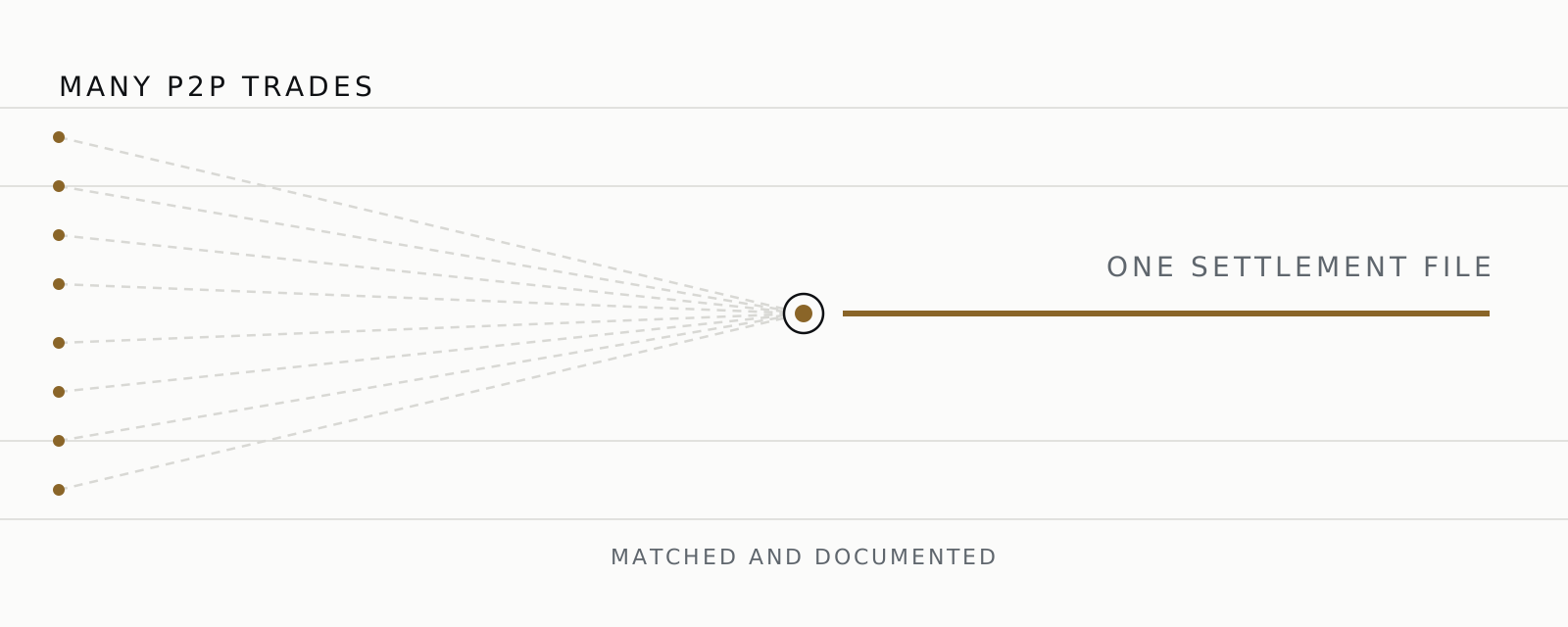
Consolidating a P2P trading history turns scattered platform receipts into one file a bank or desk can read.
-
STEP 1
Export the full trade history
Pull every completed order from the P2P platform for the whole accumulation period, not only recent trades.
-
STEP 2
Match each trade to its payment
Line up every order against the bank statement, card app or wallet record showing the same payment, in date order.
-
STEP 3
Set aside what you cannot match
Flag any trade without a matching payment record, and decide with the desk whether to exclude it from settlement.
-
STEP 4
Write a one-page narrative
Summarise the totals, the platform used and the period covered, the same way a standard onboarding file documents a simpler source.
How does a licensed OTC desk assess USDT accumulated through P2P trades?
A licensed OTC desk assesses P2P-sourced USDT by requesting the full trade export before quoting a firm price. Compliance checks counterparty concentration and cross-checks trade timestamps against the payments supplied.
A file with more than a small share of unmatched trades usually triggers enhanced due diligence on large crypto conversions. Settlement still goes only to an account in your own name, the same rule that applies under our VARA licence regardless of how the USDT was acquired.
What happens if you cannot document every P2P trade?
A small share of undocumented trades inside an otherwise clean P2P history does not usually stop a sale; a licensed desk can often exclude the unmatched portion and settle the rest. A history where most trades lack a matching payment record is different — a desk is likely to decline it rather than guess at the origin.
The documented portion can still move through the standard route for moving USDT from Binance to a UAE bank account, once separated from the unsupported trades.
The bottom line on selling USDT received from P2P trades
USDT received from P2P trades sells like any other USDT once its origin is documented; the coins are not tainted by passing through a peer-to-peer platform. What takes preparation is matching each trade to its payment before you ask for a quote.
IWGT prices a consolidated P2P history the same way it prices any other ticket, from 0.08% to 0.40% depending on size, once the file is complete.
FAQ
Can I sell USDT that came from many small P2P trades in the UAE?
Yes. A licensed desk asks for the platform's trade history and a matching bank record for each trade before settling a consolidated balance; P2P trading itself is not a barrier.
Do I need to document every single P2P trade, even very small ones?
In principle yes, though a small unmatched share of an otherwise documented history is usually manageable. A desk is more likely to exclude a handful of unmatched trades than to decline the whole file.
What if a P2P counterparty paid me in cash?
Cash payments are the hardest P2P legs to document, since a deposit slip rarely names the payer. Keep the platform's order confirmation and any bank record that does name a depositor.
Is it legal to use Binance P2P before selling USDT to a UAE bank?
Yes, using Binance P2P or a similar platform is legal. What matters afterward is documenting each trade so a licensed desk and your bank can trace the balance to real payments.
Sell a documented P2P-sourced USDT balance
IWGT reviews a consolidated P2P trade history the same way it reviews any other source of funds, then prices the ticket at 0.08–0.40% by size. Bring the trade export and the matching payment records, and a dealer will tell you what else the file needs.
SOURCES
- UAE anti-money-laundering framework (u.ae) — Federal Decree-Law No. 10 of 2025 overview, accessed 21 September 2026.
- Cabinet Resolution No. 134 of 2025 — Executive Regulations of Federal Decree-Law No. 10 of 2025 (CBUAE rulebook) — customer due-diligence threshold of AED 55,000 for occasional transactions, single or linked; effective 14 December 2025, accessed 21 September 2026.
- FATF Recommendation 10 and virtual-asset red-flag indicators, accessed 17 September 2026.
- IWGT published pricing bands and onboarding requirements — IWGT published pricing bands, September 2026.
This guide is informational and is not legal, tax or investment advice, nor an invitation to buy or sell any virtual asset. Rules and figures are as of September 2026 — re-check the sources before acting. Virtual assets may lose their value in full or in part and are subject to extreme volatility.