
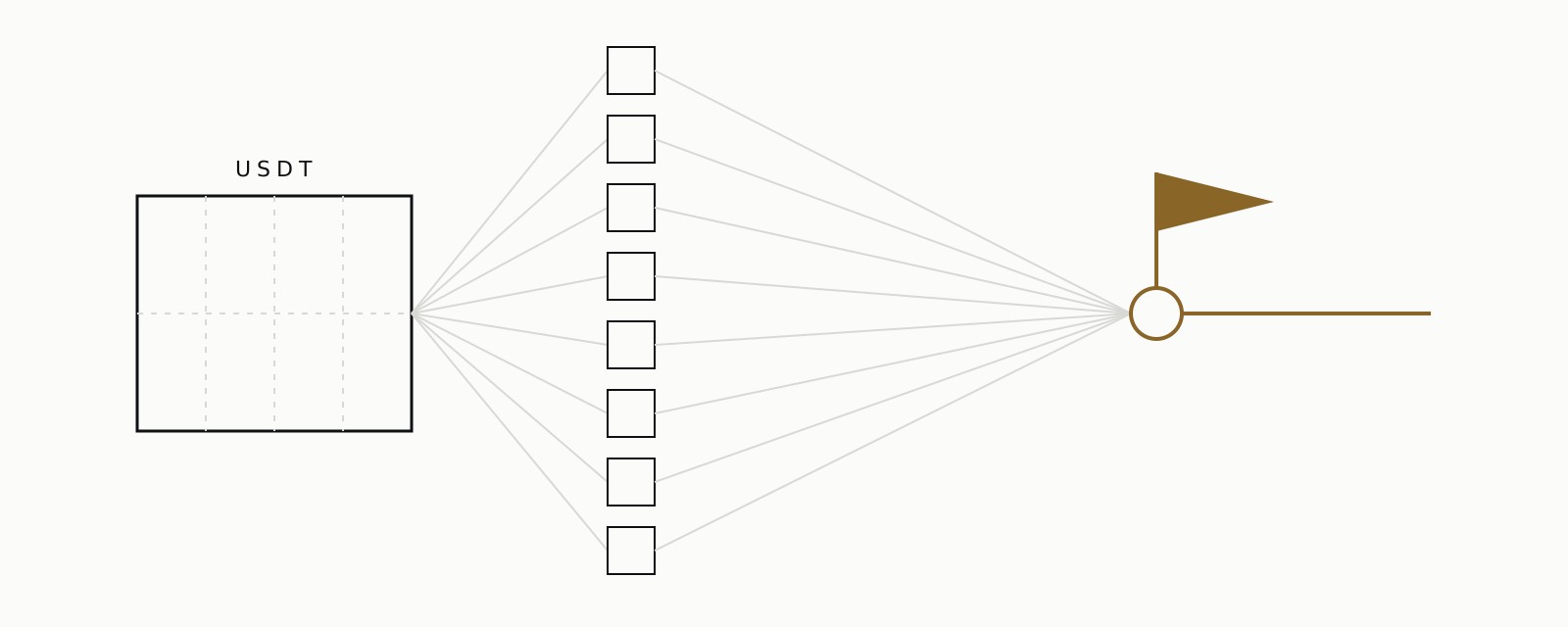
Why splitting a large USDT sale into small tickets is a structuring red flag in the UAE
Splitting a 400,000 USDT sale into eight 50,000 tickets does not avoid checks in the UAE. Licensed desks must treat linked transactions as one, banks aggregate inbound credits, and a pattern built to stay under review bands is itself a reportable red flag. Smaller tickets also sit in worse spread tiers.
KEY FACTS
| Legal basis | Federal Decree-Law No. 10 of 2025; Cabinet Resolution No. 134 of 2025 (executive regulations) |
|---|---|
| Linked-transaction rule | Due diligence from AED 55,000, in one transaction or several that appear linked |
| Who reports, and where | VARA-licensed desks and CBUAE-supervised banks; STRs to the UAE FIU via goAML |
| Spread at 100,000 vs 500,000 USDT | 0.40% vs 0.25% (IWGT tiers) |
| Extra cost of 5 × 100,000 vs 1 × 500,000 | AED 2,754 at the 3.6725 peg |
Source: UAE AML legislation, VARA rulebooks, UAE FIU and IWGT published pricing bands, as of September 2026.
What is structuring under UAE AML law?
Structuring is the practice of breaking one transaction into several smaller ones so that each piece stays below a threshold that would trigger identity checks, a source-of-funds review or a report. The UAE's anti-money-laundering rules in plain terms are written to catch this pattern, not to reward it.
The framework is Federal Decree-Law No. 10 of 2025 on anti-money laundering, combating the financing of terrorism and proliferation financing, which replaced Federal Decree-Law No. 20 of 2018, with Cabinet Resolution No. 134 of 2025 as its executive regulations. Under those regulations, customer due diligence applies to any occasional transaction of AED 55,000 or more, whether carried out as a single transaction or as several transactions that appear to be linked (Cabinet Resolution No. 134 of 2025, as of September 2026).
The words "appear to be linked" decide the case. Eight tickets of 50,000 USDT from the same client, the same wallets or into the same bank account are one sale of 400,000 USDT in the eyes of a reporting entity, and the rules require it to treat them that way.
Why do licensed desks aggregate linked transactions?
A VARA-licensed desk aggregates linked transactions because its licence requires a risk-based view of the client relationship, not of each ticket. Screening runs on the client profile: declared size, wallet origin and history at the desk. A second 50,000 USDT ticket two days after the first is compared with the first, not assessed fresh.
The Financial Action Task Force sets the same standard worldwide. FATF Recommendation 10 requires due diligence on occasional transactions above USD/EUR 15,000, including those carried out in several operations that appear to be linked, and the FATF virtual-asset red-flag indicators list structuring below thresholds as a typology in its own right (FATF, as of September 2026).
Splitting across several desks changes little. Each desk sees a client whose declared purpose does not match the ticket, or a wallet that blockchain analytics shows feeding several counterparties within days. Both are triggers for enhanced due diligence on large conversions, and both end in a request for the full picture.
What does a licensed desk report through goAML?
A licensed desk in Dubai must file a Suspicious Transaction Report (STR) with the UAE Financial Intelligence Unit through the goAML platform when it suspects that funds are linked to a crime or that a transaction is designed to evade controls. Federal Decree-Law No. 10 of 2025 sets the duty; the VARA Compliance and Risk Management Rulebook (Part III.F) requires a Dubai VASP to report suspicious transactions to the UAE FIU immediately, through goAML or another channel the FIU approves.
Two features matter for a client thinking about splitting. The desk may not tell you that a report has been filed, because tipping off is an offence under Article 29 of Decree-Law No. 10 of 2025, and the duty to report exists whether the desk then executes or declines the trade (UAE Financial Intelligence Unit, as of September 2026).
How do UAE banks see eight small inbound credits?
UAE banks see eight inbound credits of AED 183,625 each, arriving within days from several crypto-related counterparties, as one pattern rather than eight events. Transaction-monitoring systems aggregate credits by account, counterparty and period and compare the total with the customer's declared profile. That is what bank compliance teams look for in crypto inflows.
The Central Bank of the UAE supervises this monitoring, and the executive regulations require every financial institution to assess each customer's risk and to apply enhanced due diligence where that risk is higher — obtaining and verifying more information on the customer, the beneficial owner and the amount and source of the funds (Cabinet Resolution No. 134 of 2025, as of September 2026). One credit of AED 1,836,250 from a VARA-licensed desk, with a payment reference and a compliance file behind it, answers the bank's question once. Eight smaller credits raise it eight times, and the sum is the same.
How much more does splitting a USDT sale cost?
Splitting a USDT sale into smaller tickets costs more at a licensed desk because spread tiers follow ticket size. IWGT's published pricing bands run 0.40% at 100,000 USDT, 0.25% at 500,000, 0.15% at 2,000,000 and 0.08% at 10,000,000 (IWGT, as of September 2026).
Worked example at the 3.6725 peg. One ticket of 500,000 USDT is AED 1,836,250; at 0.25% the spread is AED 4,591. Five tickets of 100,000 USDT are AED 367,250 each; at 0.40% each costs AED 1,469, or AED 7,345 in total — AED 2,754 more for the same dirhams, before counting the extra days.
| Measure | One 500,000 USDT ticket | Five 100,000 USDT tickets |
|---|---|---|
| Spread tier | 0.25% | 0.40% per ticket |
| Spread cost (AED) | 4,591 | 7,345 |
| Onboarding and source-of-funds reviews | 1 | Up to 5, one per desk |
| AED settlement days | 1 (same business day, UAEFTS) | 5 if spread across days |
| Bank monitoring picture | One documented credit, one reference | Five credits, up to five counterparties, aggregated as a pattern |
One ticket wins on every row: AED 2,754 less in spread, one review instead of five, and a single documented credit for the bank to read.
Tickets of 50,000 USDT, as in the eight-ticket plan, sit below the minimum flow of around 100,000 USDT at most licensed desks. The plan therefore pushes the client into exchange and P2P routes with more counterparties and no single compliance file.
Why is one ticket with a source-of-funds file faster?
One ticket backed by a complete source-of-funds file is faster because every check runs once. Onboarding takes one business day, the enhanced review two to five business days with a complete file, and AED settles by UAEFTS the same business day you trade (IWGT practice, as of September 2026).
The file is the one a careful client needs anyway: exchange statements or CSV exports, wallet addresses and transaction hashes, the agreement behind the funds, and a one-page narrative. The standard onboarding document list covers identity; the source-of-funds file covers the money. Once cleared, the profile stays cleared for later tickets, while a split across desks starts the clock at zero each time.
The bottom line on splitting a large USDT sale
Splitting a large USDT sale into small tickets in the UAE does not avoid checks; it multiplies them and adds a reportable pattern on top. Licensed desks and banks aggregate linked transactions by law and by system design, and the client pays a worse spread tier on every piece. The single ticket with a proper file is cheaper and faster on every measure in the table above.
FAQ
Is splitting a USDT sale into small tickets illegal in the UAE?
Deliberately splitting a transaction to evade AML checks is a recognised money-laundering indicator under FATF guidance and UAE rules, and a licensed desk or bank that sees it must file a Suspicious Transaction Report. The trade itself may be lawful; the pattern still gets reported.
Will the desk tell me if it files a report?
No. Tipping off is prohibited under UAE anti-money-laundering law, so a licensed desk cannot tell a client that a Suspicious Transaction Report has gone to the UAE Financial Intelligence Unit. You may only notice a longer review or a declined trade.
Does selling on different days or at different desks reset the checks?
No. Each desk screens the client profile and wallet history, and blockchain analytics show the same wallets feeding several counterparties within days. The bank receiving the proceeds sees every credit in one account. The pattern is visible from every side, as of September 2026.
What is the cheapest way to sell 500,000 USDT at a licensed desk?
One ticket. At IWGT's published tiers, 500,000 USDT in one ticket costs 0.25%, or AED 4,591 at the 3.6725 peg, while five tickets of 100,000 USDT cost 0.40% each, or AED 7,345 in total (as of September 2026).
Does one large ticket take longer to clear than several small ones?
No. A single ticket with a complete source-of-funds file clears enhanced due diligence in two to five business days and settles AED the same business day it trades. Several tickets across desks repeat onboarding and review at each one.
Sell the whole ticket once, with the file ready
IWGT is a VARA-licensed Broker-Dealer in Dubai (licence VL/24/12/002). One quote for the full size, one source-of-funds review, and AED by UAEFTS the same business day once the profile clears. Spread 0.08–0.40% by ticket size, published openly.
SOURCES
- The Official Platform of the UAE Government — Combatting money laundering (Federal Decree-Law No. 10 of 2025), accessed 21 September 2026.
- CBUAE Rulebook — Federal Decree-Law No. (10) of 2025 on AML/CFT/CPF (Article 29, tipping off), accessed 21 September 2026.
- CBUAE Rulebook — Cabinet Resolution No. (134) of 2025, executive regulations of Decree-Law No. 10 of 2025 (AED 55,000 occasional-transaction threshold, linked transactions, enhanced due diligence), accessed 21 September 2026.
- VARA — Compliance and Risk Management Rulebook, Part III.F: Suspicious Transaction Monitoring and Reporting, accessed 21 September 2026.
- UAE Financial Intelligence Unit — goAML reporting, accessed 16 September 2026.
- FATF — The FATF Recommendations (Recommendation 10), accessed 16 September 2026.
- FATF — Virtual Assets: Red Flag Indicators of Money Laundering and Terrorist Financing (September 2020), accessed 16 September 2026.
This guide is informational and is not legal, tax or investment advice, nor an invitation to buy or sell any virtual asset. Rules and figures are as of September 2026 — re-check the sources before acting. Virtual assets may lose their value in full or in part and are subject to extreme volatility.