
How to move USDT from Binance to a UAE bank account
Binance FZE, the exchange's Dubai-licensed entity, can pay dirhams straight to a UAE bank account: AED withdrawals cost a fixed AED 10 and deposits are free, over its ADCB rail, as of September 2026. For size, the alternative is to withdraw USDT on-chain to a VARA-licensed desk and receive AED by UAEFTS the same business day at one written spread. This guide sets Binance's own published fees, limits and cut-offs next to the desk route so you can pick by ticket.
KEY FACTS
| Binance AED withdrawal fee | AED 10 fixed (Binance FZE, ADCB bank transfer) |
|---|---|
| Binance AED deposit | No fee; AED 10 minimum, AED 7.2 million per day maximum |
| Binance AED withdrawal timing | Under AED 50,000 processed instantly; above, a 19:00 GST cut-off applies |
| Binance USDT withdrawal fee | 1.5 USDT (TRC20), 0.3 USDT (ERC20), 0.01 USDT (BEP20) |
| IWGT spread | 0.08%–0.40% all-in, by ticket size |
| Desk payout | AED same business day by UAEFTS; USD in 2–5 business days by SWIFT |
Source: Binance FZE AED deposit and withdrawal FAQs, Binance withdrawal-fee schedule and IWGT published pricing bands, as of September 2026.
Does Binance pay dirhams into a UAE bank account?
Yes, as of September 2026. Binance FZE — the Dubai entity licensed by VARA — runs direct AED deposits and withdrawals by bank transfer through Abu Dhabi Commercial Bank (ADCB), launched in June 2026. You sell USDT for AED on the exchange, then withdraw the dirhams to an account in your own name; the money reaches your bank as an ordinary local transfer.
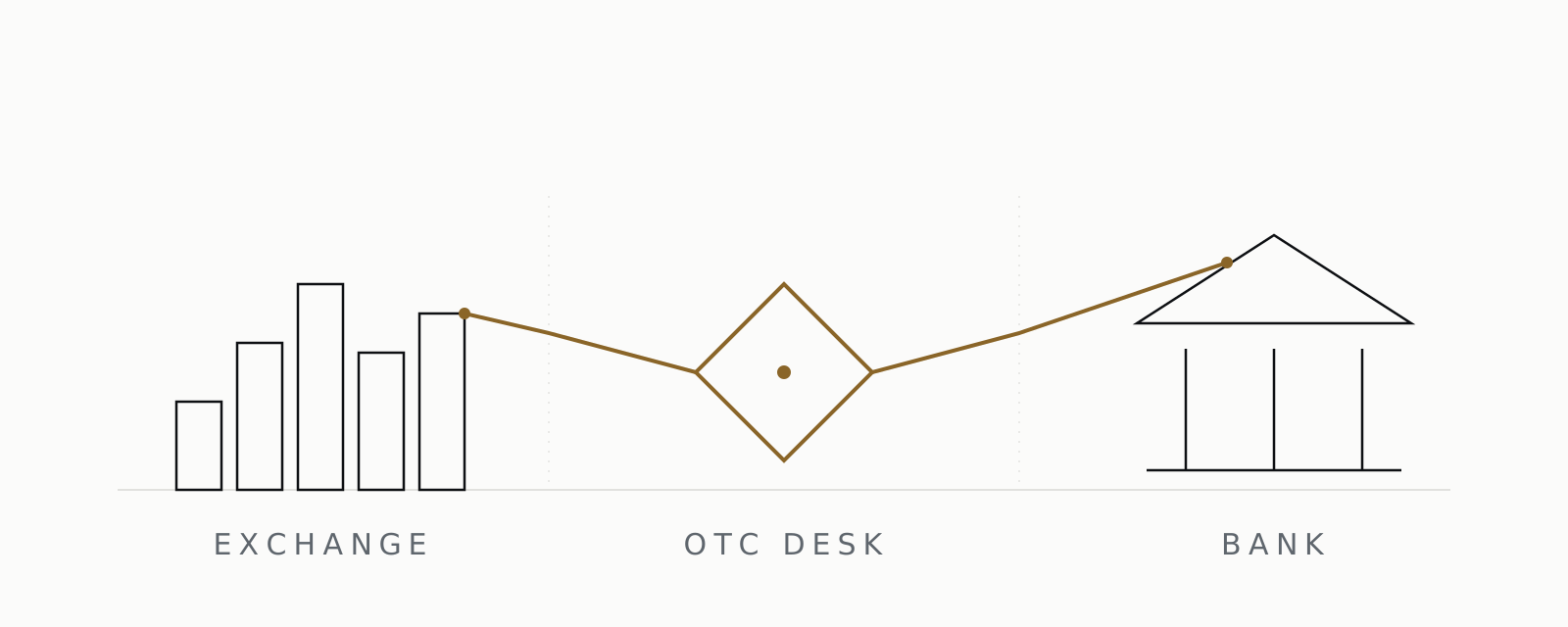
That gives a Binance user two routes to dirhams. Route one stays inside the exchange: sell USDT on the spot market, withdraw AED. Route two leaves it: withdraw USDT on-chain to a licensed OTC desk, which buys the tokens at a written price and wires AED to the same kind of own-name account. Which one wins depends on ticket size, the day's deadline and how much paperwork your bank will want later.
Three conditions apply to the Binance rail, from Binance's own FAQ: you must be onboarded to Binance FZE rather than the global platform, transfers run only between accounts in your own name, and UAE public holidays can delay the credit. The desk route shares the first and second conditions in its own form — a licensed desk also pays only to your own account — so neither route helps anyone trying to land money in a third party's account.
What Binance's AED rail costs, and how fast it runs
Binance publishes the numbers, so there is no need to guess them. AED deposits carry no fee, with a minimum of AED 10 and a maximum of AED 7.2 million per day. AED withdrawals carry a fixed fee of AED 10, whatever the amount. On top sits the spot trading fee for selling USDT into AED — 0.10% at the standard tier, as of September 2026, before any BNB or volume discount.
Timing splits at AED 50,000. Binance says withdrawals below that figure are processed instantly, while larger withdrawals follow a 19:00 GST cut-off: an instruction received after the cut-off carries the next day's value date. Deposits under AED 50,000 arrive within one business day, and the same cut-off applies above it. Your bank's own inbound checks run after that, and a first large credit from an exchange can still sit in review — the pattern is described in our guide on how UAE banks treat crypto-exchange inflows.
What the fee schedule does not price is execution. A spot market order fills against the order book level by level, so a large ticket in a thin AED pair can fill materially below the screen price — slippage that appears in your fill, not on the fee page. Working the order in slices, or resting limit orders, reduces it at the cost of time.
What does Binance charge to withdraw USDT on-chain?
If you take route two, the only Binance cost is the network withdrawal fee, which Binance sets per chain. The three networks a UAE desk is likely to accept, from Binance's schedule as of September 2026:
| Network | Binance withdrawal fee | Time to a desk credit | IWGT accepts |
|---|---|---|---|
| TRON (TRC20) | 1.5 USDT | A few minutes to solidification | Yes — default |
| Ethereum (ERC20) | 0.3 USDT | Minutes, longer under congestion | Yes |
| BNB Smart Chain (BEP20) | 0.01 USDT | Under a minute of blocks | Only if confirmed in your quote |
The cheapest fee is not the right choice if the desk does not credit that chain — on a 100,000 USDT ticket, 1.5 USDT is 0.0015%, so choose the network the receiving address was issued for.
Binance's fee on ERC20 is lower than on TRC20 in this schedule, which surprises people who assume Ethereum is always dearer; Binance sets a flat token fee per network rather than passing live gas through. That does not change the practical default. Most Dubai desks issue a TRC20 address first, and a token sent to an address on the wrong chain is the most expensive mistake on this route.
The address whitelist and the 24, 48 or 72-hour hold
Binance lets you restrict withdrawals to an address whitelist, and when the whitelist is on, a newly added address is held for a period you choose — 24, 48 or 72 hours — before the first withdrawal can go. The hold is a security control against account takeover, and it is also the single most common reason a same-day plan slips to the day after.
The fix is sequencing. Add the desk's deposit address to your Binance whitelist when you open the desk account, not on the morning you want to trade. By the time a quote is agreed, the hold has expired and the withdrawal goes at once. Bybit runs a fixed 24-hour lock on a new whitelisted address instead; that route has its own guide on moving USDT from Bybit to a UAE bank.
The desk route from Binance, in order
Four actions turn USDT on Binance into dirhams in your account through a licensed desk. Done in this order, with the account and the whitelist prepared in advance, the whole sequence fits inside a single UAE business day.
-
STEP 1
Get the desk account approved before you need it
Onboarding needs a passport, an Emirates ID if you are resident, and a proof of address issued within 90 days; a company adds its trade licence and ownership documents. Approval takes one business day in most cases. Look up the desk's licence number in the VARA public register first — ours is VL/24/12/002, and the entry is linked from the licence section.
-
STEP 2
Whitelist the desk's deposit address on Binance
Take the deposit address from the desk's written quote channel, add it to your Binance address book with the whitelist on, and let the 24-to-72-hour hold you chose run out. A small test withdrawal once the hold clears confirms the chain and the address at negligible cost.
-
STEP 3
Lock a written quote, then withdraw on the agreed network
Send the size; the dealer returns one all-in price for the whole ticket, valid for a stated window. Only after you accept it do you withdraw from Binance — TRC20 by default — so the tokens are never in transit without a price attached. Quotes come back within the hour, around the clock.
-
STEP 4
Receive AED by UAEFTS, or USD by SWIFT
Once the deposit is confirmed on-chain the desk releases the payout: AED by UAEFTS the same business day if the trade clears the bank's cut-off, or USD by SWIFT in two to five business days. The trade confirmation and the own-name wire are the two documents a bank asks for when it later queries the credit — our guide to answering a source-of-funds request shows how they are used.
Binance's AED withdrawal against the desk, at three ticket sizes
Put the two routes side by side and the exchange is cheaper on the fee line at every size; the desk is priced for certainty of fill and settlement rather than for the lowest headline fee. The table uses Binance's standard 0.10% spot fee plus the AED 10 withdrawal fee, and IWGT's published band for each ticket, at the 3.6725 dirham peg that anchors the USDT to AED rate.
| Ticket | Binance: 0.10% spot fee + AED 10 | IWGT band | IWGT all-in cost |
|---|---|---|---|
| 100,000 USDT | ≈ AED 377 | 0.40% | AED 1,469 |
| 500,000 USDT | ≈ AED 1,846 | 0.25% | AED 4,591 |
| 2,000,000 USDT | ≈ AED 7,355 | 0.15% | AED 11,018 |
What the left column leaves out: the fill price on a large market order, the 19:00 GST cut-off above AED 50,000, and any review your bank applies to a large exchange credit. Our pricing calculator gives the exact desk figure for your size.
Read the table as a price for two different things. On the exchange you pay a small fee and carry the execution and settlement risk yourself: the order book decides your average price, and a large fiat withdrawal moves at Binance's cut-off and your bank's discretion. At the desk you pay a larger spread and the counterparty carries those risks: one price for the full ticket, a fixed payout window, and a trade confirmation written for a bank's compliance team. Below roughly 100,000 USDT the desk does not quote at all, so the question only arises from that size upward.
When is Binance's own rail enough?
Binance's AED withdrawal suits a ticket with no fixed deadline, a size the order book absorbs without visible slippage, and a bank that already accepts credits from Binance FZE without a query. If all three hold, the desk adds cost without adding much.
The desk route earns its spread when one of them fails: the ticket is large relative to the AED book, the dirhams must land on a named day — a property completion, a supplier payment, a payroll run — or the receiving bank asks for a source-of-funds file that a spot-trade history does not satisfy on its own. The full documentation and red-flag checklist sits in our guide to selling USDT in Dubai, and tickets from seven figures upward have their own notes in selling large amounts of USDT.
The bottom line on Binance to a UAE bank
Binance now offers a real dirham off-ramp — no deposit fee, AED 10 to withdraw, instant below AED 50,000 — and for everyday amounts it is the cheapest way from USDT on Binance to a UAE account. From about 100,000 USDT, weigh that fee line against a desk's written price: the desk costs more per dirham and removes the fill, cut-off and paperwork risks the exchange leaves with you. Either way, the money must end in an account in your own name.
FAQ
Does Binance charge a fee to withdraw AED to a UAE bank account?
Yes — a fixed AED 10 per withdrawal from Binance FZE, as of September 2026. AED deposits carry no fee, with a minimum of AED 10 and a daily maximum of AED 7.2 million.
How long does an AED withdrawal from Binance take?
Binance processes withdrawals under AED 50,000 instantly. Larger withdrawals follow a 19:00 GST cut-off, and an instruction after the cut-off takes the next day's value date; UAE public holidays can add a delay, as of September 2026.
Can I withdraw AED from Binance to someone else's UAE account?
No. Binance FZE moves dirhams only between your Binance account and a bank account in your own name, and a licensed OTC desk applies the same own-name rule to its payouts.
What is the Binance withdrawal fee for USDT on TRC20?
1.5 USDT flat, as of September 2026; ERC20 is 0.3 USDT and BEP20 is 0.01 USDT on the same schedule. Binance shows the live figure on the withdrawal screen, and the receiving desk must credit the network you choose.
When is an OTC desk better than Binance's AED withdrawal?
From about 100,000 USDT, when the ticket needs one price for the whole amount, a payout on a fixed day, or a trade confirmation your bank will accept as source-of-funds evidence. For smaller amounts with no deadline, Binance's own rail is usually cheaper.
One written price for the whole ticket
IWGT is a VARA-licensed Broker-Dealer in Dubai. All-in spread 0.08–0.40% by size, published openly. Withdraw USDT from Binance on TRC20 to a whitelisted address and receive AED by UAEFTS the same business day once your account is approved.
SOURCES
- Binance — Binance Dubai launches direct AED deposits and withdrawals (no deposit fee, fixed AED 10 withdrawal fee; June 2026), accessed 21 September 2026.
- Binance Support — how to withdraw AED via ADCB on Binance (under AED 50,000 processed instantly; 19:00 UTC+4 cut-off above; AED 10 fee; own-name accounts only), accessed 21 September 2026.
- Binance Support — how to deposit AED via ADCB on Binance (no deposit fee; AED 10 minimum; AED 7.2 million daily maximum; Binance FZE onboarding required), accessed 21 September 2026.
- Binance — deposit and withdrawal fee schedule (USDT: 1.5 on TRC20, 0.3 on ERC20, 0.01 on BEP20), accessed 21 September 2026.
- Binance Support — withdrawal settings and address whitelist (24/48/72-hour hold), accessed 14 September 2026.
- VARA public register — licence status of Binance FZE and Dubai OTC desks, accessed 10 September 2026.
- Central Bank of the UAE — payment systems (UAEFTS), accessed 10 September 2026.
- IWGT published pricing bands and onboarding requirements — this site, September 2026.
This guide is informational and is not legal, tax or investment advice, nor an invitation to buy or sell any virtual asset. Rules and figures are as of September 2026 — re-check the sources before acting. Virtual assets may lose their value in full or in part and are subject to extreme volatility.