
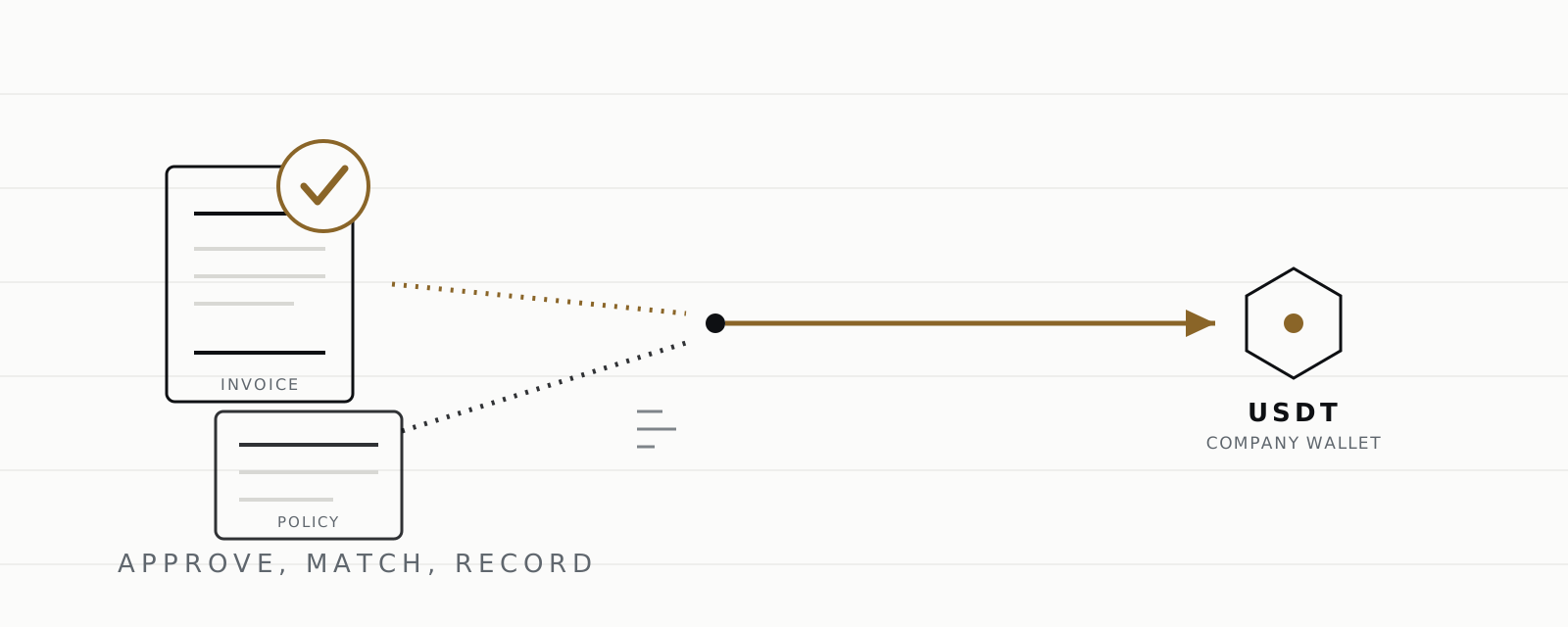
How a UAE company buys USDT for treasury or supplier payments
A UAE company buying USDT needs a corporate account already approved through KYB onboarding, a board resolution or written treasury policy naming who signs off, and a supplier invoice or policy reference to match the purchase against. Funds clear a correspondent bank in 2 to 5 business days; USDT reaches the company's whitelisted wallet once they do.
KEY FACTS
| Regulator(s) | VARA (Dubai, outside the DIFC) · FTA (Corporate Tax, VAT) |
|---|---|
| IWGT buy-side spread | 0.40% → 0.15% by ticket size (100k/500k/2M/10M); above 10M on request |
| Typical minimum ticket | From around 100,000 USDT |
| Funding wire to the desk | 2–5 business days (AED or USD, via correspondent bank) |
| USDT delivery | To the company's whitelisted wallet, same day funds confirm |
| VAT on the purchase | Exempt financial service (VAT Executive Regulation, Art. 42) |
| Corporate Tax | 9% on taxable profit above AED 375,000 (0% below) |
Source: Federal Tax Authority, VARA; desk spread and settlement terms per the pricing table on the main page, as of October 2026.
KEY TAKEAWAYS
- Treat a USDT purchase like any treasury cash movement: KYB onboarding first, approval second, payment third.
- A board resolution or written treasury policy — not a regulator-mandated figure — sets who can request and who must approve a purchase.
- Match every purchase to a supplier invoice or to the treasury policy document that authorised it, for the audit trail.
- Record the cost basis in AED or USD at the rate actually paid, including the spread, not a month-end estimate.
- The desk settles only to the company's own wallet, never a supplier directly; the company forwards USDT or pays separately in fiat.
What does a UAE company need before it can buy USDT?
A UAE company buying USDT needs a corporate bank account and a completed KYB onboarding file with a licensed desk before it sends a single wire. The desk checks the trade licence, ownership and UBO documents, and the signing authority of whoever will request a trade — a file that stays on record for every purchase afterwards, so a company buying regularly only submits it once.
Approval typically takes about one business day once the file is complete. A company funding a purchase in an unusual way should also have source-of-funds evidence ready if the desk asks where the money originates, even though the direction of the question runs opposite to a sale — here the desk wants to know the fiat is clean before it releases USDT, not before it pays out AED.
Who inside the company needs to approve a USDT purchase?
A UAE company does not face a regulator-mandated sign-off threshold for buying virtual assets; the approval control comes from the company's own board resolution or written treasury policy, not from a fixed figure set in law. The policy names who can request a purchase, who must approve it, and at what size a second signature applies, mirroring the approval chain a company already runs for a large supplier payment or a capital drawdown.
Separating the request from the approval matters more than any particular number. One person, typically the finance lead, identifies the need and requests a quote; a second person, named in the policy or the resolution, approves the trade before funds leave the account. A company without a written policy is not barred from buying USDT, but it has nothing to show a bank or an auditor who later asks who authorised the purchase.
How do you match a USDT purchase to an invoice or a treasury policy?
A USDT purchase made to pay a supplier should be matched to that supplier's invoice: the invoice number becomes the payment reference on the trade confirmation, and the two documents sit together in the file an auditor asks for later. A purchase made to build a treasury reserve has no invoice to point to, so it is matched instead to the treasury policy or board resolution that authorised holding USDT in the first place, stating the target allocation or the reason for the purchase.
Either way, the file a finance team keeps is the same shape: the trade confirmation from the desk, the supporting document — invoice or policy — and the bank statement showing the debit. A purchase with no document behind it is the one a reviewer flags first, regardless of how routine it actually was.
What accounting record does a company create when it buys USDT?
Buying USDT creates an asset on the company's books at its cost basis: the AED or USD amount actually paid, including the desk's spread, converted at the rate agreed on the trade date rather than a month-end estimate. That cost basis is the figure a later sale or a fair-value remeasurement works from, so recording it at the point of purchase, not after, is what keeps the trail usable.
Once USDT sits on the balance sheet, the ongoing question is the one covered in holding crypto in a UAE company treasury: which basis, cost with impairment or fair value, the company's reporting standard requires for the period that follows. The purchase itself only fixes the starting number; what happens to it afterwards is a separate policy question.
Does VAT or Corporate Tax apply when a company buys USDT?
UAE VAT, at a standard rate of 5%, treats the purchase of USDT the same way it treats a sale: Article 42 of the VAT Executive Regulation lists the transfer of ownership and the conversion of virtual assets as exempt financial services, and buying is a transfer of ownership like any other. The exemption does not extend to a fee charged separately for custody or management of the holding, which stays a taxable service under the same article.
Federal Corporate Tax applies to the company's overall taxable profit for the year, at 9% above AED 375,000 and 0% below it — a single purchase is not taxed on its own, and the Corporate Tax position turns on what happens to the USDT afterwards: whether it is later sold at a gain, held at fair value, or paid out to a supplier. Our guide to crypto taxation in the UAE sets out how the accounting treatment feeds into the return; a licensed tax adviser applies it to a company's own facts.
How does the purchase actually settle?
A company's funding wire, in AED or USD, clears a correspondent-banking chain before it reaches the desk, typically in 2 to 5 business days regardless of currency, because this inbound leg is not the same domestic rail the desk uses to pay AED out to a client on a sale. USDT reaches the company's wallet the same day the desk confirms the funds have cleared, at the rate fixed when the quote was accepted.
Settlement is own-name only: the desk delivers USDT to a wallet address the company whitelisted during onboarding, never to a supplier's wallet or any third party, even when the purchase is meant to fund a payment to that supplier. The company receives the USDT itself, then forwards it or pays the supplier separately. Below the typical minimum ticket of around 100,000 USDT, a regulated exchange may suit a smaller treasury top-up better than a desk.
IWGT prices a USDT purchase at 0.40% down to 0.15% by ticket size across the 100,000 / 500,000 / 2,000,000 / 10,000,000 USDT tiers, against a request-only rate above 10,000,000, set out in the pricing section of the main site. The buy-side bands are not identical to the sell-side ones above 500,000 USDT, because the desk has to source the coin rather than already hold it.
Illustrative example: buying USDT for a treasury reserve
Illustrative example. A Dubai trading company's board approves a written treasury policy allowing the CFO to hold a stated share of working capital in USDT, with any single purchase above a limit set in the policy needing a second signature from the finance director. Acting on that policy, the finance team requests a quote for 250,000 USDT.
At the 100,000 USDT tier, IWGT's buy-side spread is 0.40%. At the 3.6725 peg, the gross value of 250,000 USDT is AED 918,125; the spread adds AED 3,672; the company's funding wire totals AED 921,797. The wire clears the correspondent-banking chain, and USDT reaches the company's whitelisted wallet the same day the desk confirms the credit. Finance records the purchase at that AED value as the cost basis and files the trade confirmation alongside the treasury policy that authorised it.
The bottom line on buying USDT for a company
Buying USDT for a company works the same way as any other treasury movement: approve it before you request it, match it to a document, and let the desk settle only to the company's own wallet. The paperwork closes itself once the policy and the KYB file are both already in place before the trade.
FAQ
Does a UAE company need a VARA licence to buy USDT for its own treasury?
No. Buying and holding virtual assets as a treasury asset differs from operating a virtual-asset business, and a trading or services company does not usually need its own VARA licence to purchase USDT. A licence is required only where dealing in virtual assets is the company's business.
Who has to sign off on a company's USDT purchase?
Whoever the company's board resolution or written treasury policy names, not a figure set by a regulator. Most policies separate the person requesting the purchase from the person approving it, with a size threshold above which a second signature applies.
Can the desk send the USDT straight to our supplier instead of our own wallet?
No. Own-name settlement means a VARA-licensed desk delivers USDT only to the wallet address the purchasing company whitelisted during onboarding. The company then forwards the USDT or settles the supplier separately, the same separation that applies to an outgoing fiat payment.
How long does it take to receive USDT after we send the funding wire?
The funding wire, in AED or USD, typically clears a correspondent-banking chain in 2 to 5 business days. USDT reaches the company's whitelisted wallet the same day the desk confirms the funds, at the rate fixed when the quote was accepted.
Is VAT charged when a company buys USDT?
No. UAE VAT treats the purchase as a transfer of ownership of a virtual asset, which Article 42 of the VAT Executive Regulation lists as an exempt financial service, the same treatment a sale receives. A separate custody or management fee stays taxable.
What documents does KYB onboarding require for a company buying USDT?
The trade licence, ownership and UBO documents, and the signing authority of whoever will request a trade, reviewed in about one business day once the file is complete. A company funding the purchase in an unusual way may also be asked for evidence of where the fiat came from.
Buy USDT with the approval trail already in place
IWGT is a VARA-licensed Broker-Dealer in Dubai. Buy-side spread 0.40% to 0.15% by ticket size, settled only to the company's own whitelisted wallet, once KYB onboarding is approved.
SOURCES
- VARA public register — licence status check, accessed 5 October 2026.
- VARA Compliance and Risk Management Rulebook — Part IV, Client Money Rules (own-name settlement basis), accessed 5 October 2026.
- Central Bank of the UAE — payment systems (UAEFTS), accessed 5 October 2026.
- BIS Committee on Payments and Market Infrastructures — correspondent banking, accessed 5 October 2026.
- Federal Tax Authority — Corporate Tax (9% rate, AED 375,000 threshold), accessed 5 October 2026.
- Federal Tax Authority — Executive Regulation of Federal Decree-Law No. 8 of 2017 on VAT (consolidated, Cabinet Decision No. 52 of 2017 as amended by Cabinet Decision No. 100 of 2024) — Article 42(2)(k)–(m) and 42(3)(e): transfer and conversion of virtual assets exempt, accessed 5 October 2026.
- IWGT published pricing bands and onboarding requirements — IWGT published pricing bands, October 2026.
This guide is informational and is not legal, tax or investment advice, nor an invitation to buy or sell any virtual asset. It does not address a company's individual tax or accounting position — consult an accountant or a licensed tax adviser. Rules and figures are as of October 2026 — re-check the sources before acting. Virtual assets may lose their value in full or in part and are subject to extreme volatility.