
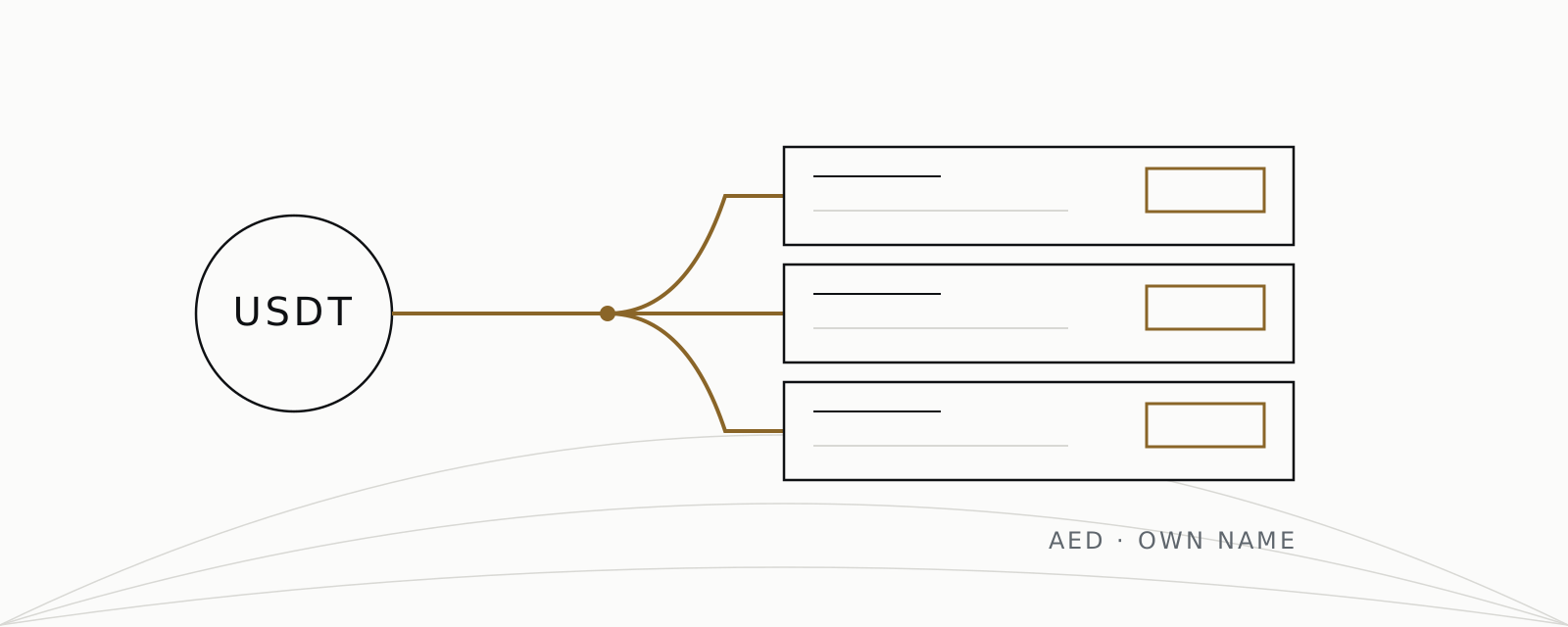
How to get a manager's cheque from USDT for a Dubai property transfer
Sell the USDT to a licensed desk, take AED to your own bank account by UAEFTS on the same business day, then have your own bank issue the manager's cheque or cheques for the Dubai Land Department trustee appointment. A cheque from a third party's company account breaks the own-name chain.
KEY FACTS
| Cheques, mortgaged resale | Three listed by the Dubai Land Department: bank or developer, seller balance, 4% fee |
|---|---|
| Cheques, unmortgaged resale | Count not published by the Department |
| Bank business week | Monday to Friday; Saturday and Sunday are the weekend |
| AED from the desk | Same business day by UAEFTS, to an account in your own name |
| Issue fee, one bank | AED 31.50 per cheque at First Abu Dhabi Bank |
| Validity period | Not published on the tariff pages checked |
Sources: Dubai Land Department, First Abu Dhabi Bank and CBUAE pages listed below, as of October 2026.
Why must the manager's cheque come from your own bank?
A manager's cheque for a Dubai resale transfer should be issued by a bank against funds in your own account, because the trustee office, the seller's bank and any mortgage bank all follow the money back to the buyer. A cheque from a USDT shop, drawn on a company account that is not yours, shows a stranger as the payer. That is a third-party payment in the form a registrar reads most closely.
The legal route to the purchase itself is covered in buying Dubai property with USDT; this page covers only the last mile, turning the coins into the instrument the trustee collects. The same logic applies when someone else offers to pay on your behalf: keep the payer, the account holder and the buyer as one name.
What is the timeline, planned backwards from the appointment?
The timeline for turning USDT into a manager's cheque runs backwards from the trustee appointment and must respect a Monday to Friday banking week. The CBUAE defines UAE business days as Monday to Friday, excluding declared holidays, as of October 2026. Federal government hours end at noon on Fridays and the weekend is Saturday and Sunday; Dubai follows a similar system, according to the u.ae portal.
| When | Step | What can go wrong |
|---|---|---|
| T minus 5 business days (previous Thursday) | Account approved; bank told which cheques you need | Bank asks for the sale contract or source of funds |
| T minus 3 (Monday) | Quote requested for the full AED total plus a buffer | Total changes after the trustee quotes final fees |
| T minus 2 (Tuesday), morning | USDT sent after written quote accepted | Wrong network, or sent after the quote window |
| T minus 2, before the bank cut-off | AED credited to your account by UAEFTS | Instruction misses the cut-off and lands the next business day |
| T minus 1 (Wednesday) | Bank issues the cheques | Branch needs balance cleared or a second approver |
| T (Thursday) | Trustee appointment, cheques handed over | Name or amount on a cheque does not match the request |
The plan holds two spare business days; with a Friday appointment, the weekend sits between any miss and the next try.
Weekends matter because a USDT transfer can arrive at any hour but the AED leg cannot. A UAEFTS instruction sent after your bank's cut-off, or on a Saturday, settles on the next business day. For bank-leg timing in detail, see same-day AED settlement for USDT sales.
What does the bank cut-off actually mean?
A bank cut-off is the time after which the bank no longer sends a customer's instruction in the current business day. The CBUAE's DONIA term sheet gives the UAEFTS operating window as 04:30 to 21:00 UAE time, as of October 2026, but that is the system window, not what your bank accepts. Each bank sets an earlier customer cut-off, and the CBUAE page does not publish it.
For the desk, the only commitment worth stating is the one already published: AED by UAEFTS on the same business day, to your own account, within the bank's limits. Ask your receiving bank for its own cut-off and for when a credit becomes available to draw a cheque against.
How many manager's cheques does a transfer need?
The Dubai Land Department publishes a cheque count only for one case: registering the sale of a mortgaged property, which lists three manager's cheques, as of October 2026. For an unmortgaged sale, the Department's sale registration page names a manager's cheque as one of four payment methods and gives no count.
| Payee | Purpose | Published count |
|---|---|---|
| Bank or developer | Outstanding debt on a mortgaged property | One, mortgaged sale only |
| Seller | Remaining balance after the debt | One, mortgaged sale only |
| Dubai Land Department | The 4% fee on the sale value | One, mortgaged sale only |
| Real estate agent | Commission, if the agreement says so | Not listed by the Department |
Treat the trustee's written list for your own file as the authority, because it reflects your exact transaction.
The sale registration page also shows 2% for the seller and 2% for the buyer, as of October 2026, while the mortgaged-sale page shows 4% on the sale value. Ask the trustee office who pays which share before you size the cheques. An off-plan purchase uses a different payment path, see paying a RERA escrow account from crypto.
What does the sizing look like in numbers?
Illustrative example, not a quote: a mortgaged resale at AED 2,000,000 with AED 900,000 outstanding on the mortgage. Under the three-cheque listing, the cheques are AED 900,000 to the bank, AED 1,100,000 to the seller and AED 80,000 to the Department, the last being 4% of the sale value. The cheque total is AED 2,080,000, before registrar, title deed and trustee charges.
The USDT to sell is that total, plus the other fees you need to cover, divided by the quote rate. Our spread for selling is 0.25% at the 500k to 2M tier, as of October 2026, which on AED 2,080,000 is AED 5,200. The published pricing bands show the other tiers, and the exact AED you receive comes from a written quote.
What do manager's cheques cost and how long are they valid?
First Abu Dhabi Bank's conventional service and price guide lists a manager's cheque or demand draft at AED 31.50 and a cancellation at AED 52.50, as of October 2026. Other banks publish different tariffs, and some publish none for this instrument. Fees may carry VAT; the bank's current guide governs.
Validity is a different matter: the tariff pages checked in October 2026 do not publish a validity period for a manager's cheque. Ask the issuing branch for it in writing, and book the trustee appointment inside it with margin. If the appointment slips, ask the branch about reissue or cancellation before the cheque is handed over, because cancellation carries a fee.
How do you get the bank to issue the cheques on time?
-
STEP 1
Get the cheque list in writing
Ask the trustee office or your agent for the payee names and amounts. Pass the same list to your bank with the sale contract.
-
STEP 2
Open the desk account first
Account approval takes time, so complete the onboarding documents before you need the money, with the source-of-funds file ready.
-
STEP 3
Settle to your own bank only
Name your own account as the payout. A payout to any other name defeats the purpose of the exercise.
-
STEP 4
Request the cheques once the AED is cleared
Ask for each cheque in the exact payee name, and check spelling at the counter before you leave.
What should you keep in the property file?
Keep one folder per transfer so each cheque can be traced from the coins to the registrar. A clean file also answers a bank's later questions about the funds, and it is the same evidence the Dubai Land Department glossary entry frames the transfer around.
- The written USDT quote, the transaction hash and the desk's trade confirmation.
- The bank credit advice showing AED arriving in your own name.
- Each cheque's copy or issue advice, plus the bank's fee receipt.
- The trustee's payment receipt and registration certificate.
- The source-of-funds papers for the original USDT.
FAQ
Can a USDT shop hand me a manager's cheque for a Dubai property transfer?
It can, but a cheque drawn on a third party's company account breaks the own-name chain that the trustee, the seller's bank and any mortgage bank check. The safer route is AED into your own account, then a cheque issued by your own bank.
How many manager's cheques does a Dubai resale transfer need?
For the sale of a mortgaged property, the Dubai Land Department lists three: one to the bank or developer for the debt, one to the seller for the balance, one to the Department for the 4% fee, as of October 2026. For an unmortgaged sale the Department does not publish a count.
How long is a manager's cheque valid in Dubai?
The tariff pages checked in October 2026 do not publish a validity period. Ask the issuing branch for the validity in writing and plan the trustee appointment inside it.
Does the Dubai Land Department accept payment methods other than a manager's cheque?
Yes. As of October 2026 the Department's sale registration page lists ePay, Dubai Pay, the Noqodi wallet and a manager's cheque. Which one fits depends on the transaction type and the trustee office.
Convert USDT to AED for your transfer
OFZA Fintech Virtual Asset Exchange Services LLC (IWGT) holds VARA licence VL/24/12/002. Selling spreads run 0.40%, 0.25%, 0.15% and 0.08% by tier, with AED by UAEFTS the same business day, to your own account.
SOURCES
- Dubai Land Department: Property Sale Registration (fees, payment methods), accessed October 2026.
- Dubai Land Department: Registering the Sale of a Mortgaged Property (three manager's cheques, 4% fee), accessed October 2026.
- First Abu Dhabi Bank: Service and Price Guide, Conventional (manager's cheque fees), accessed October 2026.
- Central Bank of the UAE: DONIA term sheet (business days, UAEFTS operating window), accessed October 2026.
- UAE Government portal: working hours in the public sector (weekend), accessed October 2026.
This guide is informational and is not legal, tax or investment advice, nor an invitation to buy or sell any virtual asset. Rules and figures are as of October 2026, so re-check the sources before acting. Virtual assets may lose their value in full or in part and are subject to extreme volatility.