
How to move USDT from MetaMask to a UAE bank account
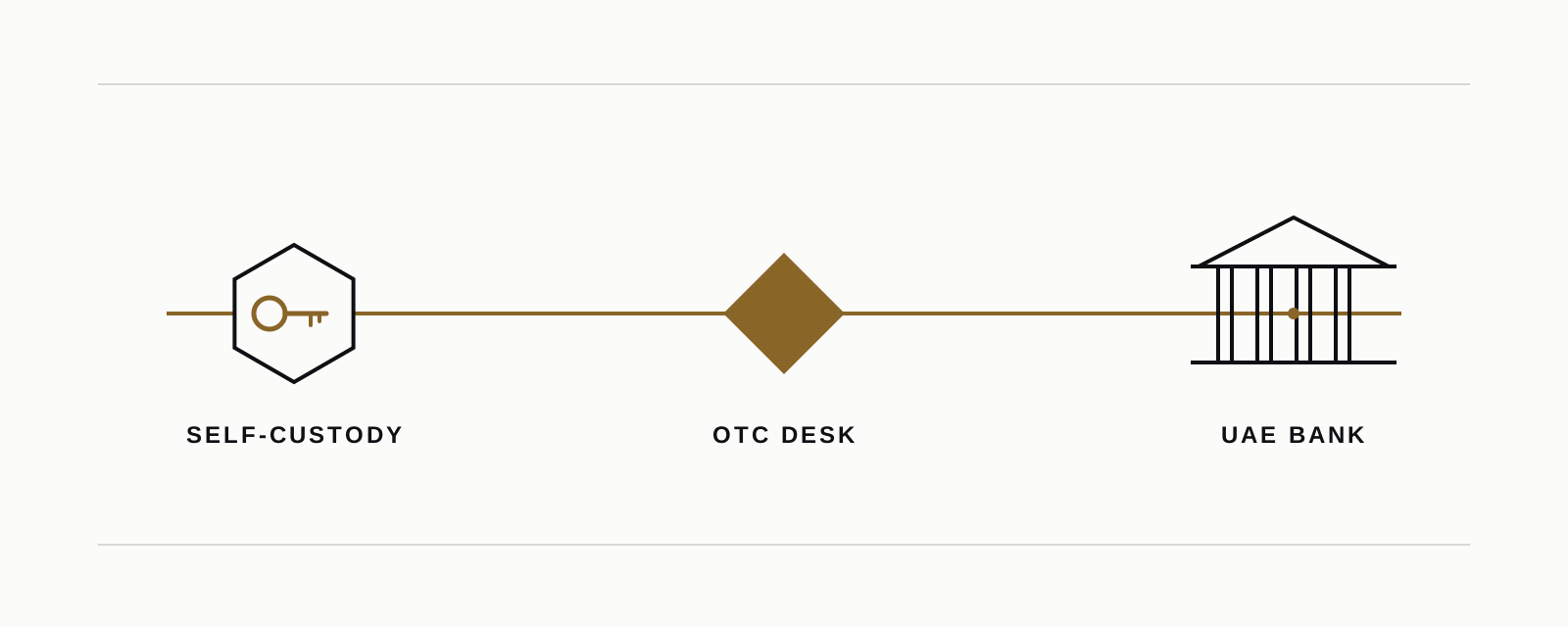
You cannot send USDT from MetaMask straight into a UAE bank account — the wallet holds tokens, not dirhams. The route: open a VARA-licensed desk account, send USDT on-chain from MetaMask on the network the desk credits — TRC20, ERC20 and BEP20 are all available in a current MetaMask wallet — and receive AED by UAEFTS the same business day.
KEY FACTS
| Route | MetaMask (self-custody) → on-chain send → licensed desk → UAE bank |
|---|---|
| Wallet type | Ethereum and EVM networks (BNB Chain, Polygon, Arbitrum, Linea and others), plus TRON, Solana and Bitcoin supported by default, as of September 2026 |
| Network used for USDT | TRC20, ERC20 or BEP20 — whichever the desk confirms; TRC20 is the regional default |
| Desk minimum | From around 100,000 USDT |
| IWGT spread | 0.08%–0.40%, by ticket size |
| AED settlement | Same business day (UAEFTS) |
| USD settlement | 2–5 business days (SWIFT) |
Source: MetaMask support documentation and IWGT published pricing bands, as of September 2026.
What changes when your USDT is already in MetaMask?
MetaMask is a self-custody wallet: you hold the private keys, and no exchange sits between you and the desk. That single fact reshapes what a UAE bank and a licensed OTC desk want to see, because proof of ownership and the source-of-funds trail work differently for self-custody vs custodial wallets — there is no exchange KYC record behind the coins.
An exchange withdrawal carries a paper trail before it even reaches the desk: the platform verified your identity, logged the deposit, and can produce a statement on request. A MetaMask send has none of that built in. The desk, and later your bank, rely on the wallet's on-chain history and your own acquisition records instead of a third party's compliance file.
This is not a legal problem. Self-custody is not a red flag at a licensed desk, and VARA regulates the counterparty you trade with, not the wallet you hold. It does mean the source-of-funds conversation starts earlier and asks for more, covered in full below.
Which network should you send USDT on from MetaMask?
MetaMask was built for Ethereum and EVM-compatible chains — Ethereum itself, BNB Chain, Polygon, Arbitrum, Linea and similar networks all run through the same wallet and the same seed phrase. It now also supports TRON by default, so a current MetaMask wallet can hold and send TRC20 USDT without add-ons, alongside Solana and Bitcoin; MetaMask's help centre explains how TRON's bandwidth-and-energy fee model works inside the wallet, as of September 2026.
That matters because TRC20 is the USDT network UAE desks quote against by default, so a MetaMask user can now send on the regional default rather than work around it. The alternatives are ERC20 on Ethereum mainnet or BEP20 on BNB Chain — both long supported in MetaMask, both accepted by many licensed desks, and each a different cost and speed trade-off. Whichever you choose, the network the desk confirms in writing wins over the network that is cheapest.
| Network | Typical gas fee | Typical confirmation | Note |
|---|---|---|---|
| Tron (TRC20) | Roughly USD 2–5, paid in TRX (about 6.5–13.5 TRX burned) | About a minute | Regional default at UAE desks; supported in MetaMask by default |
| Ethereum (ERC20) | Under USD 1 at the 0.6 gwei base fee seen on 21 September 2026; several dollars or more in congestion | 1–5 minutes | Default MetaMask network; fee moves with congestion |
| BNB Chain (BEP20) | Around USD 0.005 at the 0.05 gwei standard gas price | Seconds — 0.45-second blocks, finality in about 0.65 s | Cheapest EVM option; shares the 0x address format with Ethereum |
| Polygon | Cents — check the live fee | Under a minute | Confirm the desk credits USDT on Polygon first |
| Arbitrum | Cents — check the live fee | Under a minute | Confirm the desk credits USDT on Arbitrum first |
TRC20 is the network most UAE desks quote against; BEP20 is the cheapest EVM option; Ethereum mainnet fees are lowest in quiet hours and spike in congestion, so check the live figure before a small transfer.
Confirm which network the desk credits before you send anything — a deposit sent on the wrong chain is not something a dealer can recover. The gas fee is paid to the network itself, in the network's native token, not to MetaMask or the desk.
How does the MetaMask-to-bank route work, step by step?
Moving USDT from MetaMask to a UAE bank account has four steps: open the desk account, accept a written quote, send the USDT on-chain, and receive the wire. With the account already approved, the trading steps fit inside one business day.
-
STEP 1
Open the desk account before you need it
You register once: passport and proof of address issued within 90 days for an individual, trade licence and ownership documents for a company. Account approval takes one business day in most cases — doing this before trade day is the single biggest speed-up available.
-
STEP 2
Request a written quote for your size
State the amount through the quote form or your dealer; the desk returns one all-in price held for a defined window. A dealer answers within the hour, around the clock.
-
STEP 3
Send USDT from MetaMask on the agreed network
Copy the desk's deposit address from the written quote, check it against the address shown in MetaMask character by character, and send on the network the desk confirmed — TRC20 by default, ERC20 or BEP20 if that is what the written quote says. A small test transfer first is normal practice with a new counterparty.
-
STEP 4
Receive AED or USD in your own account
AED goes out by UAEFTS the same business day you trade; USD goes by SWIFT and takes 2 to 5 business days. A licensed desk pays only to a bank account in your own name.
How do you keep a MetaMask wallet secure during the sale?
Your seed phrase is the only thing that can move your USDT — no desk, dealer or support agent ever needs it, and typing it into a website or a message is how self-custody wallets get emptied. Keep it offline, and never enter it anywhere except MetaMask itself during setup or recovery.
Verify the receiving address before you send, not after. Copy the address from the desk's written quote, paste it into MetaMask, and check the first and last several characters against the source — clipboard-hijacking malware that swaps a copied address for an attacker's is a real, documented risk, and it works silently.
A small test transfer removes the guesswork on a new route: send a token amount first, confirm the desk credits it, then send the balance. It costs one extra network fee and one extra confirmation wait, and it is the difference between a mistake you can fix and one you cannot.
What source-of-funds documentation does self-custody through MetaMask need?
Self-custody proceeds draw more source-of-funds scrutiny than exchange-sourced USDT, because there is no exchange KYC trail sitting behind the coins for the desk or the bank to rely on. That is not a penalty for using MetaMask — it is the desk and the bank doing the checking an exchange's compliance team would otherwise have done for them.
The file looks close to what any self-custody seller assembles, the same approach covered in our guide to selling from a hardware wallet to a bank account. It has four parts: records of how you first acquired the USDT, such as an exchange statement or a client invoice; the on-chain trail from that acquisition to your current MetaMask address; a short list of every address you control and what each is for; and a block-explorer export of the sending address's history.
The weak point is usually the gap between an old platform and MetaMask. The transaction hash that moved coins out of an exchange links the two records; a screenshot of a balance links nothing. Build this file before you request a quote, not after a dealer asks for it.
What does the full route cost, end to end?
The MetaMask-to-desk route costs the desk's spread plus the network's gas fee. Licensed desks in Dubai quote 0.08% to 0.40% by size, published on our pricing section, as of September 2026. MetaMask itself charges no fee for sending USDT — the gas fee goes to the network's validators, not to the wallet or the desk.
Worked example: 100,000 USDT at the 0.40% band costs 400 USDT, about AED 1,469 at the 3.6725 dollar peg. Sending on TRC20 adds roughly USD 2–5 in TRX and on BEP20 a fraction of a cent; the same transfer on Ethereum mainnet (ERC20) cost well under a dollar at the 0.6 gwei base fee seen on 21 September 2026, but can run to several dollars or more when the network is congested. Either way, the network fee is a rounding error next to the spread — the network choice matters for reliability and desk acceptance, not for the total bill.
The bottom line on selling USDT from MetaMask to a UAE bank
The route from MetaMask to a UAE bank account has the same shape as any self-custody sale: open the account early, send on a network the desk credits — TRC20 by default, ERC20 or BEP20 if agreed — and bring the acquisition trail before anyone asks for it. Nothing about holding USDT in your own wallet blocks a same-day AED settlement; it just moves the compliance conversation earlier.
FAQ
Can I send USDT from MetaMask straight to a UAE bank account?
No. MetaMask holds tokens, not dirhams, so a conversion leg always sits in the middle. Send USDT on-chain to a VARA-licensed desk, which wires AED to your own bank account the same business day.
Can I send USDT on TRC20 from MetaMask?
Yes, as of September 2026. MetaMask supports TRON by default, so a current wallet can hold and send TRC20 USDT without add-ons; the fee is paid in TRX through TRON's bandwidth-and-energy model rather than as gas. Confirm with the desk that it credits TRC20 — IWGT's default — before you send.
Which network should I use to send USDT from MetaMask to a UAE desk?
Use whichever network the desk confirms it credits — TRC20 by default at most UAE desks, or ERC20 on Ethereum and BEP20 on BNB Chain where agreed. Confirm the network before you send — a transfer on the wrong chain is not something a dealer can recover.
Does MetaMask charge a fee to send USDT?
MetaMask itself charges no fee for a transfer. You pay the network's gas fee in the network's native token, and that fee goes to the network's validators, not to MetaMask or the receiving desk.
Why does self-custody USDT face more source-of-funds questions than exchange-sourced USDT?
An exchange withdrawal carries a KYC record and a deposit log the desk can rely on. A MetaMask send has none of that built in, so the desk and your bank ask for your own acquisition records and on-chain history to fill the same gap.
Does MetaMask have its own feature to sell USDT for AED?
MetaMask offers buy and, in some markets, sell options through third-party on-ramp and off-ramp partners inside the app, but AED and UAE coverage change without much notice. Check the Buy or Sell screen in MetaMask directly rather than planning a trade around it.
From MetaMask to your bank, the same business day
IWGT is a VARA-licensed Broker-Dealer in Dubai. All-in spread 0.08–0.40% by size, published openly. Send USDT from MetaMask on ERC20 or BEP20 and receive AED by UAEFTS the same business day once your account is approved.
SOURCES
- MetaMask Help Center — Networks (default and custom networks; Solana, Bitcoin and TRON guides), accessed 21 September 2026.
- MetaMask Help Center — Navigate TRON in MetaMask ("MetaMask supports TRON by default"; bandwidth and energy fees), accessed 21 September 2026.
- Etherscan — Ethereum gas tracker (≈0.6 gwei base fee on 21 September 2026), accessed 21 September 2026.
- BNB Chain documentation — BNB Smart Chain overview (0.05 gwei standard gas price, ≈0.45 s block time), accessed 21 September 2026.
- TRON developer documentation — paying for resources (TRX burn rates for Bandwidth and Energy), accessed 21 September 2026.
- VARA public register, accessed 19 September 2026.
- Central Bank of the UAE — payment systems (UAEFTS), accessed 19 September 2026.
- IWGT published pricing bands — this site, September 2026.
This guide is informational and is not legal, tax or investment advice, nor an invitation to buy or sell any virtual asset. Rules and figures are as of September 2026 — re-check the sources before acting. Virtual assets may lose their value in full or in part and are subject to extreme volatility.