
Selling mining proceeds in the UAE: proving origin and settling to a bank
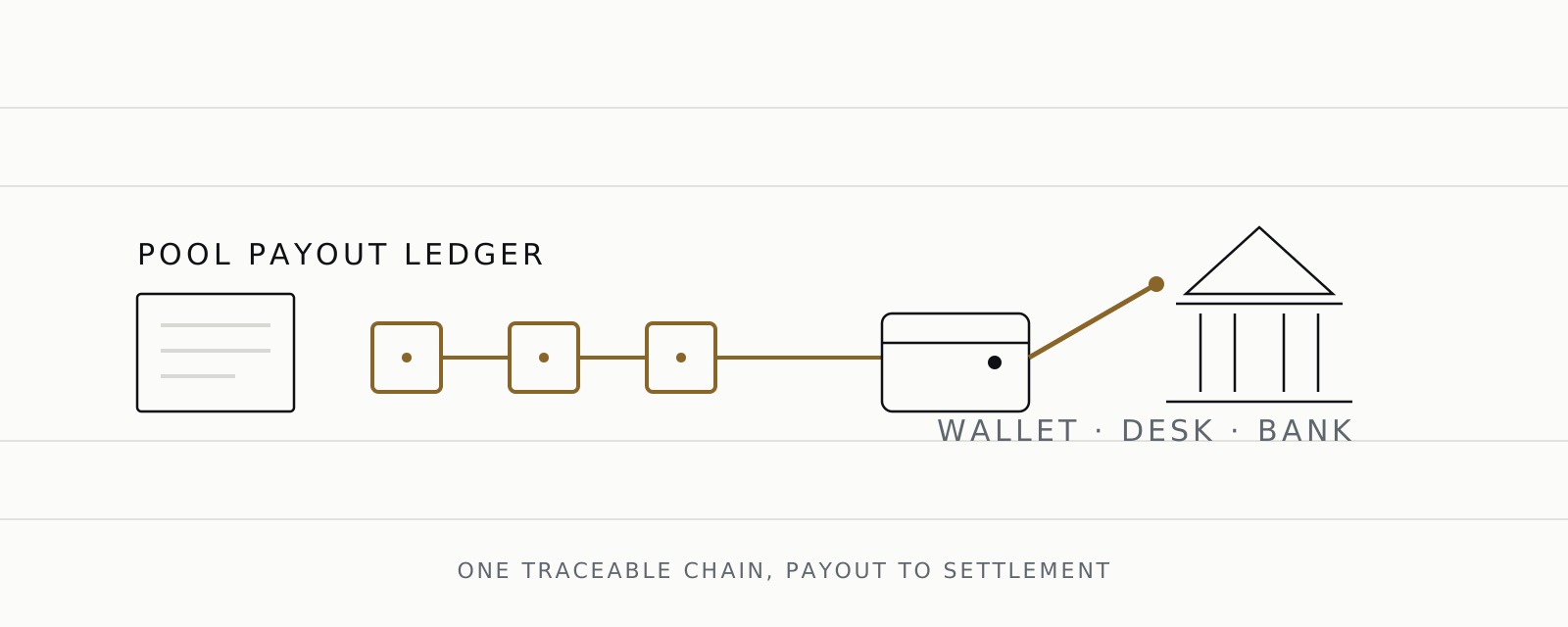
Selling mined Bitcoin or other crypto in the UAE runs through the same licensed-desk process as any other sale, with one extra step: proving the coins came from mining. Coinbase transactions, pool payout statements and a documented chain from payout to wallet to desk are the evidence that clears enhanced due diligence fastest.
KEY FACTS
| Regulator | VARA (Dubai, outside the DIFC) |
|---|---|
| Typical desk minimum | From around 100,000 USDT-equivalent |
| IWGT spread | 0.08%–0.40%, by ticket size |
| AED settlement | Same business day (UAEFTS) |
| USD settlement | 2–5 business days (SWIFT) |
| EDD trigger | From around 100,000 USDT, and especially seven-figure tickets |
Source: IWGT published pricing bands and onboarding practice, as of September 2026.
What counts as proof of origin for mining proceeds?
Proof of origin for mining proceeds is the on-chain and off-chain record that connects a block reward to the wallet you are selling from today. A licensed desk needs this before trading, in the same way it needs a source-of-funds file for any other large sale. Mining has its own paper trail, and it is usually easier to assemble than people expect.
For solo mining, the primary document is the coinbase transaction itself — the first transaction in a block, crediting the reward to the address you controlled at the time. It is public, timestamped and cannot be altered after the fact. For pool mining, the primary document is the pool's payout statement, backed by the on-chain transactions the pool sent to your wallet.
Either way, the file needs one more layer: evidence that the receiving wallet is yours, and a record of every hop the coins made since — internal transfers, exchange deposits, conversions to USDT — up to the address you send to a desk.
Is solo-mined or pool-mined crypto easier to prove?
Pool-mined crypto is the more common case and, with the pool's records attached, is just as straightforward to clear as solo-mined crypto. Solo mining produces a single, self-contained proof — the coinbase transaction — while pool mining produces a shorter, more frequent stream of payouts that needs the pool's own statement to read as one story instead of many small unexplained transfers.
| Category | Solo-mined proceeds | Pool-mined proceeds |
|---|---|---|
| Primary document | The coinbase transaction crediting the block reward to your address | The pool's payout statement, tied to the payout transactions on-chain |
| Address history | One address, credited directly by the network protocol | Pool payout address feeds your wallet; account history bridges the two |
| Typical file strength | Strong alone — the blockchain itself is the primary source | Strong once paired with the pool dashboard export; weak from payouts alone |
| Common gap | Proving you controlled the mining hardware behind the coinbase transaction | A closed or unresponsive pool that no longer issues statements |
Neither route is preferred over the other — the review looks for a consistent record, and pool statements supply for pool mining what the blockchain already supplies for solo mining.
How do you document a pool payout, step by step?
Documenting a mining pool payout means pairing the pool's own statement with the matching on-chain transactions, for every payout address you have used. Most pools keep this history in the account dashboard for as long as the account stays open.
-
STEP 1
Export the pool's payout history
Download the CSV or PDF statement from the pool account, covering every payout to the wallet you plan to sell from. Include the account username or worker ID shown on the statement — it links the export to your specific mining activity.
-
STEP 2
Match payouts to on-chain transactions
Pull the transaction hashes for those payouts from a block explorer and check the amounts and dates against the pool statement. A matching pair — pool record plus on-chain record — is stronger than either alone.
-
STEP 3
List every wallet the coins passed through
Note each address the coins moved to since the payout, in order, with one line on what each wallet is for. A desk reviewing documents reads this list before it reads the blockchain itself.
-
STEP 4
Add the conversion record, if the coins changed form
If BTC was converted to USDT on an exchange before reaching the wallet you sell from, include the exchange's trade confirmation or statement. This closes the last gap between "mined" and "the coins in front of the desk".
What if your mining hardware is outside the UAE?
Mining hardware does not need to be in the UAE for a UAE desk to sell the resulting coins. A desk reviews the coins in your wallet and the documents behind them, not the physical location of the rigs that produced them — the equipment can sit in North America, Central Asia or anywhere else, and the review looks the same.
This also covers miners who have recently relocated to the UAE with several years of accumulated proceeds. The review looks the same whether the mining happened last month or in 2019: coinbase transactions or pool statements from the relevant years, plus the chain of custody since. Older history that predates any UAE connection is normal and does not need a UAE-based explanation.
One practical note for equipment still running abroad: keep the mining contract, hosting agreement or electricity invoice for the facility if you have one. It is not always required, but it removes a question a reviewer might otherwise ask.
Why does a longer documented chain speed up EDD?
A longer, unbroken documented chain from pool payout to personal wallet to exchange or OTC desk clears enhanced due diligence (EDD) faster because it removes the questions a reviewer would otherwise have to ask one at a time. Each extra hop with a matching record — payout, internal transfer, exchange deposit, conversion, desk deposit — answers "where did this come from" before it is asked.
The opposite pattern is what slows a file down: coins that appear in a wallet with no visible history, or a chain with one unexplained jump in the middle. Reviewers read gaps as risk, regardless of how the coins were actually earned. A file with five documented hops over three years typically clears faster than a file with one large, recent, unexplained transfer — even when the underlying money is identical.
This is also where solo mining and pool mining converge: once the coinbase transaction or pool statement anchors the start of the chain, every hop after it is documented the same way as any other crypto sale.
How much does it cost to sell mining proceeds in the UAE, and how fast is settlement?
Selling mining proceeds in the UAE costs the same spread as any other sale of comparable size — 0.08% to 0.40% depending on ticket, published in our pricing bands — plus the time the document review adds up front. There is no separate "mining fee".
Once an account is approved and the source-of-funds file has cleared, settlement follows the standard rails: AED by UAEFTS the same business day you trade, or USD by SWIFT in 2 to 5 business days. Review time for a mining file with a complete pool or coinbase record typically matches the standard onboarding timeline of one to two business days; incomplete files take longer, not because mining is riskier but because the extra document round-trips add days.
For business miners, the coins may also sit inside a company structure. UAE Corporate Tax applies to mining run as a business activity through a company, separately from the desk's document review — worth checking with a tax adviser if you mine through a UAE entity.
What mistakes slow down a mining-proceeds file?
The mistakes that slow down a mining-proceeds review are almost all about broken continuity, not about the mining itself.
- Consolidating years of payouts into one brand-new wallet right before selling, with no note connecting it to the old addresses.
- Leaving a mining pool without saving the payout statements first — some pools purge history after account closure.
- Mixing mining proceeds with unrelated trading activity in the same wallet, which makes the two hard to separate on review.
- Submitting a balance screenshot instead of a pool export or block-explorer record with matching dates and amounts.
- Assuming equipment records alone are proof of origin — a reviewer wants the coins traced, not just the hardware described.
None of these is disqualifying on its own. They simply add the time it takes to rebuild the missing hop, which is the one part of the process a miner can shorten by preparing the file in advance.
FAQ
Can I sell Bitcoin I mined years ago through a UAE OTC desk?
Yes, if you can trace the coins back to the mining event. Old coinbase transactions or pool payout records still count as proof of origin, even from hardware you no longer own or a pool you have since left.
Do I need mining equipment in the UAE to sell mining proceeds here?
No. A desk sells the coins in your wallet, not the equipment that produced them. Miners who relocate to the UAE with hardware still running abroad, or with equipment already sold, both go through the same document review.
Is pool-mined crypto treated differently from solo-mined crypto during review?
Both are acceptable, but the supporting evidence differs. Solo-mined coins are proven by the coinbase transaction alone; pool-mined coins need the pool's payout statement alongside the on-chain payout history.
What if I lost access to old mining pool statements?
Most pools let a registered account re-download historical payout statements from the dashboard. If the pool has closed, on-chain payout addresses plus any surviving emails or screenshots from the time can support a partial file.
Does selling mining proceeds in the UAE create a UAE tax bill on the mining itself?
The UAE has no personal income tax, so an individual selling mining proceeds is not taxed federally on the sale. Mining run as a business through a company falls under UAE Corporate Tax, and mining income earned in another country may carry tax obligations there — this guide covers the UAE side only.
Sell mining proceeds to a desk that reads the payout trail
IWGT is a VARA-licensed Broker-Dealer in Dubai (VL/24/12/002). We review coinbase transactions and pool payout histories as standard source-of-funds evidence, then settle AED by UAEFTS the same business day.
SOURCES
- VARA public register — licence status check, accessed 20 September 2026.
- FATF — Updated Guidance for a Risk-Based Approach to Virtual Assets and VASPs (October 2021), accessed 20 September 2026.
- Central Bank of the UAE — Anti-Money Laundering and Combating the Financing of Terrorism, accessed 20 September 2026.
- IWGT published pricing bands and onboarding requirements — IWGT published pricing bands, September 2026.
This guide is informational and is not legal, tax or investment advice, nor an invitation to buy or sell any virtual asset. Rules and figures are as of September 2026 — re-check the sources before acting. Virtual assets may lose their value in full or in part and are subject to extreme volatility.