
Converting staking rewards to AED: records, timing and tax questions
Converting staking rewards to AED works like any OTC sale: a licensed desk prices the USDT-equivalent amount and settles to your own-name UAE bank account. What differs is the file behind it — a dated record of each reward, and proof of whether it came from self-custody, an exchange or a liquid staking token.
KEY FACTS
| Personal income tax on rewards | None — the UAE has no personal income tax |
|---|---|
| Federal Corporate Tax (companies) | 9% above AED 375,000 taxable profit/year; 0% below |
| IWGT spread | 0.08%–0.40%, by ticket size |
| Typical desk minimum | From around 100,000 USDT equivalent |
| AED settlement | Same business day (UAEFTS) |
| USD settlement | 2–5 business days (SWIFT) |
| Payout rule | Own-name account only — no third parties |
Source: UAE Ministry of Finance, VARA and IWGT published pricing bands, as of September 2026.
What counts as a staking reward when you convert it to AED?
A staking reward is the periodic payout a proof-of-stake network pays a validator or delegator for helping secure the chain — in ETH, SOL and similar assets, rewards often land every few days rather than as one lump sum. Converting a backlog into AED follows the same OTC process as any token sale, and works well as a recurring OTC selling program once the flow is steady.
What makes staking different is volume: many small reward events build up before the total is worth converting at a licensed desk's typical minimum, close to 100,000 USDT equivalent. Treating the balance the way you would a profit distribution paid in crypto is the simplest way to think about the paper trail — the desk cares where the tokens came from and whether each reward's timing is documented.
Self-custody, exchange staking or a liquid staking token: which is cleanest for AML screening?
Where staking rewards accrue changes how easily a licensed desk and your bank can trace them, and this matters more as reward totals grow. The three common setups — running or delegating from your own wallet, staking through an exchange, and holding a liquid staking token — carry different amounts of built-in evidence, a distinction covered in more depth in self-custody vs custodial wallets when selling crypto.
Self-custody staking gives the longest on-chain trail, since every reward lands in a wallet address you control. Exchange staking gives a shorter on-chain trail but inherits the exchange's own know-your-customer file. Liquid staking tokens sit in between: the reward shows up as the token's exchange rate moving rather than a separate payment, so the desk also checks the issuing protocol — the same FATF-aligned anti-money-laundering standards that apply to any large crypto inflow, not a rule specific to staking.
| Custody type | What screening typically checks | Typical supporting documents |
|---|---|---|
| Self-custody staking (solo validator or direct delegation) | Wallet address history and delegation transaction hashes, matched to the staked principal | Wallet address, delegation transaction hashes, validator ID |
| Exchange (custodial) staking | The exchange's own KYC file plus your account statements — rewards are not separately traceable on-chain | Exchange staking statement, KYC confirmation, withdrawal history |
| Liquid staking tokens (e.g. stETH, mSOL) | The issuing protocol and contract address, plus any wrap or redemption transactions | Protocol transaction history, contract verification, redemption record |
Exchange staking usually clears fastest because the exchange has already done the identity check; self-custody and liquid staking need the extra step of showing the underlying wallet or protocol is legitimate.
What records should you keep for each staking reward?
A usable staking-reward record has four fields per payout: the date credited, the quantity and token, the price in USD or AED that day, and the wallet or account it landed in. Keeping this at the point each reward accrues is far less work than reconstructing it later, and it is the same discipline behind any source-of-funds file a bank might ask for.
This record serves two purposes, and only one is about the UAE. It is the file a licensed desk and your bank may want before a large conversion, and separately it is the record your own tax authority may expect if your country of tax residence taxes staking income — which this guide cannot advise on.
Why convert staking rewards on a schedule instead of all at once?
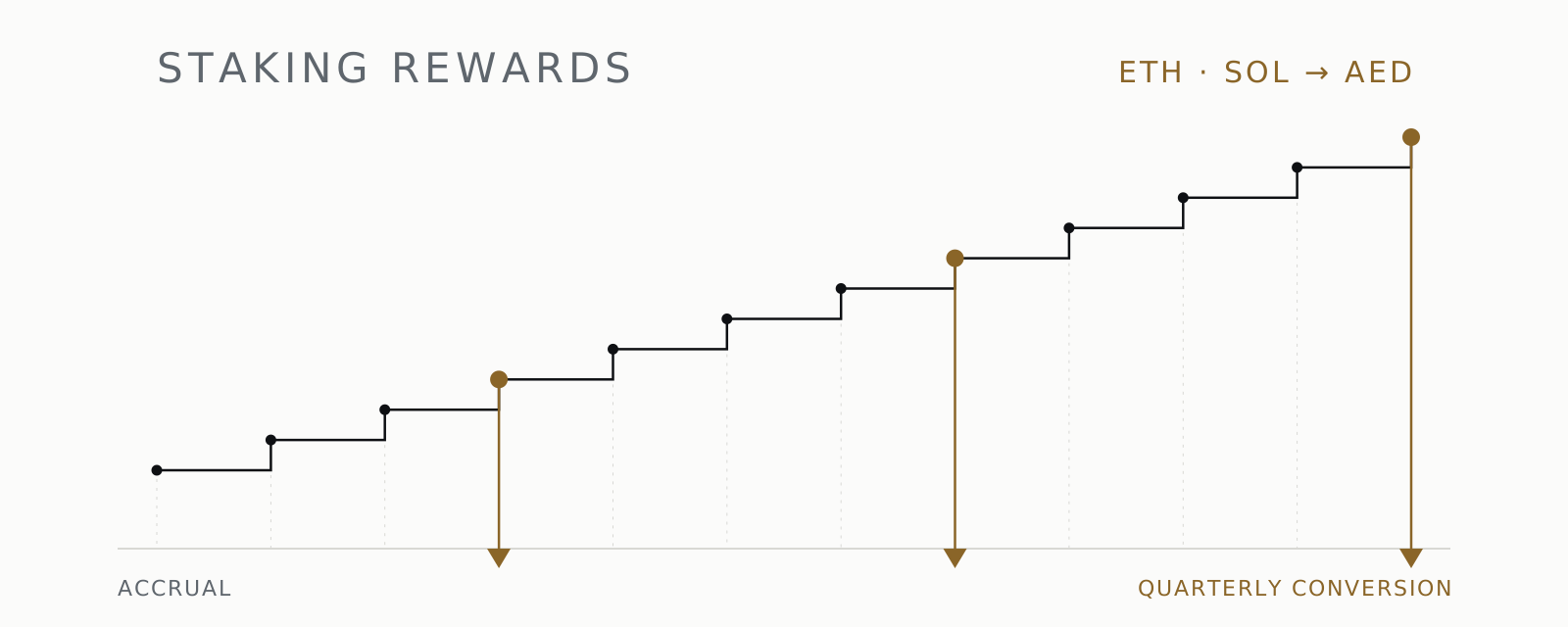
Converting rewards in fixed monthly or quarterly batches, once each clears the desk's minimum, spreads the sale across the token's price swings instead of betting the whole backlog on one day's rate. A standing schedule turns this into a routine: agreed dates, agreed pricing terms, and a trade confirmation filed against the reward record for that period.
A schedule does not remove market risk — a falling token still falls — but it removes the temptation to guess the top or bottom of a single conversion, and it produces a steadier, more explainable pattern of AED credits for your bank to review.
How does a licensed OTC desk convert staking rewards into AED?
Converting staking rewards into AED through a licensed desk takes four steps once your reward record is in order — the same sequence as any bank-settled OTC trade.
-
STEP 1
Open the account before your first conversion
Individuals register with a passport and proof of address; the full document list is in our guide to documents needed to sell USDT in the UAE. Approval takes one business day in most cases, through the onboarding section of our main page.
-
STEP 2
Total the batch and request a quote
Add up the rewards you are converting for the period, in the token or its USDT equivalent, and request a written quote at the spread published in our pricing bands — 0.08% to 0.40% by ticket size.
-
STEP 3
Send from the wallet or account that received the rewards
Sending from the same wallet or exchange account the rewards landed in, rather than consolidating through an intermediate address first, keeps the trail matching your reward record.
-
STEP 4
Receive AED or USD in your own-name account
AED settles by UAEFTS the same business day; USD settles by SWIFT in 2 to 5 business days. A licensed desk pays only an account in your own name — IWGT's licence, VARA VL/24/12/002, is checkable in the licence section of our main page.
What is the tax position on staking rewards in the UAE?
The UAE has no personal income tax, so an individual does not owe UAE tax on staking rewards or on converting them to AED, as of September 2026. A UAE company that stakes as part of its treasury may count reward income toward taxable profit under Federal Corporate Tax, charged at 9% above AED 375,000 a year and 0% below it.
This is UAE context only, not a statement about your own tax position. Many tax authorities outside the UAE expect staking income reported, sometimes once on receipt and again on a later sale — exactly why the four-field record above matters regardless of where you file. Ask an accountant who knows your tax residency before relying on any assumption here.
The bottom line on converting staking rewards to AED
Converting staking rewards to AED is an ordinary OTC sale once the paperwork catches up with the reward flow: a dated record for each payout, clarity on the custody type, and — for most delegators — a schedule instead of one irregular conversion. Request a quote once a batch clears the desk minimum.
FAQ
Do I need to convert staking rewards as soon as they land, or can I let them accumulate?
Neither is required. Most delegators let rewards build until a batch clears a licensed desk's typical minimum, around 100,000 USDT equivalent, recording each reward's date, amount and price as it accrues.
Does the UAE tax staking rewards?
No. The UAE has no personal income tax, so an individual does not owe UAE tax on staking rewards or on converting them to AED. A UAE company may count reward income toward Federal Corporate Tax; your own country of tax residence may have separate rules this guide cannot advise on.
Is converting a liquid staking token different from converting a native staking reward?
The conversion itself is the same OTC sale. The difference is upstream: a liquid staking token's reward shows up as the token's exchange rate moving, so a desk's screening also checks the issuing protocol and any wrap or redemption transactions.
What records does IWGT ask for when I sell staking rewards?
A dated log of each reward — amount, token and value at the time — plus wallet or exchange history showing the rewards accrued there. Individuals also provide a passport and proof of address as part of standard onboarding.
Can I set up a recurring sale specifically for staking rewards?
Yes. A standing schedule works the same way for staking rewards as for any other recurring crypto income: agreed dates, pricing terms within the desk's published spread, and a trade confirmation filed per period.
Convert staking rewards with a paper trail your bank expects
IWGT is a VARA-licensed Broker-Dealer in Dubai (licence VL/24/12/002). Every payout settles to an account in your own name, at a published spread of 0.08–0.40% by size, with a trade confirmation you can file against your reward log. AED by UAEFTS the same business day once your account is approved.
SOURCES
- VARA public register, accessed 20 September 2026.
- VARA — Virtual Assets and Related Activities Regulations and Rulebooks, accessed 20 September 2026.
- UAE Ministry of Finance — Corporate Tax FAQ, accessed 20 September 2026.
- FATF Recommendations (incl. R.16, the travel rule), accessed 20 September 2026.
- IWGT published pricing bands — this site, September 2026.
This guide is informational and is not legal, tax or investment advice, nor an invitation to buy or sell any virtual asset. It does not recommend staking or estimate staking returns. Rules and figures are as of September 2026 — re-check the sources before acting. Virtual assets may lose their value in full or in part and are subject to extreme volatility.