
Selling NFT Sale Proceeds (ETH or USDT) Through a UAE OTC Desk
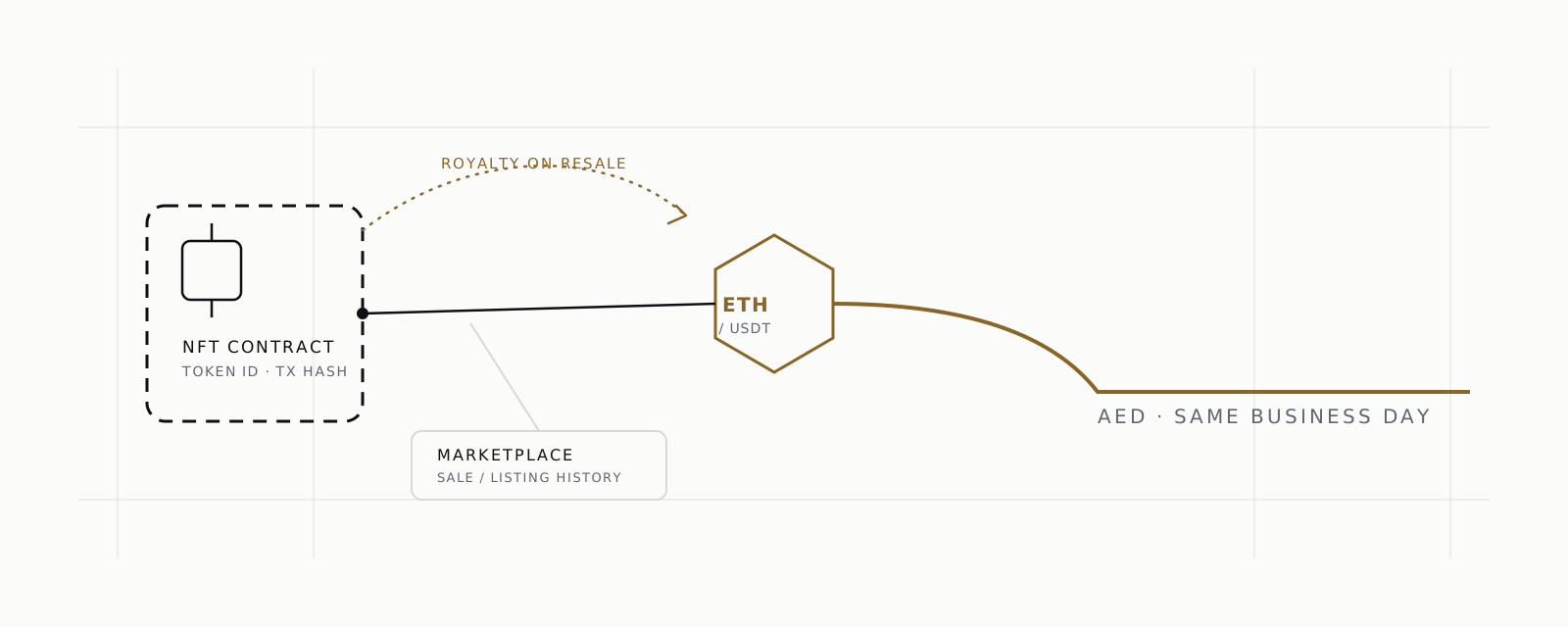
Selling NFT sale proceeds in the UAE means cashing out the ETH or USDT a marketplace paid you — not the NFT itself. A VARA-licensed desk checks the sale's transaction hash and contract address, and for royalties the smart contract's payout mechanism, then settles AED the same business day.
KEY FACTS
| Regulator | VARA (Dubai, outside the DIFC) |
|---|---|
| Accepted proceeds | ETH or USDT only — not the NFT itself |
| Primary on-chain evidence | NFT contract address and the sale's transaction hash |
| Royalty standard (where used) | EIP-2981 royaltyInfo(), payment voluntary |
| EDD trigger | From around 100,000 USDT equivalent |
| IWGT spread | 0.08%–0.40%, by ticket size |
| AED settlement | Same business day (UAEFTS) |
Source: EIP-2981 (Ethereum Foundation), IWGT published pricing bands, as of September 2026.
What counts as NFT sale proceeds for a UAE OTC desk?
NFT sale proceeds are the ETH, USDT or other liquid asset a marketplace or buyer paid you after a non-fungible token sold, including a secondary-sale royalty on a collection you created. A licensed Dubai desk treats this as a distinct case from an ordinary crypto sale, because the money's origin is a specific, dated on-chain event rather than a trading balance built up over time.
The starting document is the same one behind any USDT sale in the UAE — proof of identity, and a source-of-funds file for the proceeds. What differs for an NFT sale is what fills that file: a transaction record and, where royalties are involved, an explanation of why they arrived without a separate sale on your part.
What on-chain evidence proves an NFT sale actually happened?
The transaction hash and the NFT's contract address are the two pieces of on-chain evidence that prove a sale happened. Every Ethereum transaction is recorded with a cryptographic hash, a sender, a recipient and, for a contract interaction, the function called — and once a block is finalised, that record is public and effectively immutable, per Ethereum's own developer documentation (accessed September 2026).
For an NFT specifically, the contract address plus the token ID identify the exact item under the ERC-721 standard, where "the combination of a contract address and a token ID must be globally unique," as ethereum.org's ERC-721 reference puts it (accessed September 2026). A block explorer link showing the sale transaction, the buyer and seller addresses and the ETH or USDT amount is usually enough on its own.
What does the marketplace's own sales history add?
A marketplace's account history adds a human-readable confirmation of a sale that the raw blockchain record does not spell out — the listing price, the collection name and the date, matched to your logged-in account. Where a marketplace offers an official activity export or order history page, attaching it alongside the transaction hash closes the gap between "a wallet received ETH" and "you sold this specific NFT."
Not every marketplace keeps this available indefinitely, and platforms open and close. Where no statement exists, the on-chain record described above stands on its own, because the contract address and transaction hash do not depend on any single platform staying online.
Why do royalties arrive automatically on secondary sales?
Royalties on secondary NFT sales arrive automatically when the collection's smart contract implements a royalty standard such as EIP-2981, which lets a contract report a royaltyInfo(tokenId, salePrice) value giving the payment recipient and amount for any resale. The standard states plainly that "the percentage value used must be independent of the sale price," so the same rate applies whether the resale is small or large — see the EIP-2981 specification (Final status, accessed September 2026).
EIP-2981 only standardises how the rate is reported; it does not force anyone to pay it. The specification itself calls royalty payment "voluntary," since a contract cannot always tell a sale from an ordinary transfer. Some marketplaces layer their own enforcement on top — OpenSea's own documentation, for instance, describes a contract-level mechanism for ERC-721C and ERC-1155C collections that a creator must actively opt into, separate from EIP-2981 (OpenSea creator fee enforcement docs, accessed September 2026). Either way, the royalty payment itself is still a transfer of ETH or USDT you can trace on-chain, which is what a UAE desk actually checks.
Why does the desk take the ETH or USDT, not the NFT itself?
A UAE OTC desk accepts ETH, USDT and other liquid assets because they trade continuously against a visible market price, and it does not accept the NFT directly because a single NFT has no such price. IWGT's published spread — 0.08% to 0.40% depending on ticket size — is quoted against an asset the desk can hedge and value at the moment of the trade; an NFT's last sale price tells you what one buyer paid once, not what the next buyer will.
This is why the sequence always runs sale first, cash-out second: you sell the NFT on the marketplace for ETH or USDT, then bring that liquid balance — with its transaction history — to the desk. Our onboarding page sets out the account steps that apply before any conversion, regardless of what generated the coins.
How is this different from token-sale proceeds?
NFT sale proceeds differ from token-sale proceeds in what document sits behind the money: a token sale usually rests on an investment agreement such as a SAFT, with vesting and lock-up terms that a reviewer reconciles over months or years. An NFT sale is a single, discrete on-chain event — there is no underlying contract to trace beyond the sale itself, so the file is generally simpler once the transaction and contract address are in hand.
When does an NFT sale trigger enhanced due diligence?
Enhanced due diligence on NFT sale proceeds typically applies from around 100,000 USDT equivalent, the same threshold used across other large crypto conversions, and more readily on a pattern of many resales or high-value single sales in a short period. The document list does not change in kind — contract address, transaction hash and, where relevant, marketplace history — but a reviewer will expect it complete rather than partial at this size.
A broader source-of-funds file for crypto covers the general standard a UAE bank or desk applies; NFT proceeds simply substitute the transaction record described above for the exchange statements a standard file would otherwise carry. Reporting obligations under frameworks such as the OECD's Crypto-Asset Reporting Framework, covered in our CARF reporting guide, sit on top of this and do not change what evidence you assemble for the sale itself.
How do you prepare the file before you cash out?
Preparing an NFT sale proceeds file before you approach a desk takes four steps, and each one maps to a piece of evidence covered above.
-
STEP 1
Collect the transaction hash and contract address
Pull the sale transaction from a block explorer and note the NFT contract address and token ID it involved.
-
STEP 2
Export the marketplace history if it still exists
Save the listing and sale confirmation from the marketplace's own account or activity page while it is still accessible.
-
STEP 3
Note the royalty mechanism, if any applies
If the proceeds include a secondary-sale royalty, keep the contract address and, if published, the rate the collection sets.
-
STEP 4
Bring the ETH or USDT balance to the desk
Request a quote for the liquid balance under our published pricing bands, and settle to an account in your own name.
FAQ
Can I sell the NFT itself through IWGT?
No. A licensed desk deals in liquid, independently priceable assets — ETH, USDT and similar. An NFT has no continuous market price, so you sell it on the marketplace first and bring the ETH or USDT it generated to the desk.
What if the marketplace I sold on has since shut down?
The blockchain record survives even if the marketplace does not. The transaction hash, the NFT contract address and the wallet-to-wallet transfer remain publicly verifiable on-chain, and that is usually sufficient without a marketplace statement.
Do royalties from resales count as NFT sale proceeds?
Yes. Royalty payments triggered by a secondary sale of a collection you created are proceeds from that collection, and the file should show the same on-chain sale record plus, where relevant, the smart contract's royalty logic.
Is every NFT marketplace royalty automatic and enforced?
No. EIP-2981 only standardises how a contract reports the royalty rate; payment itself is voluntary and depends on whether the marketplace processing the sale chooses to honour it.
How is this different from cashing out token-sale proceeds?
Token-sale proceeds come from a contractual allocation such as a SAFT, with vesting and an investor agreement behind them. NFT sale proceeds come from a discrete on-chain sale or resale with no underlying investment contract to reconcile.
Turn NFT sale proceeds into AED the same business day
IWGT is a VARA-licensed Broker-Dealer in Dubai. Bring the ETH or USDT from your NFT sale, keep the transaction hash and contract address on hand, and settle to your own account at a published spread of 0.08–0.40%.
SOURCES
- EIP-2981: NFT Royalty Standard, Ethereum Improvement Proposals, accessed 22 September 2026.
- ERC-721: Non-Fungible Token Standard, ethereum.org, accessed 22 September 2026.
- Transactions, ethereum.org developer documentation, accessed 22 September 2026.
- Creator Fee Enforcement, OpenSea developer documentation, accessed 22 September 2026.
- IWGT published pricing bands and onboarding requirements — IWGT published pricing bands, September 2026.
This guide is informational and is not legal, tax or investment advice, nor an invitation to buy or sell any virtual asset. Rules and figures are as of September 2026 — re-check the sources before acting. Virtual assets may lose their value in full or in part and are subject to extreme volatility.