
Selling USDT in the UAE and receiving INR, PKR, PHP, EUR, GBP or another currency: how the second leg works
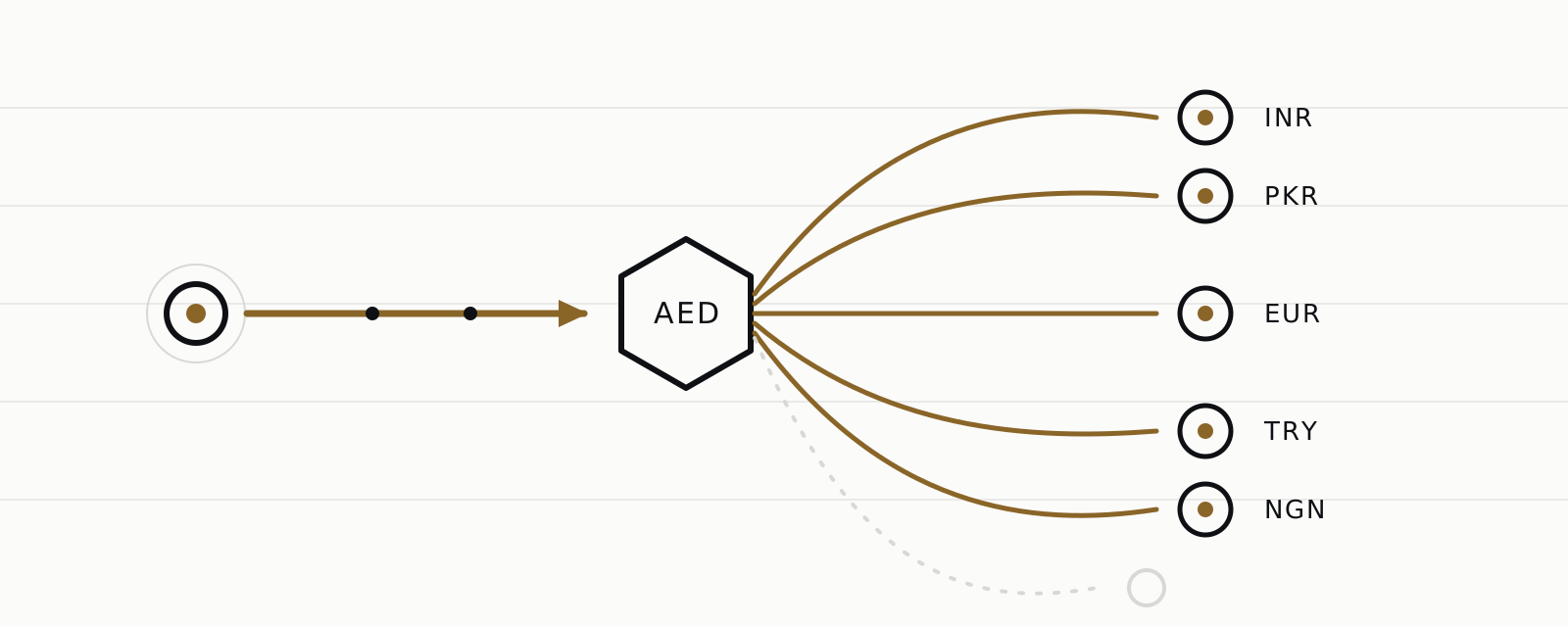
A licensed Dubai desk does not pay rupees, pesos, euros or pounds. It buys your USDT and pays AED the same business day, or USD by SWIFT in 2 to 5 business days, to an account in your own name. The conversion into the currency you need is a separate transaction at your bank or a licensed remittance provider.
KEY FACTS
| What the desk pays | AED by UAEFTS the same business day, or USD by SWIFT in 2 to 5 business days |
|---|---|
| Where the conversion happens | At your bank or a licensed remittance provider, after the desk has paid |
| Payout account | Your own name only; no third parties, no relatives, no suppliers |
| Desk spread (you sell USDT) | 0.40% from 100,000, 0.25% from 500,000, 0.15% from 2,000,000, 0.08% from 10,000,000 USDT |
| Second-leg cost | Set by the provider: transfer fee plus FX margin, not published by the desk |
| Not available | RUB to Russian banks, in any currency, as of September 2026 |
Source: pricing table and settlement terms on the main page (/#pricing); central-bank and regulator sources per corridor, listed below, as of September 2026.
Which currencies can you end up with, and by which route?
Every route in the table starts the same way: a USDT sale at a VARA-licensed desk, settled to your own account, the trade described in our guide to selling USDT in Dubai through a licensed desk. What differs is the second leg: which payout currency to take from the desk, which rail carries it onward, and what the receiving country's rules say about the money once it arrives.
| Currency | Typical route | Second-leg rail | Indicative timing after the desk pays | Notable constraint | Source |
|---|---|---|---|---|---|
| INR (India) | AED, then remittance to an Indian bank account | UAE bank or CBUAE-licensed exchange house | Same day on instant-credit services, otherwise 1 to 3 working days | Forex only through RBI-authorised persons under FEMA; Indian tax residents pay 30% on virtual digital asset gains plus 1% TDS | RBI; Income Tax Department of India |
| PKR (Pakistan) | AED, then remittance to a Pakistani bank account | Licensed exchange house or bank | Same day to about 2 business days | Hundi and hawala are illegal in Pakistan; Pakistani IBANs are 24 characters starting PK | State Bank of Pakistan; SWIFT IBAN registry |
| PHP (Philippines) | AED, then remittance; or USD wire to your own Philippine bank account | Remittance provider, or SWIFT with conversion at the receiving bank | Same day to 1 day on a remittance rail; 3 to 6 business days on the USD wire | BSP publishes the USD/PHP reference rate; Philippine banks run AML checks on large inbound wires | Bangko Sentral ng Pilipinas |
| EUR (euro area) | USD wire to your own euro account; the bank converts | SWIFT into the euro area; SEPA for onward transfers inside the zone | 2 to 5 business days; most gpi payments credit within 24 hours | SEPA covers 41 countries; European banks work Monday to Friday, the desk deals Sunday to Thursday | ECB; European Payments Council; SWIFT |
| GBP (United Kingdom) | USD wire to your own UK account; the bank converts | SWIFT, addressed by BIC and GB IBAN | 2 to 5 business days | UK banks screen inbound international payments and can ask for source of funds before crediting | SWIFT |
| RUB (Russia) | Not available through licensed UAE desks | None | Not applicable | Largest Russian banks sanctioned and disconnected from SWIFT since 2022; FATF suspended Russia's membership in February 2023 | Council of the EU; OFAC; FATF |
| TRY (Turkey) | AED, then remittance to a Turkish bank account | Bank or licensed exchange house; FAST instant payments inside Turkey | Same day to about 2 business days | The Capital Markets Board regulates crypto platforms under Law No. 7518; a fiat remittance sits outside that regime; Turkish IBANs are 26 characters | SPK; CBRT |
| EGP (Egypt) | AED, then remittance to an Egyptian bank account | Bank or licensed exchange house | 1 to 3 business days | Law No. 194 of 2020 restricts crypto activity to CBE-licensed entities and none are licensed; the CBE publishes the daily rates banks price from | Central Bank of Egypt |
| BDT (Bangladesh) | AED, then remittance to a bank or mobile financial service account | Bank, licensed exchange house or registered MFS | Same day to about 2 business days; Bangladesh's weekend is Friday and Saturday | Bangladesh Bank warns that crypto dealing is not permitted; hundi is illegal; average UAE remittance cost 2.92% in April to June 2026 | Bangladesh Bank |
| NPR (Nepal) | AED, then remittance to a Nepali bank or wallet | Bank or licensed money transfer operator | 1 to 2 business days after the AED credit | Nepal Rastra Bank declares crypto, including stablecoins, illegal inside Nepal; NPR is fixed at 160 per INR 100 | Nepal Rastra Bank |
| NGN (Nigeria) | AED, then remittance to a Nigerian bank account | Bank or licensed money transfer operator | 1 to 3 business days after the onward transfer | Beneficiary identified by Bank Verification Number; CBN guidelines govern bank accounts for SEC-licensed VASPs; the naira rate moves between quotes | Central Bank of Nigeria; SEC Nigeria |
The desk leg is identical in every row. Only the second leg changes, and that leg is priced and timed by the bank or provider you choose, not by the desk.
What the desk pays, and what it never pays
IWGT settles in two currencies. AED goes out over UAEFTS, the Central Bank of the UAE's domestic transfer system, and credits the same business day once your account is approved; our UAEFTS explainer covers the cut-offs. USD goes out by SWIFT and takes 2 to 5 business days, with correspondent banks in the chain, as set out in our guide to sending a SWIFT transfer from the UAE.
Both go only to an account in the name on your desk account, a person's or a company's. The desk does not pay a relative, a supplier or a P2P counterparty, and it holds no third currency. A desk offering rupees or naira "through a partner" is describing a flow outside the licensed perimeter; check it on the VARA public register first.
The spread is the whole desk fee, published in the pricing bands: 0.40% from 100,000 USDT, 0.25% from 500,000, 0.15% from 2,000,000 and 0.08% from 10,000,000, as of September 2026. On 500,000 USDT at 0.25%, the spread is 1,250 USDT, about AED 4,591 at the 3.6725 peg, and AED 1,831,659 reaches your account. The payout currency does not change that arithmetic.
Where the conversion into the target currency actually happens
The conversion happens after the desk has paid, at whichever institution you instruct next. With AED in a UAE account, that is a UAE bank or a CBUAE-licensed exchange house, which sells you rupees, pesos, lira or naira against dirhams and delivers them to the beneficiary account abroad. With USD in an account abroad, that is the receiving bank, which converts the dollars at its own buying rate on the day they land.
Two prices therefore apply, set by two different parties. The desk spread is fixed in writing before you send USDT. The provider's fee and FX margin are not, and on most of these corridors they are the larger of the two numbers. A "zero fee" transfer paired with a wide margin routinely delivers less than a modest fee with a tight rate, so compare providers on the amount actually delivered against the day's reference rate, using the central bank's published rate and the World Bank's Remittance Prices Worldwide tool as benchmarks.
The dirham leg is fixed the moment you accept the quote, because the AED is pegged at 3.6725 to the dollar. The second leg is not: INR, PHP, TRY, EGP, BDT and NGN all float, and the provider's rate is locked only when that transfer executes.
Documents the banks ask for on each leg
The desk verifies you once, before the first quote: passport or Emirates ID, proof of address issued within 90 days, and for a company the trade licence and ownership documents. Larger tickets add the evidence described in our guide to documenting the source of crypto funds. The full list sits in the onboarding section, and approval takes about one business day, which is why the account should be open before the day you need the money.
The second leg asks for the recipient's account details, a stated purpose of payment, and often the sender's relationship to the recipient or an invoice reference. A large inbound credit can trigger a source-of-funds question at the receiving bank, whatever the country. The desk's trade confirmation and the UAE bank statement showing the AED or USD credit answer it in one reply.
Name consistency carries the whole file. The desk pays the name on your account, the remittance provider expects the sender on its record to match it, and the beneficiary's name must match the receiving bank's record. A mismatch at any link is the usual reason a transfer is held. Splitting one transfer into several to stay under a review threshold reads as structuring, so send once, with the documents ready.
Corridor notes where the rules differ
The mechanics above hold on every corridor. The points below are the places where a national rule changes what the second leg looks like, with the primary source for each.
India: FEMA and the tax on virtual digital assets
Foreign-exchange transactions into India run only through persons authorised by the Reserve Bank of India under FEMA; the RBI's 3 February 2022 press release cautions against unauthorised forex platforms for that reason. Tax follows residency: an Indian tax resident pays a flat 30% on gains from virtual digital assets under Section 115BBH, with 1% TDS on transfers under Section 194S, as of September 2026. The sale happening in Dubai does not move that liability, and the UAE levies no personal income tax on its side.
Russia: sanctions close the banking leg
In 2022 the EU disconnected Russia's largest banks from SWIFT and the US and UK placed most of the sector on their sanctions lists; the restrictions remain in force as of September 2026. FATF suspended Russia's membership in February 2023. No licensed banking channel carries a payment from a UAE account into a sanctioned Russian bank, and UAE banks apply enhanced controls to Russia-linked payments generally. IWGT does not execute the Russia corridor in any currency and does not structure payments to route around sanctions; this is a statement of availability, not advice on alternatives.
Nigeria: BVN, VASP bank accounts and a moving rate
The Central Bank of Nigeria's Guidelines on Operations of Bank Accounts for Virtual Assets Service Providers set out how Nigerian banks may operate accounts for SEC-licensed VASPs under ordinary AML and KYC duties, and SEC Nigeria's Accelerated Regulatory Incubation Program framework of June 2024 supervises providers working toward registration. Neither reaches an inbound fiat remittance, which is what the second leg is. The receiving bank identifies the beneficiary by Bank Verification Number, and the AED to NGN rate reflects Nigeria's official FX market on the day, so ask for a live rate.
Egypt: crypto restricted at home, ordinary FX on the remittance
Egypt's Central Bank and Banking Sector Law No. 194 of 2020 restricts issuing, promoting and trading cryptocurrency to entities licensed by the Central Bank of Egypt, and the CBE has licensed none, as of September 2026. The route stays on the right side of that line because the USDT sale is completed in the UAE and only AED converted to pounds enters Egypt. The CBE publishes the daily rates that banks and exchange houses price from, and the AED to EGP rate can move materially between quotes.
Turkey: the Capital Markets Board regulates platforms, not this remittance
Turkey's Capital Markets Board (SPK) has supervised crypto-asset service providers since Law No. 7518 amended the Capital Markets Law in 2024, and its provisional list of operating providers states that inclusion is not an authorisation. That regime covers platforms trading inside Turkey. An AED to TRY bank transfer is an ordinary fiat remittance checked under Turkish AML rules, and once inside the Turkish banking system the CBRT's FAST instant payment rail lets participating banks credit lira within minutes.
Bangladesh and Nepal: crypto is off-limits inside the country
Bangladesh Bank's press release of 30 July 2026 warns the public against unauthorised crypto trading platforms, which it says are licensed by no regulator; its survey puts the simple average cost of a remittance from the UAE at 2.92% for April to June 2026, a benchmark a large transfer should beat. Nepal Rastra Bank's notice of 2079/12/20 BS (April 2023) declares cryptocurrency, stablecoins included, illegal under the Foreign Exchange (Regulation) Act, and its daily rate sheet fixes the Indian rupee at NPR 160.00 buying and 160.15 selling per INR 100, so NPR quotes move as INR quotes do. On both corridors the route works only because the crypto leg is completed in Dubai and ordinary converted money crosses the border; do not hold, trade or receive USDT while in either country.
Should you take AED or USD from the desk?
Take AED when the next step is a remittance from the UAE. It arrives the same day, the exchange houses and banks that serve the India, Pakistan, Philippines, Turkey, Egypt, Bangladesh, Nepal and Nigeria corridors price from a dirham balance, and there is one conversion, at a rate you can see before you send. Routing those corridors through a USD wire adds 2 to 5 days and a second conversion at the receiving bank's rate.
Take USD when the money is going to your own account in a country whose banks receive dollar wires as a matter of course, which is the euro area and the United Kingdom. Our guide to selling USDT for USD by SWIFT covers the wire itself; the receiving bank then converts to EUR or GBP at its buying rate, and a clear purpose line helps its compliance team match the credit to your documents. Watch the calendars: the desk deals 24/7, and European and UK banks work Monday to Friday, so a late-Thursday trade can lose two days in transit.
The bottom line on receiving another currency
Selling USDT in the UAE and ending up with rupees, pesos, euros, pounds, lira, taka or naira is one licensed trade followed by one ordinary transfer. The desk's part ends when AED or USD lands in your own account. Everything after that, the rate, the fee, the timing and the receiving bank's questions, belongs to the second leg, and it is the second leg that deserves the comparison shopping. Keep the trade confirmation and the transfer receipt together; between them they answer every question either bank will ask.
FAQ
Can a Dubai OTC desk pay me in rupees, pesos, euros or pounds directly?
No. IWGT settles a USDT sale in AED by UAEFTS the same business day, or in USD by SWIFT in 2 to 5 business days, to a bank account in your own name. Any conversion into INR, PKR, PHP, EUR, GBP or another currency is done afterwards by your bank or a licensed remittance provider.
Should I take AED or USD from the desk if I need another currency?
Take AED when the second leg is a remittance from a UAE bank or exchange house, which is the usual case for INR, PKR, PHP, TRY, EGP, BDT, NPR and NGN. Take USD when the receiving account is your own account abroad in a country whose banks accept a USD wire, which is the usual case for EUR and GBP.
How long does it take from USDT to money in the other currency?
The AED leg settles the same business day once your desk account is approved. A remittance from the UAE then lands the same day to about three business days later, depending on the provider and the receiving bank. A USD wire by SWIFT takes 2 to 5 business days, and the receiving bank converts on arrival. Account approval, about one business day, is the step to plan for.
Can the desk send the money to a family member or a supplier abroad?
No. A licensed desk pays only an account that carries the same name as the desk account, whether that is a person or a company. Paying a third party is done by you, from your own account, as an ordinary remittance with a stated purpose.
Can I sell USDT and receive Russian rubles?
Not through a licensed UAE desk, as of September 2026. The largest Russian banks are under EU, US and UK sanctions and were disconnected from SWIFT in 2022, FATF suspended Russia's membership in February 2023, and IWGT does not execute the Russia corridor in any currency.
Where is the real cost hiding on these corridors?
In the FX margin of the second leg, not in the desk spread. The desk spread is published: 0.40%, 0.25%, 0.15% and 0.08% from 100,000, 500,000, 2,000,000 and 10,000,000 USDT. The remittance provider or bank sets its own fee and rate, so compare the amount actually delivered against the day's reference rate before you send.
Start the corridor with a licensed first leg
IWGT is a VARA-licensed Broker-Dealer in Dubai, licence VL/24/12/002. Sell-side spread 0.40% to 0.08% by ticket size, AED by UAEFTS the same business day or USD by SWIFT, always to your own account: the paper trail the second leg needs.
SOURCES
- VARA public register: licence status check for any Dubai desk, accessed 24 September 2026.
- Central Bank of the UAE: payment systems (UAEFTS): the domestic AED settlement rail, accessed 24 September 2026.
- Reserve Bank of India: caution against unauthorised forex trading platforms, press release of 3 February 2022: forex transactions only with authorised persons under FEMA, accessed 24 September 2026.
- Income Tax Department of India: virtual digital asset provisions, Sections 115BBH and 194S of the Income Tax Act, accessed 24 September 2026.
- State Bank of Pakistan: home-remittance rules and the position on hundi and hawala, accessed 24 September 2026.
- Bangko Sentral ng Pilipinas: exchange rate statistics (USD/PHP reference), accessed 24 September 2026.
- European Central Bank: SEPA and retail payment integration, accessed 24 September 2026.
- European Payments Council: EPC list of SEPA scheme countries, v8.0 (24 December 2025): 41 countries, accessed 24 September 2026.
- Swift: gpi payment times: almost all gpi payments credited within 24 hours, accessed 24 September 2026.
- Swift: IBAN registry: IBAN length by country (PK 24, TR 26, GB 22 characters), accessed 24 September 2026.
- Council of the EU: restrictive measures against Russia over Ukraine: SWIFT disconnection of major Russian banks, accessed 24 September 2026.
- US Treasury OFAC: Russian Harmful Foreign Activities Sanctions, accessed 24 September 2026.
- FATF: statement on the Russian Federation: membership suspended February 2023, accessed 24 September 2026.
- Capital Markets Board of Türkiye (SPK): provisional list of crypto-asset service providers: Law No. 7518; inclusion is not authorisation, accessed 24 September 2026.
- Central Bank of the Republic of Türkiye: payment systems: the FAST instant payment system, accessed 24 September 2026.
- Central Bank of Egypt: Central Bank and Banking Sector Law No. 194 of 2020 and daily exchange rates, accessed 24 September 2026.
- Bangladesh Bank: press release of 30 July 2026 on unauthorised crypto trading and MLM platforms (PDF, Bangla), accessed 24 September 2026.
- Bangladesh Bank, Statistics Department: country-wise simple average cost of wage earners' remittances: UAE 2.92% overall, April to June 2026, accessed 24 September 2026.
- Nepal Rastra Bank, Foreign Exchange Management Department: notice of 2079/12/20 BS: cryptocurrency, stablecoins, NFT and DeFi transactions declared illegal under the Foreign Exchange (Regulation) Act, accessed 24 September 2026.
- Nepal Rastra Bank: daily exchange rates: Indian rupee fixed at NPR 160.00/160.15 per INR 100, accessed 24 September 2026.
- Central Bank of Nigeria: Guidelines on Operations of Bank Accounts for Virtual Assets Service Providers (PDF), accessed 24 September 2026.
- SEC Nigeria: Framework on the Accelerated Regulatory Incubation Program for the Onboarding of VASPs (June 2024, PDF), accessed 24 September 2026.
- World Bank: Remittance Prices Worldwide: corridor cost benchmarking tool, accessed 24 September 2026.
- IWGT spread bands by direction and settlement terms: pricing table on the main page (/#pricing), September 2026.
This guide is informational and is not legal, tax or investment advice, nor an invitation to buy or sell any virtual asset. Rules, rates and timings are as of September 2026 and vary by provider and bank; re-check the sources before acting. Virtual assets may lose their value in full or in part and are subject to extreme volatility.