
USDT on TRC20 vs BEP-20: fees, speed and which desks accept each
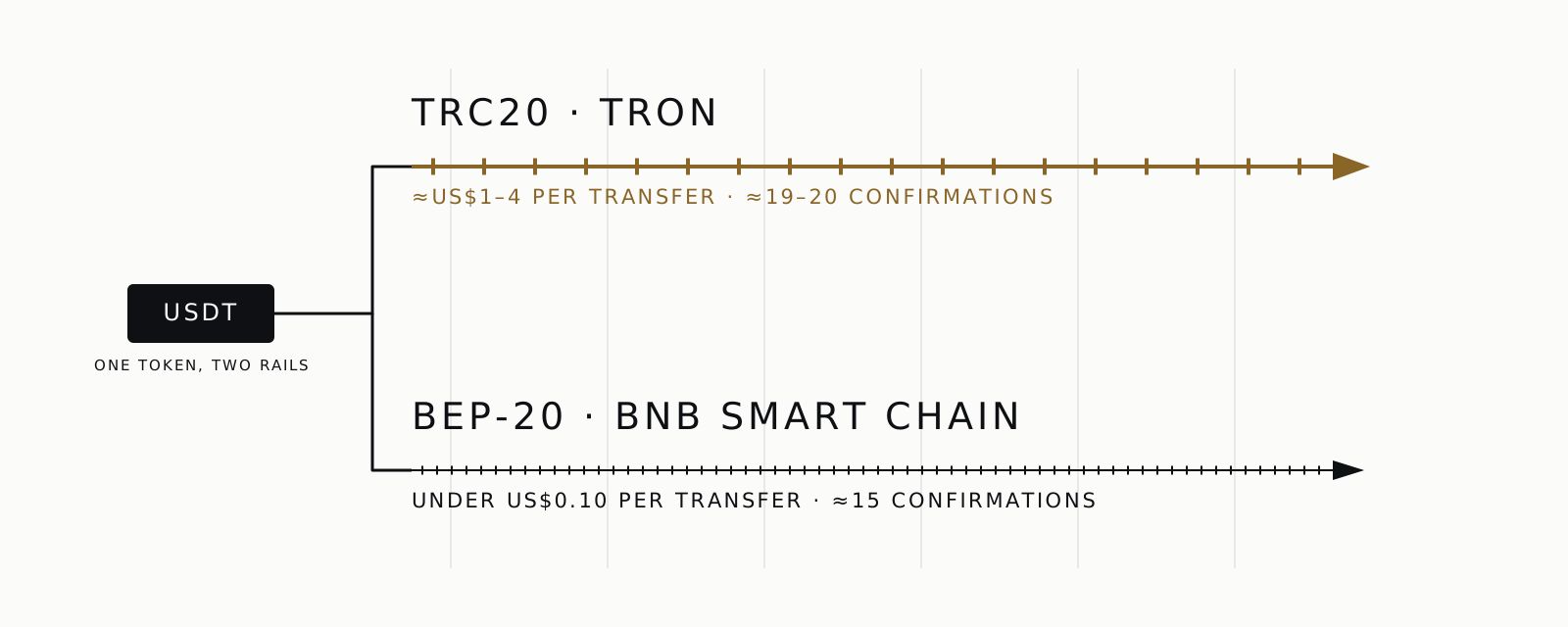
TRC20 (Tron) and BEP-20 (BNB Smart Chain) carry the same Tether-issued USDT on two separate blockchains. TRC20 costs roughly US$2–5 per transfer and is the default at most exchanges; BEP-20 costs a fraction of a cent but shares its address format with Ethereum, so confirming the network before you send matters more than the fee.
KEY FACTS
| The token | The same Tether-issued USDT on both networks |
|---|---|
| TRC20 transfer fee | ≈US$2–5, paid in TRX (about 6.5–13.5 TRX burned at 100 sun per Energy unit), as of 21 September 2026 |
| BEP-20 transfer fee | Around US$0.005 or less at the 0.05 gwei standard gas price (BNB Chain documentation) |
| TRC20 confirmations to credit | ≈19–20 (about 1 minute) |
| BEP-20 confirmations | Venue-specific — the old 15-block rule dates from 3-second blocks; BNB Chain now points integrators to the "finalized" tag (≈0.65 s) — not a published IWGT threshold |
| At IWGT | TRC20 and ERC20 accepted as standard; confirm BEP-20 with your dealer |
Source: Tron, BNB Chain and Tether public documentation, and IWGT published terms, as of September 2026.
What are TRC20 and BEP-20?
TRC20 is the token standard of the Tron blockchain, and BEP-20 is the token standard of BNB Smart Chain. Tether issues USDT on both, and one USDT holds the same dollar value on either — what differs is the rail: its fee, its speed, and which wallets and exchanges default to it.
BNB Smart Chain is EVM-compatible, built on the same software environment as Ethereum, while Tron runs its own separate virtual machine. That single technical difference explains most of what follows: BEP-20 inherits Ethereum's address format and tooling, TRC20 does not.
How much does a USDT transfer cost on TRC20 vs BEP-20?
A TRC20 transfer costs roughly US$2–5 in TRX, as of September 2026: about 65,000 Energy to an address that already holds USDT and about 130,000 to a fresh one, burned at the network's rate of 100 sun per Energy unit (the rate TRON set in August 2025) — 6.5 to 13.5 TRX at a TRX price near US$0.34. A BEP-20 transfer typically costs around US$0.005 or less at BNB Smart Chain's 0.05 gwei standard gas price — a fraction of a cent, well below TRC20's flat fee and ERC20's variable gas cost.
At OTC ticket sizes the gap is noise. On a 250,000 USDT trade, IWGT's published spread of 0.08–0.40% costs between 200 and 1,000 USDT — the network fee, on either chain, is a rounding error next to it.
TRC20 vs BEP-20: the comparison
The table below sets out what actually changes when you pick a network: cost, speed, the confirmations a desk waits for, who defaults to it, and what goes wrong if you send to the wrong one.
| Attribute | TRC20 (Tron) | BEP-20 (BNB Smart Chain) |
|---|---|---|
| Network fee | ≈US$2–5, paid in TRX | ≈US$0.005 or less at 0.05 gwei |
| Block time / confirmation speed | ≈3-second blocks; solidified and credited in about 1 minute | ≈0.45-second blocks since the Maxwell and Fermi upgrades; deterministic finality in about 0.65 seconds |
| Confirmations before OTC crediting | ≈19–20 at IWGT and most regional desks | Venue-specific — the old 15-block rule dates from 3-second blocks; BNB Chain now recommends the "finalized" tag. IWGT has no published threshold — ask first |
| Default wallets and exchanges | Binance, most CEXs, TronLink, Trust Wallet — the usual default for USDT | Binance (BNB Chain withdrawal option), Trust Wallet, MetaMask with BNB Chain added |
| Wrong-network risk | Addresses start with "T" — a non-Tron address is rejected outright | Uses the same "0x" format as Ethereum — a wrong-chain send can go through and land nowhere you control |
BEP-20 wins on raw fee; TRC20 wins on default acceptance and on being harder to send to the wrong place by accident.
How fast do TRC20 and BEP-20 confirm?
Tron produces a block every three seconds, so a TRC20 transfer is typically solidified and credited within about a minute once a venue's confirmation count is met. BNB Smart Chain is now far faster at the protocol level: after the Maxwell and Fermi upgrades its block interval is about 0.45 seconds, and with Fast Finality a block becomes deterministically final in about 0.65 seconds under normal conditions, as of September 2026. The "15 confirmations" many venues still wait for is a holdover from BSC's old three-second blocks, when 15 blocks meant roughly 45 seconds; BNB Chain now advises exchanges and payment processors to use the finalized block tag instead. IWGT and most regional desks wait for 19–20 confirmations on TRC20 before crediting; no equivalent published threshold exists for BEP-20 at IWGT, because it sits outside the two networks the desk quotes against by default.
Network speed is rarely the bottleneck in a same-day OTC trade — an approved account and a written quote decide the timeline far more than either chain's block time.
Which wallets and exchanges default to each network?
TRC20 is the default USDT withdrawal option on most major exchanges, including Binance, and the network most self-custody wallets in the region already hold funds on. BEP-20 shows up as a second option on Binance-linked platforms and in wallets built around BNB Chain — rarely the pre-selected default, which is one reason TRC20 order flow dominates at desks across the UAE.
What happens if you send USDT to the wrong network?
Sending BEP-20 USDT to a TRC20 address fails immediately — Tron addresses start with "T" and the chain rejects the wrong format. The costlier mistake runs the other way: BEP-20 and ERC20 share the "0x" address format, so a BEP-20 transfer sent to an Ethereum-only address can post successfully and land where nobody who expected it can retrieve it.
- Match the network named in your written quote exactly — never guess from the address format alone.
- A 0x address does not tell you which EVM chain it belongs to; the platform's network selector does.
- Send a small test amount to any address you have not settled to before.
- Recovery after a wrong-network send is never guaranteed — it depends entirely on whether anyone controls the receiving address on that chain.
Which network does IWGT accept?
IWGT accepts USDT on TRC20 and ERC20 as standard networks for settlement. BEP-20 is not a published default, so if your USDT sits on BNB Smart Chain, confirm with your dealer during onboarding whether that trade can be quoted and settled on it before you move anything.
The network never changes your price or your payout: once USDT is credited, AED goes out by UAEFTS the same business day and USD by SWIFT in two to five business days, regardless of which network carried the tokens.
The bottom line on TRC20 vs BEP-20
Use TRC20 for USDT settlement in the UAE unless a specific reason points elsewhere — it is the network IWGT and most regional desks quote against by default, and its address format makes a stray transfer to the wrong chain far less likely. BEP-20 costs less in raw fees but demands more care, because its address format overlaps with Ethereum's. Our main FAQ covers onboarding and settlement basics before you request a quote.
FAQ
Does IWGT accept USDT on BEP-20?
IWGT accepts TRC20 and ERC20 as standard. BEP-20 is not a published default, so confirm it with your dealer before sending — an unconfirmed network is the error a written quote exists to prevent.
Which network is cheaper, TRC20 or BEP-20?
BEP-20 is cheaper in raw fee terms, often a fraction of a cent, against roughly US$2–5 on TRC20. At OTC ticket sizes the difference is immaterial next to the desk's spread.
How many confirmations does a BEP-20 transfer need before a desk credits it?
It depends on the venue's deposit policy. BNB Smart Chain now finalises a block in about 0.65 seconds on 0.45-second block intervals, and the common 15-confirmation rule is a holdover from its three-second-block era; BNB Chain recommends the finalized tag instead. IWGT publishes no BEP-20 threshold; ask your dealer for the current policy.
What happens if I send BEP-20 USDT to a TRC20 address?
It fails outright, since the two formats differ and the transaction cannot post. The harder mistake is sending BEP-20 to an ERC20 address — both use the same 0x format, and the send can go through on the wrong chain.
Which network do most exchanges use by default for USDT withdrawals?
TRC20 is the default USDT withdrawal network on most major exchanges, thanks to its low, stable fee. BEP-20 appears mainly where Binance-linked liquidity is deep, and the exchange always states the network next to the address.
Confirm your network, then settle the same day
IWGT is a VARA-licensed Broker-Dealer in Dubai. We quote against TRC20 and ERC20 as standard; spread 0.08–0.40% by size, AED by UAEFTS the same business day once your USDT is credited.
SOURCES
- TRON developer documentation — block production (one block every 3 seconds), accessed 21 September 2026.
- TRON developer documentation — paying for resources (TRX burn rates: 1,000 sun per byte of Bandwidth, 100 sun per unit of Energy), accessed 21 September 2026.
- Tronscan API — USDT (TRC20) transfer record (130,285 Energy to a fresh address; 64,285 to an address already holding USDT in neighbouring transfers), accessed 21 September 2026.
- BscScan — BNB Smart Chain gas tracker (0.05 gwei standard gas price), accessed 21 September 2026.
- Tether — supported protocols, accessed 20 September 2026.
- BNB Chain documentation — BNB Smart Chain overview (block time ≈0.45 s after the Lorentz, Maxwell and Fermi hard forks; typical fees around US$0.005), accessed 21 September 2026.
- BNB Chain blog — What Sub-Second Finality Means for BSC Settlement (20 August 2026: ≈0.65 s finality, origin of the 15-confirmation rule, finalized tag), accessed 21 September 2026.
- IWGT published pricing bands and onboarding requirements — IWGT published pricing bands, September 2026.
This guide is informational and is not legal, tax or investment advice, nor an invitation to buy or sell any virtual asset. Rules and figures are as of September 2026 — re-check the sources before acting. Virtual assets may lose their value in full or in part and are subject to extreme volatility.