
What is an LEI code?
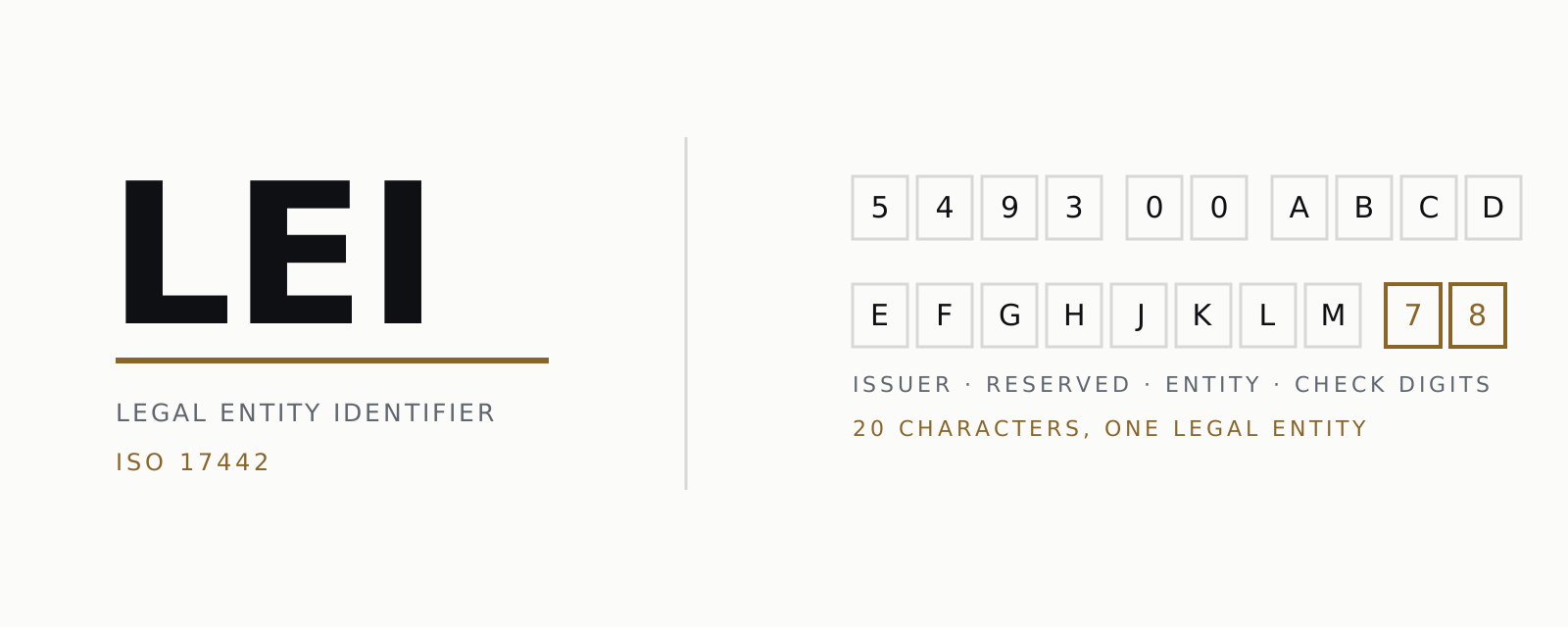
An LEI code — short for Legal Entity Identifier — is a 20-character code that identifies a legal entity in financial transactions worldwide. Issued under the ISO 17442 standard and searchable free of charge in the GLEIF database, it confirms exactly which company sits on the other side of a trade.
KEY FACTS
| Full name | Legal Entity Identifier (LEI) |
|---|---|
| Standard | ISO 17442 |
| Format | 20 alphanumeric characters |
| System operator | GLEIF (Basel, Switzerland) |
| Where to check a code | search.gleif.org, free |
| Issue cost | Set by the issuer (LOU); GLEIF publishes no tariff, the lookup is free |
Source: GLEIF and ISO 17442, as of September 2026.
What an LEI code contains
The 20 characters follow ISO 17442: four characters for the issuer, "00", twelve for the entity and two check digits. Behind the code sits a public record: Level 1 is who is who (legal name, registered address, country, registration number); Level 2 is who owns whom (direct and ultimate parents).
GLEIF runs the system and its free database of more than 3 million active records, as of September 2026; accredited Local Operating Units issue the codes. No UAE law obliges every company to hold one, but banks request it for corporate accounts and OTC desks at onboarding (our corporate onboarding includes it where the entity has one).
Why it matters when selling USDT in the UAE
Large trades settle by wire between named legal entities, including when you sell crypto from a UAE company account, and the name on a website proves nothing. The lookup returns the exact registered name, jurisdiction and status (ISSUED, not LAPSED or RETIRED). It complements the licence check: for a Dubai desk the first test is the VARA public register (ours is in the licence section), and the LEI confirms the entity behind it. The route is in cashing out crypto in Dubai legally.
How to check an LEI
Search the code or legal name at search.gleif.org (no account or fee), match name and address against the trade licence, check the status and keep a dated copy: two minutes for a JLT company selling 500,000 USDT (about AED 1,836,250 at the 3.6725 peg). No LEI proves nothing by itself; the red flag is a code that does not resolve, or resolves to a different entity than the one being paid.
How does a UAE company get an LEI?
Apply to an issuer that GLEIF accredits for the UAE, with the trade licence to hand. As of October 2026, GLEIF lists 12 such issuers, none based in the UAE. Eleven manage codes for UAE entities: Bloomberg, Bundesanzeiger Verlag, EQS, Euronext Dublin, GS1, Japan Exchange Group, KDD, London Stock Exchange, Saudi Credit Bureau (Moa'rif), Ubisecure RapidLEI and WM Datenservice. The twelfth, GMEI Utility, manages none: GLEIF transferred its LEIs to London Stock Exchange in August 2023. Registration agents and GLEIF Validation Agents can also obtain one for you.
| Check | What to have ready |
|---|---|
| Identity | Legal name, licence number and the register that issued it, legal form, registered and head-office address. GLEIF's Registration Authorities List has 67 UAE entries, including DIFC, ADGM, DMCC and JAFZA. |
| Parents | Direct and ultimate accounting consolidating parent, with their LEIs if they hold one, or the reason none is reported. Consolidation counts, not shareholding alone. |
| Authority | Proof that the applicant may act for the company, if someone else applies. |
| Papers | Incorporation or registry documents confirming name and address, where the register is not publicly searchable. |
Issuers' own help pages quote from minutes to about two days; missing details put the request on hold. The code must be renewed every year. GLEIF says issuers set fees on a cost-recovery basis, and some sell multi-year plans or pro-rate early renewal. A code that is not renewed shows as LAPSED in the GLEIF search.
FAQ
Is an LEI mandatory for companies in the UAE?
No UAE rule requires every company to hold an LEI. Certain regulated activities and reporting regimes use the code, and banks and licensed desks often request it during corporate onboarding. Whether your entity needs one depends on what it does.
How do I get an LEI code in the UAE?
Apply to one of the issuers GLEIF accredits for the UAE: as of October 2026, 11 of them manage codes for UAE entities, all based abroad. Give the legal name, trade licence number and issuing register, addresses and parent companies. Issuers quote from minutes to about two days, and the code must be renewed every year.
How much does an LEI cost?
Fees are set by each accredited issuer, not by GLEIF, and are published on the issuer's own price list; the code is renewed every year at a fee the issuer also sets. Looking up a code in the GLEIF database is free — GLEIF describes the LEI as a public good, available free of charge to all users.
Does an LEI prove a company is trustworthy?
No. An LEI proves identity: a legal entity with that name and address exists and maintains its public record. It says nothing about solvency or conduct. For a Dubai virtual-asset desk, check the VARA licence as well.
What is the difference between an LEI and a trade licence number?
A trade licence number is issued by a UAE licensing authority and identifies a company locally. An LEI is a global code under the ISO 17442 standard, recognised across borders and used in financial transactions. A company can hold both; they serve different checks.
Trade with a desk that shows its credentials
IWGT is a VARA-licensed Broker-Dealer in Dubai, licence VL/24/12/002. Spread 0.08–0.40% by ticket size, AED by UAEFTS the same business day, tickets from around 100,000 USDT. We expect to be checked — that is the point of this article.
SOURCES
- GLEIF: LEI search: free public lookup, accessed 10 September 2026.
- GLEIF: introducing the Legal Entity Identifier: system structure and governance; the LEI as a public good, free of charge to all users, accessed 21 September 2026.
- ISO 17442: Financial services, Legal entity identifier, accessed 10 September 2026.
- GLEIF: active LEI population surpasses 3 million in Q1 2026, accessed 14 September 2026.
- GLEIF: Get an LEI, find LEI issuing organizations: accredited issuers (LOUs) supply registration, verification and renewal; any issuer accredited for the jurisdiction may be used; registration agents and Validation Agents, accessed 12 October 2026.
- GLEIF API: LEI issuers, accredited jurisdictions and LEI records: 12 issuers accredited for the UAE, 11 managing LEIs of UAE entities, issuers' registered countries, accessed 12 October 2026.
- GLEIF: Registration Authorities List, v1.9 of 30 September 2026: 67 UAE entries, accessed 12 October 2026.
- GLEIF: Level 2 data, who owns whom: direct and ultimate accounting consolidating parents, accessed 12 October 2026.
- GLEIF: The Legal Entity Identifier, questions and answers (PDF): LEIs renewed annually, fees set on cost-recovery principles, multi-year and pro-rated renewal, accessed 12 October 2026.
- Ubisecure RapidLEI: LEI registration: data requested, authority to apply for another entity, stated issue time, accessed 12 October 2026.
- GS1 LEI.direct: FAQ: stated turnaround of 36 to 48 hours, parent-company documents, accessed 12 October 2026.
- London Stock Exchange: Legal Entity Identifier: incomplete requests put on hold, registry documents where a register is not public, lapse without yearly re-verification, GMEI/DTCC LEIs transferred by GLEIF on 9 August 2023, accessed 12 October 2026.
This guide is informational and is not legal, tax or investment advice, nor an invitation to buy or sell any virtual asset. Rules and figures are as of October 2026. Re-check the sources before acting. Virtual assets may lose their value in full or in part and are subject to extreme volatility.