
What is multisig?
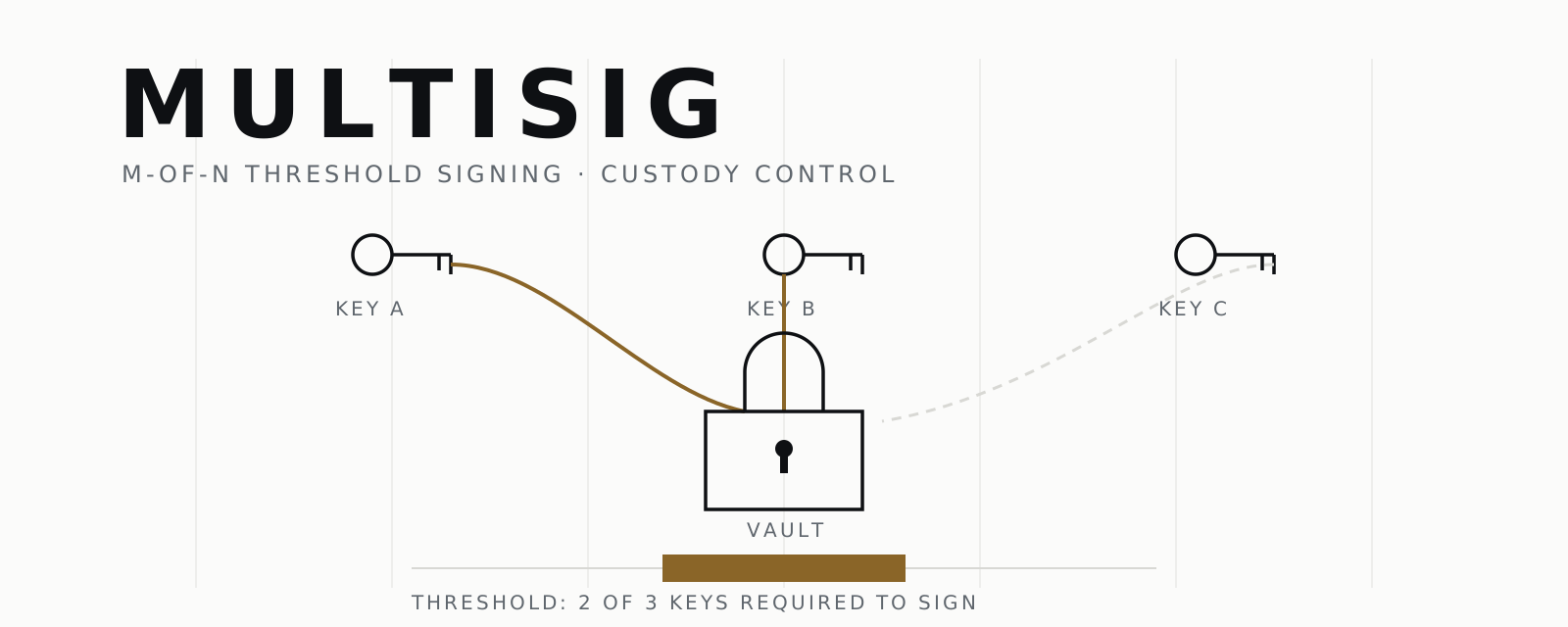
Multisig (multi-signature) is a wallet or account structure that requires signatures from a set number of independent private keys — for example 2 of 3 — before it will authorise a transaction. No single compromised key can move funds alone. Licensed custodians and desks use multisig, alongside segregation, to protect client USDT before settlement.
KEY FACTS
| Full name | Multi-signature (multisig) wallet or account |
|---|---|
| Core mechanism | M-of-N signature threshold — e.g. 2-of-3, 3-of-5 |
| Distinct from | Single-signature (one key) and MPC (split key shares) |
| Typical use | Custodian and OTC desk segregation of client funds pre-settlement |
| Client option | A self-custody wallet can be set up as multisig too |
Source: Bitcoin.org Developer Guide; NIST Threshold Cryptography project, as of September 2026.
How multisig differs from a single private key
A single private key lets whoever holds it move funds without a second check. A multisig wallet spreads control across several complete keys, written as M-of-N: N keys exist and at least M must sign together. 2-of-3 and 3-of-5 are the common custodian setups, with keys split across active signers and an offline backup. A higher threshold means one lost device or one stolen key cannot move funds alone, at the cost of slower transactions because more people in more places must sign.
Multisig versus MPC
MPC (multi-party computation) also splits control, but never assembles one full key: the key exists only as shares held by separate parties who jointly compute a signature. Multisig relies on several separate, auditable keys; MPC on a cryptographic protocol and the operational separation of shares. Neither is inherently more secure; both remove the single point of failure of one key.
Why it matters when selling USDT in the UAE
A desk's custody controls decide who can move your USDT before it settles. Ask during onboarding whether client funds sit in a segregated client account, how the desk defines custody of client keys, and whether any single employee can authorise a transfer alone. A firm using multisig or MPC answers with its architecture, not only a policy statement.
Your own wallet can be multisig too: a personal 2-of-3 with keys on two hardware devices plus one backup held elsewhere means no single lost phone or stolen laptop can empty it before you sell.
FAQ
Is multisig the same as a hardware wallet?
No. A hardware wallet stores one private key offline; multisig is a wallet structure that can use one key or several. You can run a single-signature wallet on hardware, or split a multisig wallet's keys across separate hardware devices.
Does multisig make a transaction slower?
It can. A multisig transaction needs signatures from the minimum number of keyholders the threshold sets, so a 3-of-5 wallet takes longer than a single-signature wallet where one person acts alone.
Can one person run a multisig wallet alone?
Yes, for self-custody. One person can hold every key in a personal multisig wallet — for example on two hardware devices plus one backup — which still removes the single point of failure of one device.
Is MPC more secure than multisig?
Neither is inherently more secure; the two carry different risk profiles. Multisig relies on separate, auditable keys; MPC relies on a cryptographic protocol and the operational separation of key shares. Fit depends on the custodian's policy and audit needs.
What happens if a multisig keyholder becomes unavailable?
A threshold below the total key count keeps working: a 2-of-3 wallet still moves funds if one keyholder is unreachable. A wallet requiring all N keys stops working the moment any one keyholder is unavailable.
Ask about custody controls before you send size
IWGT is a VARA-licensed Broker-Dealer in Dubai (VL/24/12/002). Client funds move under segregation and custody controls covered during onboarding, with AED settlement by UAEFTS the same business day.
SOURCES
- Bitcoin.org Developer Guide — Transactions: multisig (m-of-n) and pay-to-script-hash (P2SH), accessed 21 September 2026.
- NIST Computer Security Resource Center — Multi-Party Threshold Cryptography project (threshold schemes, secure multiparty computation), accessed 21 September 2026.
- IWGT licence and regulatory disclosures, September 2026.
This guide is informational and is not legal, tax or investment advice, nor an invitation to buy or sell any virtual asset. Rules and figures are as of September 2026 — re-check the sources before acting. Virtual assets may lose their value in full or in part and are subject to extreme volatility.