
What is an order book?
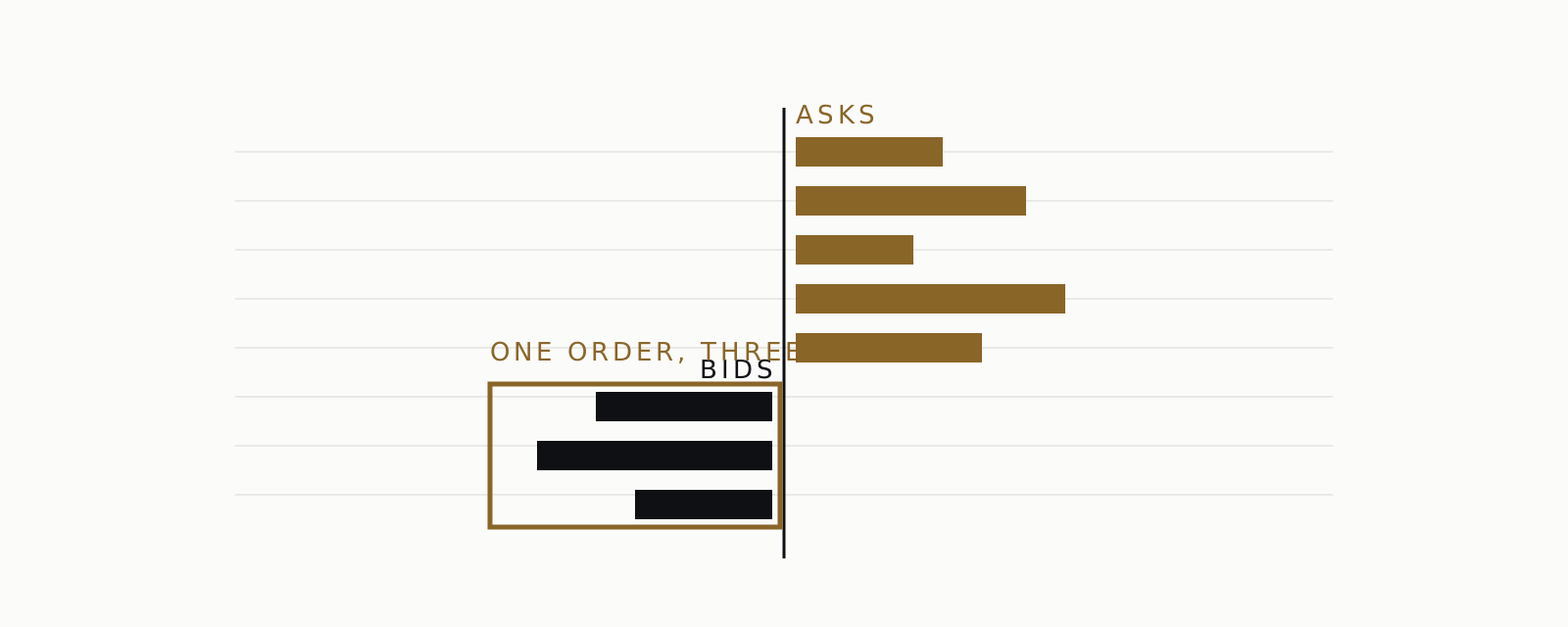
An order book is the live list of all outstanding buy and sell orders for an asset on an exchange, sorted by price. The buy side is the bids, the sell side is the asks, and the volume resting at each price level is the depth.
KEY FACTS
| Definition | The live, price-sorted list of outstanding buy and sell orders on an exchange |
|---|---|
| Best bid / best ask | Highest standing buy price / lowest standing sell price |
| Depth | Volume resting at each level — decides how far a large order walks |
| Worked example below | AED 2,275 price impact on a 1,000,000 USDT market sale (illustrative) |
| IWGT spread | 0.08%–0.40% by ticket size, as of September 2026 |
Source: IWGT published pricing bands; the worked example is illustrative, as of September 2026.
How an order book works
The exchange's matching engine pairs each new order with the best opposing order resting in the book. A market sell takes the highest bid first; when it is bigger than that level, the remainder moves down to the next, which is the mechanism behind partial fills and slippage on large orders. The best bid and best ask are the two ends of this queue at one instant, and their average is the mid price a quote is measured against.
Depth is the volume resting at each price level. A deep book absorbs a large order close to the top price; a thin book forces it through level after level. The gap between the price on screen and the average fill is slippage.
Illustrative example
A market sale of 1,000,000 USDT into AED on an exchange meets bids of 300,000 at 3.6700, 350,000 at 3.6680 and 350,000 at 3.6655, for an average of 3.66773 and AED 3,667,725 received. Had the whole ticket cleared at the best bid, the seller would receive AED 3,670,000: AED 2,275 (about 0.06%) is given up to depth, before any exchange fee.
Why it matters when selling USDT in the UAE
Size is what a public book absorbs worst. A desk prices the whole ticket at once and holds the number in writing for a defined window; the 0.08% to 0.40% bands in IWGT's published spread pricing are the entire cost, with no walk down a book behind them. Compare total cost, not headline rate. Desks in Dubai typically start around 100,000 USDT; below that an exchange is usually the cheaper route, and the bigger the ticket, the more a firm written quote is worth.
FAQ
What is the difference between bids and asks?
Bids are standing buy orders, asks are standing sell orders. The highest bid and the lowest ask sit at the top of the book, and the gap between them is the spread.
Why does a large order move the price?
A large market order consumes every level of the book until it is filled. Each level it eats is priced worse than the last, so the average fill sits below the price shown on screen.
Can I see the order book before I sell USDT?
Yes — exchanges publish the book in real time. The catch is that it changes in milliseconds: the depth you checked a minute ago is not the depth your order will meet.
Do OTC desks have an order book?
Not on your side of the trade. A desk prices your full ticket from its own inventory and hedging cost and quotes one firm number, so no public book stands between you and the fill.
One price for the whole ticket
IWGT is a VARA-licensed Broker-Dealer in Dubai. All-in spread 0.08–0.40% by size, quoted in writing and held for a defined window — no order book on your side, no partial fills. AED by UAEFTS the same business day once your account is approved.
SOURCES
- Central Bank of the UAE — payment systems (UAEFTS), accessed 11 September 2026.
- IWGT published pricing bands and onboarding requirements, September 2026.
This guide is informational and is not legal, tax or investment advice, nor an invitation to buy or sell any virtual asset. Rules and figures are as of September 2026 — re-check the sources before acting. Virtual assets may lose their value in full or in part and are subject to extreme volatility.