
What is a spread?
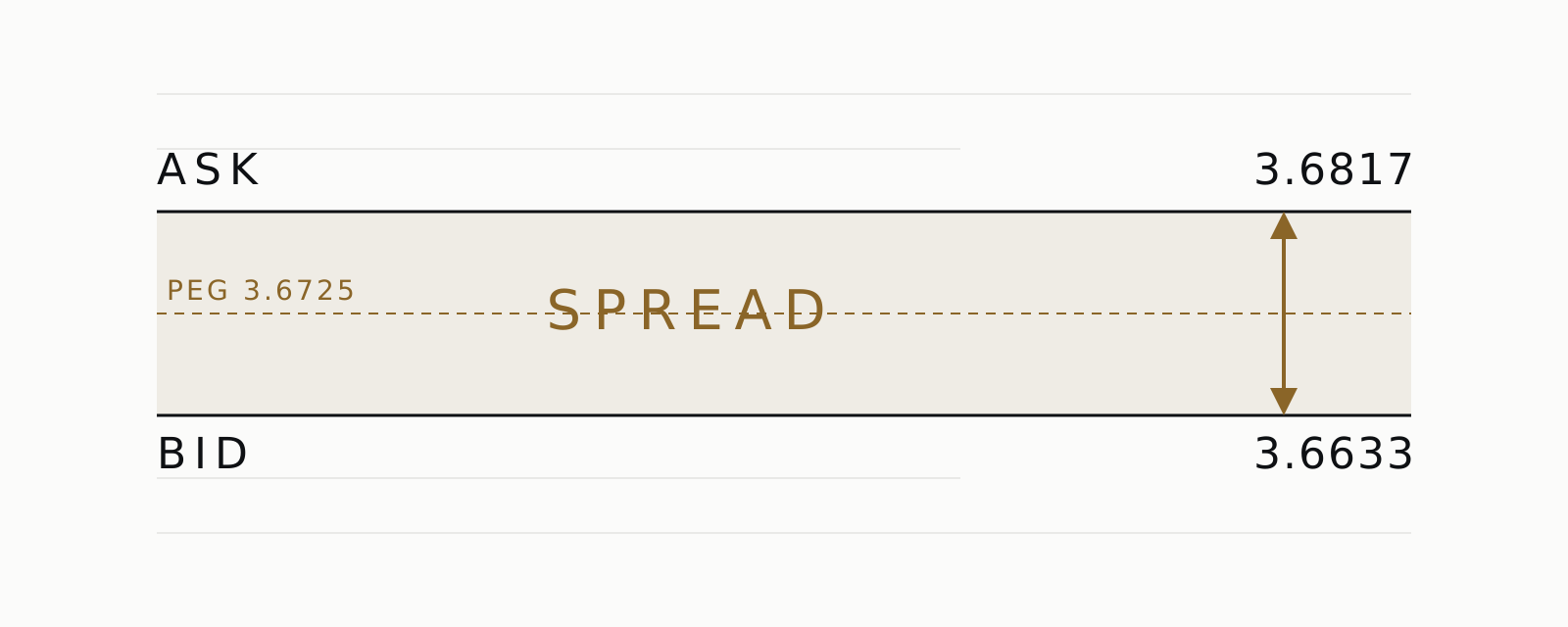
A spread is the difference between the price you can buy an asset at (the ask) and the price you can sell it at (the bid). At an OTC desk the spread is all-in: one written price that already includes the desk's fee, so the number you accept is the number you receive.
KEY FACTS
| Definition | Spread = ask price − bid price |
|---|---|
| AED peg | 3.6725 per US dollar, held since 1997 |
| IWGT spread | 0.08%–0.40% all-in, by ticket size |
| Desk flow starts | From around 100,000 USDT |
| AED settlement | Same business day (UAEFTS) |
Source: IWGT published pricing bands and the Central Bank of the UAE, as of September 2026.
How does a spread work in the UAE?
The bid is what a buyer will pay, the ask is what a seller will accept, and the spread is the gap. For USDT against the dirham the quote is anchored by the peg: the Central Bank of the UAE has held the dirham at 3.6725 per US dollar since 1997 and USDT tracks the dollar, so a Dubai quote is the peg minus a spread. Why the rate barely moves is in the USDT to AED rate guide.
Why is an OTC spread quoted all-in?
On an exchange the visible price is only the start: taker fee, slippage on a large order and withdrawal fee stack on top. A desk quotes one price for your exact size and holds it in writing for a defined window, with no separate fee and no partial fill. The all-in quote tells you final money in the bank per USDT sent.
Why it matters when selling USDT in the UAE
The peg removes currency risk and the network fee is small, so the spread is close to the entire cost: compare desks on dirhams received for your size. A quote better than the peg is a warning sign: the margin then sits where you cannot see it. Check the licence number in VARA's public register (IWGT's is in the licence section).
Illustrative example
A ticket of 1,000,000 USDT is worth AED 3,672,500 at the peg. At the 0.08% end of the published band (larger tickets) the spread costs AED 2,938, you receive AED 3,669,562; at the 0.40% end (smaller tickets) it costs AED 14,690, you receive AED 3,657,810. The AED 11,752 gap is ticket size at work, as of September 2026.
FAQ
Is a spread the same as a fee?
Not exactly. A fee is a separate charge added on top of the price; a spread is built into the price itself. At an OTC desk the all-in spread replaces the fee: you see one number, and that number is what you pay.
What spread should I expect at a licensed OTC desk in Dubai?
Bands vary by desk and by ticket size. IWGT publishes an all-in spread of 0.08% to 0.40%, with the tighter end for larger tickets, as of September 2026. Below roughly 100,000 USDT, a regulated exchange is usually the cheaper route.
Can the spread change after I accept a quote?
No. A written OTC quote is held for a defined window, and the all-in price in it is fixed for that window. If the window expires you ask for a fresh quote; the old one is simply no longer valid.
Why is the USDT/AED rate almost always near 3.67?
The dirham has been pegged to the US dollar at 3.6725 since 1997, and USDT is designed to track the dollar. So USDT/AED sits near the peg, and the only real variable in a Dubai quote is the spread.
Get an all-in quote on your size
IWGT is a VARA-licensed Broker-Dealer in Dubai. All-in spread 0.08–0.40% by ticket size, published openly. AED by UAEFTS the same business day once your account is approved.
SOURCES
- Central Bank of the UAE — payment systems (UAEFTS), accessed 10 September 2026.
- VARA public register — licence status check, accessed 10 September 2026.
- IWGT published pricing bands, September 2026.
This guide is informational and is not legal, tax or investment advice, nor an invitation to buy or sell any virtual asset. Rules and figures are as of September 2026 — re-check the sources before acting. Virtual assets may lose their value in full or in part and are subject to extreme volatility.