
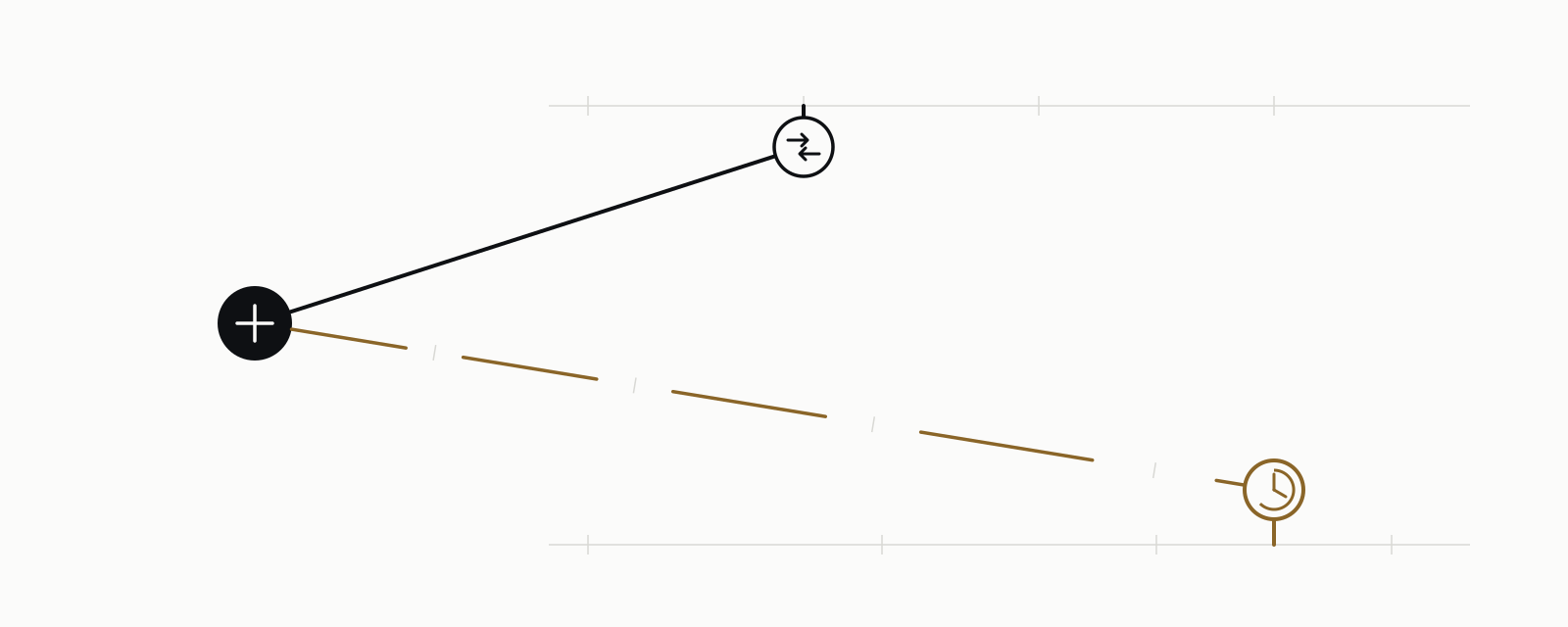
How an OTC desk hedges a client ticket: quote, hedge leg, settlement risk
Between quoting a client and receiving their coins, the market can move. A desk removes that risk with a hedge leg, an offsetting trade at a liquidity provider, so its own book stays flat. Settlement risk, the gap between the crypto leg and the fiat leg, is managed separately through timing and segregated funds.
KEY FACTS
| Quote window | Held live, typically seconds to a few minutes, then repriced |
|---|---|
| Spread by ticket size | 0.40% (100k) down to 0.08% (10M USDT) |
| AED settlement | Same business day via UAEFTS |
| USD settlement | 2–5 business days via SWIFT |
| Client money | Segregated under VARA Client Money Rules (Part IV) |
| Dealing hours | 24/7 |
Source: IWGT dealing practice; VARA Compliance and Risk Management Rulebook; CBUAE payment systems, as of September 2026.
What happens in the window between a quote and a client's acceptance?
A quote window is the short period — usually seconds to a few minutes — during which an OTC desk's price is held firm, as covered in our guide to why OTC quotes have a validity window. Inside that window the desk is committed to a fixed price while the market keeps moving.
For USDT against AED the exposure is narrow, since both sides sit close to a fixed peg: the dirham at 3.6725 to the dollar, and USDT intended to track the dollar one for one. For BTC or ETH the same window can move the price materially, which is why the mechanics below matter more.
What is a hedge leg, and how does it remove the desk's market risk?
A hedge leg is the offsetting trade an OTC desk places at a liquidity provider or exchange the moment it prices a client's ticket, so its net position returns to flat regardless of which way the market moves before settlement. If a client sells the desk 500,000 USDT, the desk goes long that USDT the instant it quotes; the hedge leg closes an equivalent notional at the same moment, so it carries no directional bet while the client's coins confirm on-chain.
In practice a hedge leg takes one of three shapes: a spot sale on an exchange order book, an OTC swap agreed directly with a market maker at its own quoted price, or a swap into another dollar instrument that is easier to move to fiat immediately. Whichever channel it uses, the exposure it closes on a USDT ticket is USDT trading away from its one-dollar peg, not a view on the dirham, fixed to the dollar at 3.6725 since 1997.
A worked example: hedging a 500,000 USDT ticket at a 0.25% spread
A 500,000 USDT ticket sits in the desk's second pricing tier, where the published spread is 0.25% — the bands run 0.40% at 100,000, 0.25% at 500,000, 0.15% at 2,000,000 and 0.08% at 10,000,000, on our pricing section. At the 3.6725 peg, 500,000 USDT is worth AED 1,836,250 before the spread; the 0.25% spread is AED 4,590.63, so the client's net proceeds are AED 1,831,659.37.
The moment the desk issues that quote, it books an offsetting hedge leg for the same notional, so its position nets to flat whether USDT trades a fraction above or below one dollar before the transfer confirms. Once the USDT lands on-chain — about a minute on TRC20, at 19–20 confirmations — the desk closes the hedge leg and pays AED the same business day through UAEFTS. The 0.25% spread pays for that hedge leg, the compliance review and the wire; it is not a bet on where USDT or the dirham will move.
What is settlement risk, and why is it sometimes called Herstatt risk?
Settlement risk is the exposure that remains after market risk is hedged: the gap in time between a desk receiving one leg of a trade and paying out the other. On a USDT-for-AED ticket, the desk receives the crypto leg — USDT, confirmed on-chain in minutes — before it pays the fiat leg, AED same business day by UAEFTS or USD in 2–5 business days by SWIFT. For that gap the desk carries the client's counterparty exposure, not a market position.
The term traces to Bankhaus Herstatt, a Cologne bank whose licence was withdrawn on 26 June 1974, after the German payment system had closed for the day but before its New York correspondent had paid out the dollar legs. Counterparties that had already paid deutschmarks that morning were left unpaid on the dollars owed on the other side of the same trades, as the Bank for International Settlements later documented. The lesson generalised: whenever one leg of a trade settles before the other, whoever paid first is exposed to the other side failing or delaying, regardless of the market.
It matters to a client because a desk that manages settlement risk with segregated funds and same-day rails does not need to price in a cushion for the odd failed counterparty — part of why a VARA-licensed desk can hold a tighter spread than one outside the regulated perimeter.
Who bears each risk on an OTC ticket: the client, the desk, or nobody?
Three different risks sit inside a single OTC ticket, and the table below sorts each one by where it lives in the trade and who carries it once the desk has hedged its own book.
| Risk | When it exists | Who bears it | How it is managed |
|---|---|---|---|
| Market risk (quote window) | Between the quote and the client's acceptance | Desk, until hedged | Hedge leg placed the moment the quote is issued |
| Market risk (in transit) | Between acceptance and the coins confirming on-chain | Nobody — hedge leg already flat | Hedge leg held open until the client's leg confirms |
| Settlement risk (Herstatt) | Between the crypto leg confirming and the fiat leg paying out | Desk, as counterparty exposure | Segregated client funds; same-day AED rails |
| Counterparty insolvency | At any point the desk holds client funds | Client, only if funds are not segregated | VARA Client Money Rules (Part IV) require segregation |
| Operational error | Wrong network or an expired, unread quote | Client, in most cases | Written quote naming the network, address and expiry |
Once the hedge leg is in place, the only risk left on the table is settlement risk — and that is a counterparty question, not a market one.
Why can a hedged desk quote a narrower spread than an unhedged one?
A hedged OTC desk can quote a narrower spread than an unhedged one because its price no longer needs a cushion for the market moving against it before settlement. An unhedged dealer pricing at 0.25% but leaving the position open is betting the market will not move enough, in either direction, to erase that margin — a bet that occasionally fails badly.
IWGT's published bands get narrower as size grows because the fixed costs of compliance review and the hedge leg are spread over a larger notional, as explained in our guide to why OTC desks set a minimum ticket. The spread pays for hedging and settlement infrastructure, not a forecast of where the market is headed.
The bottom line on how an OTC desk hedges a client ticket
An OTC desk manages two separate risks on every ticket. Market risk, between a quote and the coins confirming, is closed within moments by a hedge leg. Settlement risk, between the crypto leg confirming and the fiat leg paying out, is managed by timing and segregated funds, not by pricing.
FAQ
What is a hedge leg in OTC trading?
A hedge leg is the offsetting trade an OTC desk places at a liquidity provider or exchange the moment it prices a client's ticket, so its position returns to flat and the desk is not betting on the market before settlement.
Does a desk need to hedge a USDT-for-AED ticket the same way as a BTC ticket?
Less aggressively, but yes. USDT and the dirham both sit close to fixed pegs, so the residual price risk is small; a desk still hedges USDT trading away from one dollar, a risk BTC and ETH tickets face on a far larger scale.
What is settlement risk, and why is it sometimes called Herstatt risk?
Settlement risk is the exposure between receiving one leg of a trade and paying out the other. The term traces to Bankhaus Herstatt, whose 1974 collapse left counterparties unpaid on the other side of trades they had already settled.
Why does a client care whether the desk hedges its tickets?
A hedged desk prices once and does not need to widen its spread to cover a market move it might lose on, part of why IWGT can quote 0.08% to 0.40% instead of a wider, defensive margin.
Can a hedge leg fail?
A hedge leg can fail to fill in full if a liquidity provider's price moves before the trade confirms. Desks manage this by dealing with more than one counterparty and keeping ticket sizes within what the market can absorb.
What happens to the desk's hedge if the client's coins never arrive?
The hedge leg is already flat, so the desk unwinds it at the current price and the client's quote lapses. No money changes hands until fresh coins are confirmed and a new quote is accepted.
Trade with a desk that hedges before it settles
IWGT is a VARA-licensed Broker-Dealer in Dubai. Every ticket is hedged the moment it is quoted, client funds are held in segregated accounts, and AED settles the same business day through UAEFTS.
SOURCES
- VARA Compliance and Risk Management Rulebook — Part IV, Client Money Rules, accessed 16 September 2026.
- Central Bank of the UAE — payment systems (UAEFTS), accessed 16 September 2026.
- Tron developer documentation — block times and confirmation depth, accessed 16 September 2026.
- Bank for International Settlements, CPMI Papers No. 17 — Settlement risk in foreign exchange transactions (March 1996), section 2.2.1 on the failure of Bankhaus Herstatt, 26 June 1974, accessed 21 September 2026.
This guide is informational and is not legal, tax or investment advice, nor an invitation to buy or sell any virtual asset. Rules and figures are as of September 2026 — re-check the sources before acting. Virtual assets may lose their value in full or in part and are subject to extreme volatility.