
OTC settlement failures: what goes wrong between quote and bank credit, and who bears the risk
An OTC settlement fails at one of four points: the crypto leg (wrong network, wrong address, too few confirmations), timing (quote expiry, bank cut-off, weekend), the fiat leg (name mismatch, IBAN error, compliance hold) or the counterparty. Most cost a business day, not money; a wrong-network send and an unlicensed desk are the two that cost money.
KEY FACTS
| Failure points | Four: crypto leg, timing, fiat leg, counterparty |
|---|---|
| Requote | Coins confirmed after expiry are repriced at market — no penalty |
| Confirmation threshold | TRC20 19–20 (about 1 minute); ERC20 12 (about 3 minutes) |
| Same-day AED window | Monday–Thursday, before the bank's UAEFTS cut-off |
| USD by SWIFT | 2–5 business days; correspondent fees possible |
| Payout rule | Own-name account only; a name mismatch is refused at the desk |
Source: IWGT dealing practice; Tron and Ethereum documentation; CBUAE payment systems, as of September 2026.
Where does an OTC settlement actually fail?
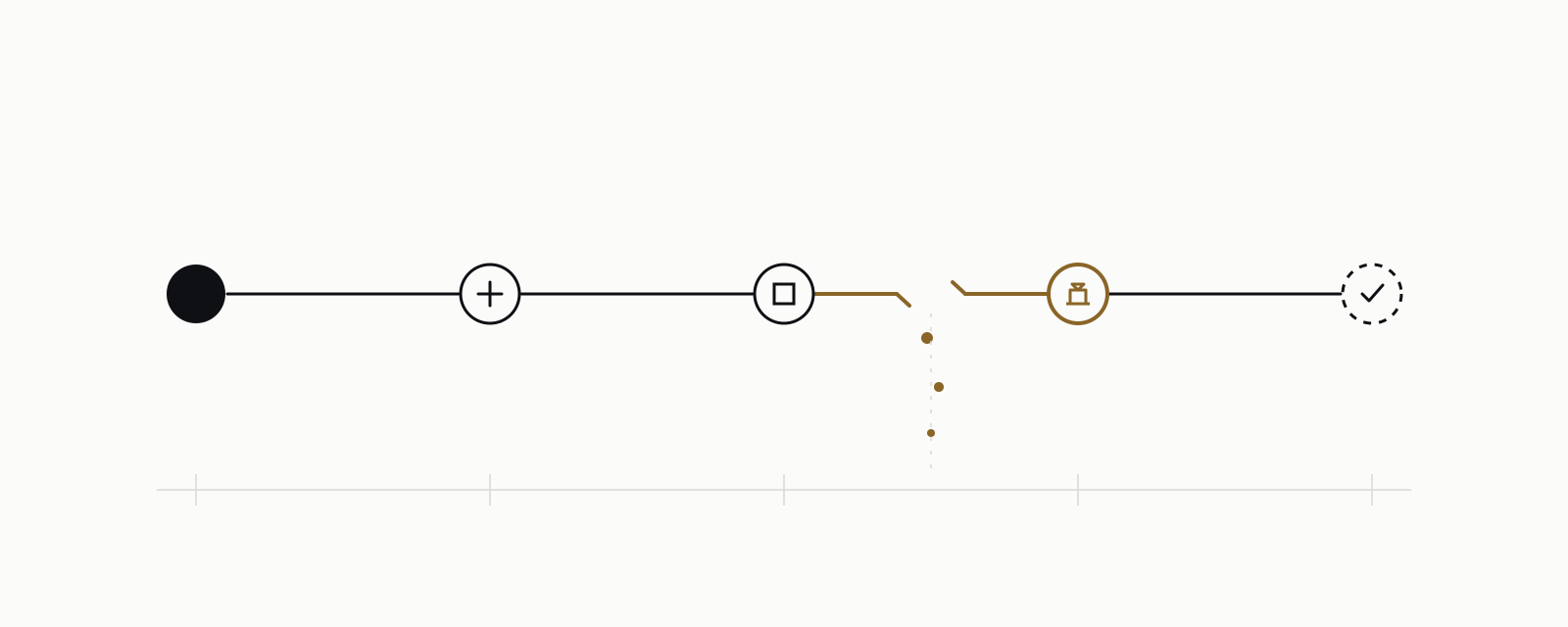
An OTC settlement fails at one of four points between the accepted quote and the bank credit: the crypto leg, the timing of the two legs, the fiat leg, or the counterparty itself. Each has its own cause, its own bearer of cost and its own fix, and the four are far from equally serious.
The normal sequence at a licensed desk is written quote, acceptance, USDT sent to the desk's address, on-chain confirmation, payout instruction, bank credit. Our guide to how a crypto OTC desk works walks the happy path; this one covers each step misfiring. Most failures cost a day rather than money, and the two that cost money are both decided before the trade starts.
What goes wrong on the crypto leg?
The crypto leg of an OTC settlement fails when the USDT does not arrive where the desk expects it, or arrives before the desk can price it. Six patterns cover nearly every case as of September 2026.
- Wrong network. Tron addresses start with "T" and Ethereum addresses with "0x", so most wallets refuse a TRC20-to-ERC20 mix-up outright. The dangerous case is between chains that share the 0x format, such as Ethereum and BNB Smart Chain: the transfer confirms and the coins land on a chain the desk may not hold keys for. Our comparison of USDT on TRC20 versus ERC20 explains why the quote names one network.
- Wrong or retired address. An address copied from an old chat rather than from the written quote can point at a wallet the desk has rotated out. Coins sent there are recoverable only if the desk still controls the keys.
- Coins sent before acceptance. USDT that lands before a quote is accepted has no price attached. A licensed desk holds it in a segregated client wallet and quotes when you are ready; it does not trade without an instruction, so the market move until then is yours.
- Too few confirmations. Fiat is released only after the threshold: 19–20 confirmations on Tron (about one minute, per Tron's developer documentation) and 12 on Ethereum by market convention (about three minutes). This costs minutes, not money.
- Memo or tag omitted. USDT on Tron and Ethereum needs no memo. On networks that use one (TON, XRP, Stellar), or when the receiving address is exchange-hosted, a missing memo drops the coins into the custodian's omnibus wallet and recovery runs through its support queue.
- Exchange withdrawal hold. Exchanges commonly hold withdrawals to a new address after a password or security change — Kraken, for example, documents a 24-hour hold on withdrawals to new addresses after a password change on accounts without sign-in 2FA or a Master Key, as of September 2026 — and a large withdrawal to a new address may need manual approval. The quote clock does not pause with them.
The cost of a wrong-network or wrong-address send sits with the client, because the desk's instruction was the written quote. Recovery, where technically possible, is at the desk's discretion and can carry a fee.
What goes wrong with the timing of the two legs?
Timing failures in an OTC settlement come from three clocks that do not agree: the quote window, the bank's cut-off and the calendar. None of them loses you money on a USDT-for-AED trade; all of them can cost a business day.
Quote expiry before the coins arrive is the most common. The desk reprices at the current market and issues a new written quote at the same published spread — the bands, 0.08% to 0.40% by ticket size, are on our pricing section. For USDT against the dirham the move is usually negligible because of the 3.6725 peg; for BTC or ETH a slow send can cost real money, which is why you send the moment you accept.
Bank cut-offs and the calendar are the second and third clocks. UAEFTS, the Central Bank of the UAE's real-time gross settlement system, runs on bank business days, Monday to Friday, and each bank sets its own afternoon cut-off for outgoing payments. IWGT deals 24/7, but UAEFTS does not: a Sunday trade settles AED on Monday; our guide to UAE dealing hours and the settlement week maps the two calendars.
SWIFT correspondent delays affect USD payouts only. Each intermediary bank on the route adds its own business day and its own compliance check, which is why USD settles in 2 to 5 business days rather than one. SWIFT gpi attaches a unique end-to-end transaction reference (UETR) to every payment, so the desk can tell you where the wire is sitting rather than guessing.
What goes wrong on the fiat leg?
The fiat leg of an OTC settlement fails when the bank cannot, or will not, credit the account you named. Four patterns account for nearly every case, and two of them are caught before the wire leaves a licensed desk.
A beneficiary name mismatch is the first. A VARA-licensed desk settles only to an account in the client's own name, so a payout to a relative, an employer or an unrelated company is refused at the desk, not bounced by the bank. An IBAN error is the second: a UAE IBAN is 23 characters starting "AE" and carries check digits, so most typos fail validation at the sending bank.
A valid but wrong IBAN is the exception, and it is the client's error: recovery depends on the receiving bank and the account holder's cooperation. This is why a licensed desk takes the IBAN from a bank letter or statement at onboarding and pays to that account only.
A compliance hold on the inbound credit is the third pattern, and the one clients notice most. A first six-figure credit referencing a virtual-asset firm can trigger a source-of-funds request at the receiving bank; the money is held, not lost, and the desk's trade confirmation and invoice usually answer the question. Our guide to what UAE bank compliance teams look for lists the documents that close a review quickly.
A returned wire is the fourth. If the receiving bank rejects the credit — account closed, or a compliance refusal — the funds come back to the desk's segregated client account and are re-paid to another own-name account after a fresh check. On an AED wire nothing is lost; on a USD wire the correspondent banks may deduct fees on the way back, and that cost sits with the client.
What if the desk itself is the failure point?
The counterparty risk in an OTC settlement is the desk holding your coins or your money at the moment it stops paying. It is the only failure on this list that can cost the whole ticket, and it is decided before the trade by one question: is the desk licensed, and does it segregate client funds.
VARA's Compliance and Risk Management Rulebook requires a licensed Virtual Asset Service Provider to hold client money apart from its own funds (Part IV, Client Money Rules, checked September 2026). If a licensed desk fails, segregated client money is not part of its estate. At an unlicensed desk there is no such rule, no register entry and no regulator to complain to, so the client bears the loss in full.
Pre-funding demands are the visible symptom. Coins-before-fiat sequencing is normal at any desk, because the payout goes out only after the deposit confirms; a request to send coins before onboarding, before a written quote, or as a "verification deposit" or "rate lock" is not. A licensed desk never asks for that, and ours is listed in the VARA public register linked from the licence section of the main page.
Who bears the cost of each settlement failure?
Who bears the cost of an OTC settlement failure depends on whose instruction was wrong. The table below sorts the failures by leg, names the usual bearer and gives the single prevention that removes each one.
| Failure | Cause | Who bears the cost | Prevention |
|---|---|---|---|
| Wrong network | USDT sent on a chain the quote did not name | Client; recovery at the desk's discretion | Match the network on the written quote |
| Wrong or retired address | Address copied from a chat, not the quote | Client | Send only to the quoted, whitelisted address |
| Coins sent before acceptance | No price attached on arrival | Client (market move until quoted) | Accept first, then send |
| Quote expires before coins land | Slow network or late send | Client (repriced at market); desk (hedge unwind) | Send the moment you accept; use TRC20 |
| Bank cut-off or weekend missed | Trade agreed after cut-off or on a Sunday | Nobody — one business day lost | Trade Monday–Thursday morning |
| SWIFT correspondent delay | Intermediary checks on a USD wire | Client (time; correspondent fees) | Take AED by UAEFTS where possible |
| Beneficiary name mismatch | Account not in the client's name | Nobody — refused before sending | Own-name account verified at onboarding |
| IBAN error | Typo, or a valid IBAN for the wrong account | Client, if the IBAN validates | IBAN from a bank letter, held on file |
| Bank compliance hold | First large crypto-related credit | Client (time) | Trade confirmation and invoice ready |
| Returned wire | Account closed or bank refusal | Desk re-pays; client bears USD return fees | Keep the account open until credited |
| Desk insolvency or disappearance | No segregation; unlicensed desk | Client, up to the full ticket | Licence check; segregated client money |
Every failure the client bears comes from an instruction outside the written quote or the onboarding file; the failures the desk absorbs are the ones inside them.
How do you prevent an OTC settlement failure?
Preventing an OTC settlement failure takes five checks, all of them before the coins move. Together they remove every failure in the table except a bank compliance hold, which they shorten.
-
STEP 1
Verify the desk before the first trade
The licence number resolves in the VARA public register and the desk confirms in writing that client funds are held in segregated accounts. Both checks take minutes and settle the only failure that can cost the whole ticket.
-
STEP 2
Put the IBAN on file at onboarding
Supply an IBAN from a bank letter or statement in your own name, verified once and reused for every trade. The document list is in our onboarding section.
-
STEP 3
Read the network and the address off the written quote
The quote names one network, one deposit address and one expiry. Whitelist that address in your wallet or exchange before the trade day, and send to nothing else.
-
STEP 4
Accept, then send, then watch the confirmations
Send the moment you accept, on TRC20 where the quote allows it, and check that your exchange has no withdrawal hold in place before you request the quote.
-
STEP 5
Time the trade to the bank calendar
Monday to Thursday morning puts the AED wire on UAEFTS the same day. Keep the trade confirmation and invoice to hand in case your bank asks.
The bottom line on OTC settlement failures
OTC settlement failures are mostly delays, not losses: a missed cut-off, a compliance question, a requote. The two that cost money — a wrong-network send and an unlicensed counterparty — are both prevented by reading the written quote and checking the licence before the first trade.
FAQ
What happens if I send USDT on the wrong network?
The transfer confirms on-chain but lands where the desk may not hold keys. Recovery depends on whether the desk controls the same address on that chain; it is at the desk's discretion and can carry a fee. Confirm the network on the written quote before sending.
What if my quote expires before my coins arrive?
The desk reprices at the current market and issues a new written quote; there is no penalty. For USDT against AED the move is usually negligible because of the 3.6725 peg; for BTC or ETH the new price can differ materially.
Can a licensed OTC desk pay a third-party account?
No. A VARA-licensed desk settles only to an account in the client's own name, so a payout to a friend's or a company's account is refused before it leaves. That rule protects you as much as the desk.
What happens if my bank holds the incoming credit?
The money is held, not lost. The bank asks for source-of-funds evidence; the desk's trade confirmation, invoice and your onboarding file usually answer it. Reply the same day and keep the correspondence.
Who bears the loss if an OTC desk goes insolvent?
If client money is held in segregated accounts as VARA's Client Money Rules require, it sits outside the desk's own estate. At an unlicensed desk there is no such rule and no regulator to complain to, so the client bears the loss.
Settle with a desk that writes the quote down
IWGT is a VARA-licensed Broker-Dealer in Dubai. Every quote names the network, the address and the expiry in writing; client funds are held in segregated accounts; payouts go only to your own account. AED by UAEFTS the same business day once your account is approved.
SOURCES
- VARA Compliance and Risk Management Rulebook — Part IV, Client Money Rules, accessed 16 September 2026.
- Central Bank of the UAE — payment systems (UAEFTS), accessed 16 September 2026.
- Tron developer documentation — block times and confirmation depth, accessed 16 September 2026.
- SWIFT gpi — end-to-end payment tracking (UETR), accessed 16 September 2026.
- Kraken Support — adding and confirming a new cryptocurrency withdrawal address (24-hour withdrawal hold after a password change), accessed 21 September 2026.
This guide is informational and is not legal, tax or investment advice, nor an invitation to buy or sell any virtual asset. Rules and figures are as of September 2026 — re-check the sources before acting. Virtual assets may lose their value in full or in part and are subject to extreme volatility.