
Buying USDT in the UAE: OTC desk vs exchange for large tickets
On 22 September 2026 the three venues quoting USDT against the dirham held 10,627,488 USDT on the ask side between them. A 5,000,000 purchase swept through those books at +10.3 bp over the peg, and 10,000,000 at +17.5 bp. The screen price is not the execution price.
KEY FACTS
| Measurement date | 22 September 2026, one snapshot |
|---|---|
| Visible USDT/AED ask depth | 10,627,488 USDT across Binance, Bybit and OKX |
| Cost to buy 5,000,000 USDT | +10.3 bp over the 3.6725 peg, taker fee included |
| Cost to buy 10,000,000 USDT | +17.5 bp over the peg, taker fee included |
| IWGT buy spread | 0.40% to 0.15% by ticket size; above 10,000,000 on request |
| Where an exchange wins | Below about 250,000 USDT |
Source: IWGT order-book measurement of 22 September 2026; desk spread and settlement terms per the pricing table on the main page (/#pricing).
How much USDT is actually for sale against the dirham?
The three exchanges quoting USDT against the UAE dirham — Binance, Bybit and OKX — held 10,627,488 USDT on the ask side between them on 22 September 2026. That is the entire visible offer, counted across every price level of all three books at one moment. It is a snapshot of one afternoon, not a standing capacity, and it is the number that decides what a large order does to an order book.
| Venue | Best ask (AED per USDT) | Visible ask depth (USDT) |
|---|---|---|
| Binance USDT/AED | 3.6710 | 1,383,309 |
| Bybit USDT/AED | 3.6680 | 1,914,272 |
| OKX USDT/AED | 3.6670 | 7,329,907 |
| All three together | — | 10,627,488 |
OKX carried about 69% of the dirham-side offer that day; a buyer using only Binance had 1.38 million USDT to work with.
The method is deliberately dull. We pulled the public order books through each venue's API, walked the ask side upwards from the best price until the ticket was filled, and took the volume-weighted average price of that walk. The 0.10% taker fee sits in its own column, because an exchange charges it on top of the fill rather than inside it.
What does a 5,000,000 USDT purchase cost against the screen price?
A 5,000,000 USDT purchase swept across the three dirham books on 22 September 2026 filled at an average of 3.67259 — that is +0.3 basis points over the 3.6725 peg, or +10.3 bp once the taker fee is added. One basis point is 0.01%, so +10.3 bp on that ticket is roughly AED 18,900, or USD 5,150.
The best asks on screen that afternoon ran from 3.6670 on OKX to 3.6710 on Binance, all of them below the peg. The gap between those numbers and the average fill is the whole point: on a thin pair, the price you can see is the price of the first slice, not of the ticket.
| Ticket (USDT) | Sweep, all three books | Cost (USD) | IWGT buy band | Cost (USD) |
|---|---|---|---|---|
| 2,000,000 | +3.6 bp | 720 | 0.20% | 4,000 |
| 5,000,000 | +10.3 bp | 5,150 | 0.20% | 10,000 |
| 10,000,000 | +17.5 bp | 17,500 | 0.15% | 15,000 |
| 10,600,000 | +21.9 bp | 23,214 | 0.15% | 15,900 |
On that day the sweep was cheaper than the desk band up to around 5 million and more expensive at 10 million. The crossover belongs to that snapshot, not to the market in general.
Two things sit behind the sweep column and neither is free. The figure assumes all three books are hit at the same moment, which means funded accounts at three venues and the dirhams already sitting on each. Working one book alone costs more, because a single ladder has to be walked further to fill the same size.
Is the dollar market any deeper than the dirham market?
The USDT/USD market is deeper than USDT/AED, and it still ends. On Kraken the same measurement on 22 September 2026 found a 0.10 bp spread and 9,290,000 USDT of visible ask depth: 2,000,000 cost +0.45 bp over the mid, 5,000,000 cost +1.78 bp, and 9,000,000 exhausted the book at +44 bp. Coinbase showed 1,050,000 USDT of depth, where 500,000 already cost +2.64 bp.
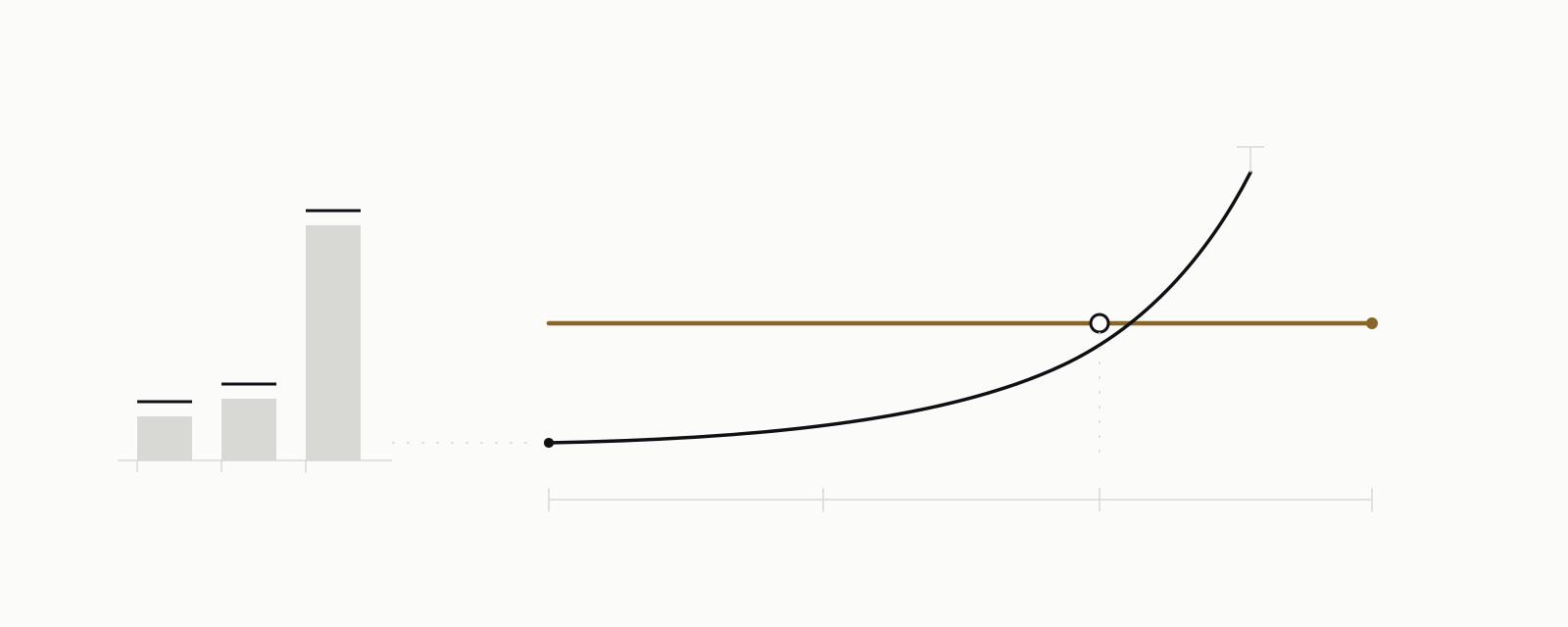
The shape matters more than the levels. Cost stays near nothing while the book has room, then turns vertical in the last stretch — which is why the way a desk sources and hedges a ticket is a question about the tail of the book, not about its top.
When does your price get fixed on each route?
On an exchange the money moves first and the price comes later. You wire dirhams or dollars to the venue, wait for the credit to clear, and then trade at whatever the book shows on the day it lands — which may be several days after you decided to buy. The rate you saw when you sent the transfer was never yours.
At a desk the order is reversed: the rate is agreed in writing before the transfer leaves your account, and it is held for a stated acceptance window. For a stablecoin the transit time then costs nothing, because USDT tracks the US dollar and the dirham is pegged at 3.6725 — there is no market underneath the quote to drift.
What do fiat transfer limits do to a large purchase?
Exchange fiat rails are capped, and the cap is usually per day and per verification tier rather than per trade. A seven-figure purchase therefore becomes a sequence of transfers spread over days, each one arriving separately at your bank and each one capable of drawing a separate question. Every venue publishes its own ceilings and changes them, so check yours before assuming one transfer will land.
A desk takes the whole amount in a single wire, which is also why desks set a minimum ticket — the fixed cost of a compliance review and a bank instruction does not shrink with size. AED settles the same business day through UAEFTS; USD moves by SWIFT in two to five business days. The sequence is set out in the buy-side steps on the main page.
How does the payment read to your bank and your auditor?
An outgoing wire to a VARA-licensed broker-dealer carries a contract note behind it, and that is what a compliance officer or an auditor asks for. The payment names a licensed counterparty, the contract note states the rate and the size, and the on-chain transfer has a hash that matches both. Three documents describe one transaction.
A series of transfers to a trading platform has no contract note at all, only a platform statement assembled after the fact. Identity and source of funds are settled once at desk onboarding, before any money moves, and the document list sits in the onboarding section. Finding out about a compliance problem after a seven-figure transfer is already in flight is the expensive version of the same conversation.
Where do your funds sit while the trade settles?
On the exchange route your money rests on the platform twice: first as a fiat balance waiting to trade, then as a token balance waiting to be withdrawn. Both stages are exposure to the venue rather than to the market, and the withdrawal leg has its own queue and its own limits.
The desk route has no resting place. Funds go bank to desk, and coin goes desk to a wallet address you give once and the desk whitelists, with the transaction hash returned to you. A small test transfer before the full amount is normal practice and costs nothing extra.
What does the desk charge to buy USDT, and why more than to sell?
IWGT prices a USDT purchase at 0.40%, 0.25%, 0.20% and 0.15% by ticket size, against 0.40%, 0.25%, 0.15% and 0.08% on the sell side. The two ladders are identical up to 500,000 USDT and separate above it. Tickets above 10,000,000 are priced on request, against the liquidity of the day rather than a table.
| Ticket from (USDT) | You buy USDT | You sell USDT |
|---|---|---|
| 100,000 | 0.40% | 0.40% |
| 500,000 | 0.25% | 0.25% |
| 2,000,000 | 0.20% | 0.15% |
| 10,000,000 | 0.15% | 0.08% |
The gap opens at 2,000,000 and widens at 10,000,000, where sourcing cost stops being a rounding error. Full bands are in the published pricing table.
The asymmetry has one cause. On a sale the coin arrives at the desk by itself; on a purchase the desk has to go and buy it, walking the same books this article measured. The depth numbers above are the sourcing cost written out — which is why a buy band below roughly 15 bp at the top tier would be priced under what execution actually costs on a day like that one.
When is an exchange the cheaper answer?
Below about 250,000 USDT an exchange is usually cheaper and simpler, and a desk that tells you otherwise is selling. A quarter-million ticket sits inside the top of the book on any of the three dirham venues, the fiat rails handle it in one transfer, and the taker fee is the whole cost. Desk pricing at that size starts at 0.40%, which is more than the exchange charges.
The desk starts to win where the book and the transfer limits start to get in the way — and the crossover is a property of the day, not a constant. Depth on a stablecoin pair moves hour to hour; the only way to know where you sit is to price both routes in money on the morning you trade, which also means checking where the USDT/AED rate sits against the peg at that moment.
The bottom line on buying USDT at a desk or on an exchange
Buying USDT in the UAE is a question about depth, timing and paperwork rather than about a headline fee. The 22 September 2026 measurement shows a dirham market that absorbed 5 million at +10.3 bp and ran out of road a little past 10.6 million — enough for most tickets, on one afternoon, if you can reach all three books at once.
What a desk actually sells at that size is not a better basis-point number in every case. It is a price fixed before the money moves, one wire instead of six, a counterparty your bank can name, and compliance finished in advance.
FAQ
Is it cheaper to buy USDT on an exchange or at an OTC desk?
It depends on size and on the depth of the day. In the 22 September 2026 measurement, sweeping the three dirham books beat the desk band at 2 and 5 million USDT and lost to it at 10 million. Below about 250,000 the exchange wins comfortably.
How much USDT can you buy against the dirham at one time?
On 22 September 2026 the visible ask side of Binance, Bybit and OKX held 10,627,488 USDT against the dirham in total. That is the whole screen, across three venues and every price level, on one afternoon. It is not a standing capacity.
When is the price fixed if I buy USDT through an OTC desk?
The desk agrees the rate in writing before you send the bank transfer, and the days the wire spends in transit do not change it. USDT tracks the US dollar and the dirham is pegged at 3.6725, so there is no market to drift underneath a stablecoin quote.
Why does the desk charge more to buy USDT than to sell it?
On a sale the coin arrives at the desk on its own. On a purchase the desk has to source it in the market first, and that sourcing cost is exactly what the depth measurement prices. The two bands are identical up to 500,000 and diverge above it.
Do I need accounts at three exchanges to buy 5 million USDT?
To match the swept price, yes: the figure assumes all three books are hit at the same moment with money already funded on each. Working one book alone costs more, because a single ladder has to be walked further to fill the same ticket.
Price a large USDT purchase before you fund anything
IWGT is a VARA-licensed Broker-Dealer in Dubai. Buy-side spread 0.40% to 0.15% by ticket size, agreed in writing before your transfer leaves the bank, with the coin delivered to a wallet address you whitelist yourself.
SOURCES
- IWGT order-book measurement, 22 September 2026 — our own snapshot of the public USDT/AED books on Binance, Bybit and OKX and of USDT/USD on Kraken and Coinbase. Volume-weighted average price computed from published depth; taker fee added separately; the 3.6725 dirham peg used to convert into basis points.
- IWGT, USDT order-book depth and execution cost for UAE buyers: USDT/AED and USDT/USD on public exchanges, Zenodo, doi:10.5281/zenodo.22912475 — the open dataset with the snapshot data, method notes and collection script (CC BY 4.0), first version 23 September 2026.
- Binance Spot API — order book (depth) endpoint — the public data structure the measurement reads, accessed 22 September 2026.
- Binance spot trading fee schedule — 0.100% maker and taker for a Regular User, the rate used in the taker column, accessed 22 September 2026.
- Kraken fee schedule — stablecoin and FX pairs priced separately from crypto spot pairs, accessed 22 September 2026.
- VARA public register — licence status check for any Dubai desk, accessed 22 September 2026.
- Central Bank of the UAE — payment systems (UAEFTS) — the domestic AED settlement rail, accessed 22 September 2026.
- IWGT spread bands by direction and settlement terms — pricing table on the main page (/#pricing), September 2026.
This guide is informational and is not legal, tax or investment advice, nor an invitation to buy or sell any virtual asset. Market depth figures are a single measurement taken on 22 September 2026 and will not hold on another day — re-check the sources before acting. Virtual assets may lose their value in full or in part and are subject to extreme volatility.