
Source of wealth vs source of funds when you buy crypto in the UAE
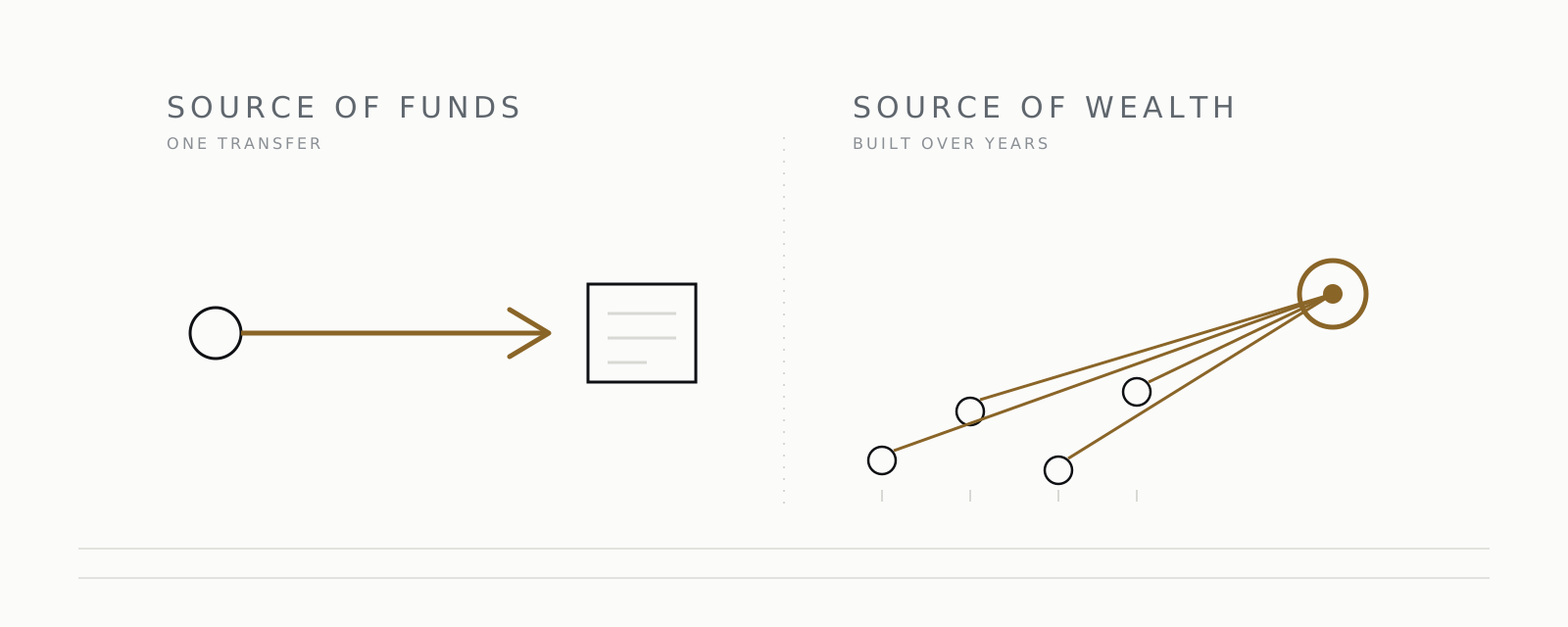
When you buy crypto in the UAE with a bank transfer, compliance checks source of funds: where that specific money came from. Source of wealth, how your overall net worth was built, is asked only of clients rated high-risk or politically exposed, non-residents, or unusually large purchases, not for every transaction.
KEY FACTS
| Regulator, crypto leg | VARA (virtual assets in Dubai, outside the DIFC) |
|---|---|
| Regulator, fiat leg | CBUAE (bank AML/CFT rules) |
| Source of funds | Origin of the money in this one transfer (FATF Recommendation 10) |
| Source of wealth | How the client's total net worth was built (FATF Recommendation 10, Interpretive Note) |
| Who gets asked for source of wealth | Clients rated high-risk or identified as a PEP (VARA Rule III.E.10, III.E.6) |
| Standard CDD threshold | AED 3,500 per occasional transaction (VARA Rule III.E.4) |
| IWGT buy-side spread | 0.40% down to 0.15% by size; quote on request above 10,000,000 USDT |
Source: VARA Compliance and Risk Management Rulebook; FATF Recommendation 10, as of October 2026.
What is the difference between source of funds and source of wealth?
Source of funds is the documented origin of the exact money used in one transaction, and source of wealth is the broader explanation of how a client's total net worth was built, under the Financial Action Task Force's Recommendation 10 and its Interpretive Note (FATF, accessed October 2026). When you send a bank transfer to buy crypto, source of funds answers where that specific transfer came from: a salary account, a business account, or the proceeds of selling a property. Source of wealth answers a wider question: how a client accumulated everything they own, not only the money in one wire.
The two checks are not interchangeable. A buyer with a documented salary and a clean bank statement satisfies source of funds for a routine purchase quickly. Source of wealth takes longer, because it covers years of business activity, investments or inheritance, and a provider reserves it for clients it rates as higher risk. Our companion guide on source of funds for crypto covers a seller's documents; this guide covers the opposite direction.
Why do the questions differ when you buy crypto instead of sell it?
Compliance questions differ by direction because the risk sits on a different side of the trade. Selling hands the provider your coins, so it checks the coin's own history: which wallet held it, which exchange it passed through, and when it was acquired. Buying hands you the coins, so the check moves to the money leaving your bank account, and to what happens to the coins afterward.
A provider that hands over crypto without checking the fiat's origin can become the first step in moving money into an asset that crosses borders more easily than cash. That is why a Virtual Asset Service Provider licensed in Dubai applies ongoing due diligence to purchases under VARA's rulebook, checking that the money used to buy is consistent with what is already known about the client, not only that the wire cleared (VARA, Rule III.E.5, accessed October 2026).
What does a UAE provider check on a bank transfer that buys crypto?
A VARA-licensed desk or exchange checks four things on an incoming transfer: the account holder's name matches the client on file, the transfer comes from a bank in an accepted jurisdiction, the amount fits the client's declared profile, and standard due diligence has been completed for any occasional transaction of AED 3,500 or more (VARA Rule III.E.4, accessed October 2026).
Settlement has to go back to an account in the buyer's own name, so the originating transfer has to match it too; a transfer from a third party's account or a company account for a personal purchase usually pauses the trade until it is resolved. Opening the account through a provider's onboarding checklist before the day you need to trade moves this check earlier. Buy-side pricing, from 0.40% down to 0.15% by size, is published on the pricing page alongside the sell-side spread.
When does compliance ask for source of wealth, not just source of funds?
Compliance asks for source of wealth, not only source of funds, once a client is rated high-risk or identified as a politically exposed person. VARA's rulebook requires a licensed VASP to identify and verify both the source of funds and the source of wealth of a client, and of any beneficial owner, once enhanced due diligence applies (VARA Rule III.E.10, accessed October 2026).
VARA does not publish a single AED figure at which source of wealth starts; the trigger is the client's risk rating, not a fixed ticket size. A politically exposed person (PEP), or a PEP's beneficial owner, needs sign-off from the money laundering reporting officer and a senior manager before the relationship can begin (VARA Rule III.E.6, accessed October 2026). CBUAE's PEP guidance asks licensed institutions to understand a foreign PEP's total net worth and principal sources of income, not only one transfer (CBUAE, accessed October 2026).
Four categories tend to trigger the question: politically exposed persons and their close associates, non-residents with no verifiable local income, clients whose occupation does not match the purchase size, and purchases large enough to move a client into a higher-risk tier. A salaried resident buying a modest amount through a documented account is unlikely to be asked for anything beyond source of funds.
Which documents prove source of funds vs source of wealth for a crypto purchase?
Source of funds and source of wealth call for different documents. The table below separates what proves a single transfer from what proves a client's overall financial position, both part of the enhanced due diligence (EDD) a provider runs on higher-risk purchases.
| Aspect | Source of funds | Source of wealth |
|---|---|---|
| What it answers | Where the money for this one transfer came from | How the client's entire net worth was built |
| Typical trigger | Every purchase above the standard CDD threshold | High-risk rating, PEP status, or an unusually large purchase |
| Documents | Bank statement, payslip, or sale agreement for this transfer | Company ownership records, audited accounts, inheritance papers, investment statements, tax filings |
| Covers | One transaction | Years of financial history |
| Who asks | The provider receiving the transfer, and the client's own bank on the outgoing wire | The provider's compliance team under enhanced due diligence |
Source of funds is satisfied by records of one transaction; source of wealth needs years of financial history, which is why it is asked of fewer buyers but takes longer to clear.
What if you cannot fully document source of wealth?
A buyer who cannot fully document source of wealth should disclose the gap early rather than leave it for the reviewer to find. A provider can sometimes proceed when one segment is missing, for example a closed business with no surviving records, provided the rest is consistent and the gap is explained in writing.
Where a client under enhanced due diligence cannot provide a coherent account of their net worth at all, VARA's rulebook does not allow the relationship to start, since the senior management and MLRO approval it requires for higher-risk and PEP clients depends on that information (VARA Rule III.E.10, accessed October 2026). Checking that a provider is actually licensed, through VARA's public register, confirms which rulebook applies before you send the transfer.
FAQ
Do I need to prove source of wealth every time I buy crypto in the UAE?
No. Source of wealth applies once a provider rates a client high-risk or identifies them as a politically exposed person. A standard-risk buyer only documents source of funds for that transfer.
Is source of wealth the same as proof of funds?
No. Proof of funds shows you currently hold enough money for a purchase; source of funds shows where that money came from; source of wealth explains how your entire net worth was built.
Does buying crypto from a salary account avoid source-of-wealth checks?
For a standard-risk purchase, yes. A salary account with a consistent, documented income history satisfies source of funds. Source of wealth only becomes relevant if the client's risk rating or the size of the purchase triggers enhanced due diligence.
What documents prove source of wealth for a crypto purchase?
Typical evidence includes business ownership or incorporation records, audited company accounts, inheritance or probate documents, investment or brokerage statements, and several years of tax filings, not records of one transaction.
Who has to approve a crypto purchase from a politically exposed person?
Under VARA's rulebook, a business relationship with a politically exposed person needs sign-off from the money laundering reporting officer and a member of senior management before it can start.
Buying crypto with your paperwork ready
IWGT is a VARA-licensed Broker-Dealer in Dubai (licence VL/24/12/002). Buy-side spreads run 0.40% down to 0.15% by size, with AED settled the same business day by UAEFTS once your account and source-of-funds file are approved.
SOURCES
- VARA Compliance and Risk Management Rulebook, Rules III.E.4, III.E.5, III.E.6 and III.E.10, accessed 5 October 2026.
- FATF: The FATF Recommendations (Recommendation 10 and its Interpretive Note), accessed 5 October 2026.
- Central Bank of the UAE: guidance on politically exposed persons, accessed 5 October 2026.
- IWGT published pricing bands and onboarding requirements, this site, October 2026.
This guide is informational and is not legal, tax or investment advice, nor an invitation to buy or sell any virtual asset. Rules and figures are as of October 2026, re-check the sources before acting. Virtual assets may lose their value in full or in part and are subject to extreme volatility.