
Why a UAE OTC desk declines a trade: what you can fix and what you cannot
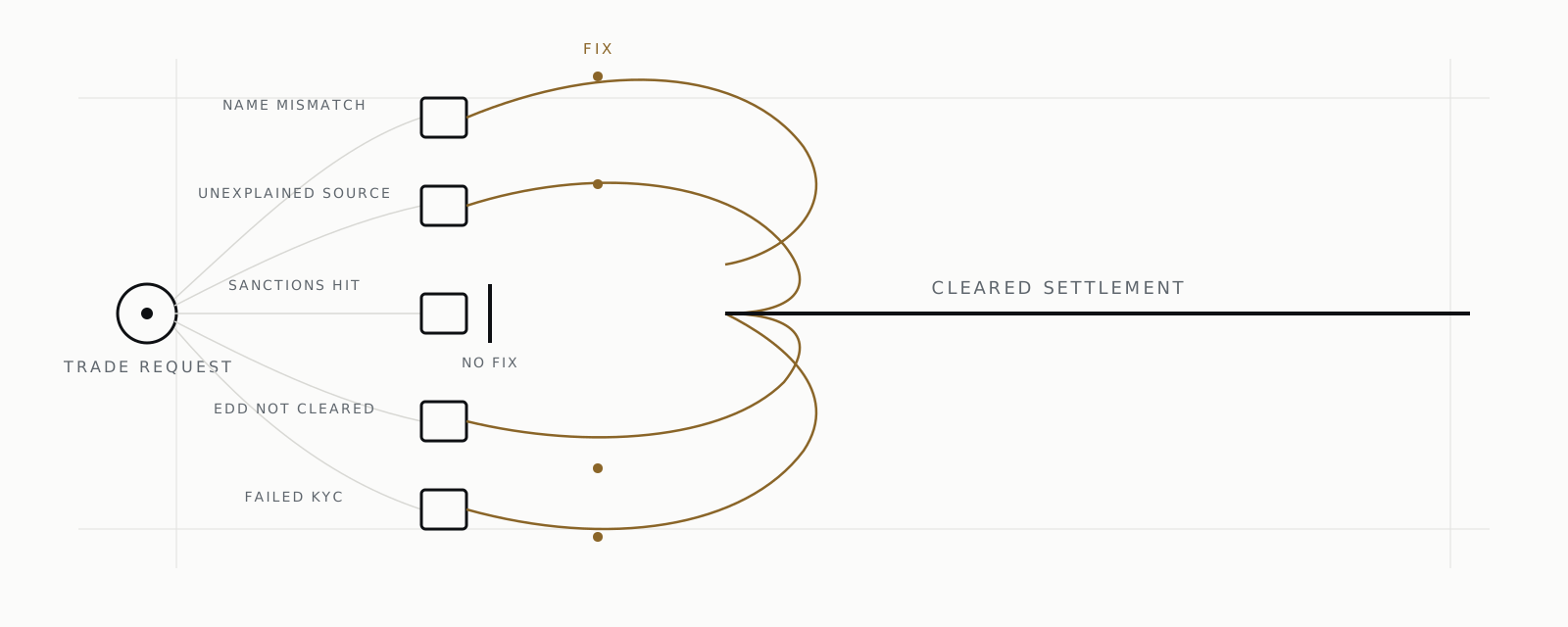
A licensed UAE OTC desk declines a trade for five recurring reasons: a sanctions hit on the wallet, a name mismatch between the wallet or bank account and the client, an unexplained source of funds, enhanced due diligence that has not cleared, or failed KYC. Documentation resolves most of these; a genuine sanctions match does not.
KEY FACTS
| Regulators | VARA (desk conduct, Dubai outside the DIFC); CBUAE (bank payment screening) |
|---|---|
| Core AML law | Federal Decree-Law No. 10 of 2025 — in force 14 October 2025 |
| Mandatory CDD threshold | AED 55,000 on an occasional transaction (Cabinet Resolution No. 134 of 2025) |
| EDD trigger | Risk-based, above the desk's own threshold — no fixed statutory figure |
| Sanctions lists used | UN Security Council list; UAE Local Terrorist List (EOCN); OFAC SDN where USD/correspondent banking applies |
Source: VARA Compliance and Risk Management Rulebook; Federal Decree-Law No. 10 of 2025 and Cabinet Resolution No. 134 of 2025, as of October 2026.
Why does a sanctions hit or a tainted wallet stop a trade?
A sanctions hit stops a UAE OTC trade when on-chain screening finds that the wallet being sold from has direct or close exposure to an OFAC-listed address, a comprehensively sanctioned jurisdiction, or a known mixing or darknet-market service. A desk declines rather than asks for a workaround, because VARA's Compliance and Risk Management Rulebook makes this screening a licence condition, not a discretionary check. See how sanctions screening works on a UAE crypto sale for the full mechanics.
A false-positive name match is different from a wallet hit. A common name can trigger a hold against the UN Security Council Consolidated List or the UAE's own sanctions roster, the Local Terrorist List run by the Executive Office for Control and Non-Proliferation; compliance usually clears that hold once it confirms date of birth and nationality do not match the listed individual. A genuine wallet-level sanctions exposure does not clear the same way, because the exposure sits in the asset itself, not in a name.
Why does a name mismatch between the wallet or bank account stop a trade?
A name mismatch stops a UAE OTC trade when the wallet being sold from, or the bank account set to receive settlement, is not verifiably linked to the client who completed onboarding. A licensed desk settles only to an account in the client's own name, so a bank account under a spouse's, employer's or business partner's name does not qualify without separate proof of the relationship.
Beneficial-ownership checks sit inside the same framework that makes customer due diligence mandatory on an occasional transaction once it reaches AED 55,000, under Cabinet Resolution No. 134 of 2025, the Executive Regulations to Federal Decree-Law No. 10 of 2025. Confirming who actually controls the wallet and the receiving account is part of that duty, not an extra step a desk invents.
What makes a source of funds unexplained, and why can't a client just explain it in writing?
A source of funds is unexplained when the wallet's own transaction history shows no credible trail — no exchange trade confirmation, no prior wallet-to-wallet transfer with context, no documented event such as a sale, salary or inheritance — connecting the balance to a legitimate origin. A desk cannot accept a verbal or written assurance in place of that trail, because a source-of-funds file works on independent evidence, not a client's own account of events.
This is the category where the line between fixable and not fixable is genuinely about evidence, not paperwork for its own sake. A real but undocumented source — an old private sale, a long-held mining reward, an inheritance abroad — is usually fixable with the right record. Funds that remain unexplained because the actual origin cannot be disclosed are not fixable by better phrasing.
What triggers enhanced due diligence, and is EDD itself a decline?
EDD triggers when a conversion's size, pattern or counterparty profile sits above a desk's risk-based threshold, which the UAE's Executive Regulations leave each institution to set above the AED 55,000 mandatory customer due-diligence floor. EDD is a deeper review, not itself a decline: it asks for more evidence on how the assets were acquired and takes longer to clear than a standard check. The documents a desk typically requests are covered in our guide to enhanced due diligence on large crypto conversions.
EDD becomes a decline only when the deeper review turns up one of the harder blocks above — a sanctions exposure, an unresolved name mismatch, or a source of funds that stays unexplained after the extra scrutiny. A clean file that simply takes longer to review is not the same outcome as a file that fails the review.
What happens when a client does not pass KYC?
KYC fails when the identity documents a client submits cannot be verified — an expired passport, a selfie that does not match the document photo, or a proof-of-address document older than the desk's accepted window. A licensed desk cannot open an account or settle a trade without completed KYC, because identity verification is the foundation the rest of the AML framework in Federal Decree-Law No. 10 of 2025 depends on. See the real cost of no-KYC desks in the UAE.
A failed KYC check is usually the most straightforward category to fix: a current passport, a dated utility bill or bank statement, and a selfie taken under normal lighting resolve most document-quality rejections. KYC becomes a harder block only when a client is unwilling or unable to provide any document that verifies their identity at all — at that point, the issue is not the paperwork.
Which decline reasons can you fix, and which can't you?
Five decline reasons account for most refusals at a licensed UAE desk, and they split clearly into what documentation can resolve and what it cannot.
| Decline reason | What usually resolves it | Can it be fixed? |
|---|---|---|
| Sanctions / wallet exposure hit | Nothing — a direct match to a sanctioned address or mixer is final | No |
| Name mismatch | Ownership proof: sale agreement, notarised declaration, probate document | Often |
| Unexplained source of funds | Exchange statements, contracts, tax records, inheritance documents | Sometimes |
| EDD not yet cleared | Source-of-wealth documentation and time for the deeper review | Usually, given time |
| Failed KYC | Valid, current identity and address documents | Usually |
Only a confirmed sanctions match sits outside what paperwork can change; the other four categories are, in practice, about producing the right document before the desk needs to ask twice.
What should you do after a desk declines your trade?
After a decline, ask the desk which category applies — a sanctions hit, a name mismatch, an unexplained source, unfinished EDD or failed KYC — because the fix depends entirely on which one it is. A desk running a documented onboarding process should be able to tell you that much, even where compliance cannot share every internal detail of the review.
Moving the same wallet to a different desk does not change a genuine sanctions result: the address screens the same way wherever it is checked, against the same lists. For the fixable categories, the opposite is true — gathering the missing document and reapplying, at the same desk or another licensed one, usually resolves it. Check a desk's VARA licence on our site, or directly in VARA's public register, before relying on its decision either way.
The bottom line on why a UAE OTC desk declines a trade
A UAE OTC desk declines a trade to meet obligations under Federal Decree-Law No. 10 of 2025 and VARA's Compliance and Risk Management Rulebook, not as a judgment on the client personally. Four of the five recurring reasons — name mismatch, unexplained source of funds, unfinished EDD and failed KYC — are usually resolved with the right document. Only a confirmed sanctions match stays declined regardless of what is supplied afterward.
FAQ
Can a UAE OTC desk refuse a trade without giving a reason?
A licensed desk can decline without disclosing every internal compliance detail, but it should tell you the general category — sanctions, identity, source of funds or KYC — since that is what determines whether the issue is fixable.
Can a sanctions hit on a wallet ever be cleared?
A false-positive name match can be cleared once compliance confirms it is not the listed individual. A genuine, confirmed link between the wallet and a sanctioned address or service does not clear, at that desk or any other.
How do I fix a name mismatch between my wallet and my bank account?
Provide a document proving the relationship between the names — a notarised declaration, a sale agreement, a company ownership record or a probate document — or settle to an account verifiably in your own name.
Does enhanced due diligence mean the desk suspects me of a crime?
No. EDD is a deeper, risk-based review required once a conversion sits above a desk's own threshold under the UAE's Executive Regulations. It usually clears once source-of-wealth documentation is provided.
Can I reapply at the same desk after a decline?
Yes, for the fixable categories — once the missing document is ready, reapplying usually resolves a name mismatch, an unexplained source or a failed KYC check. A confirmed sanctions match stays declined regardless of reapplication.
Trade through a desk that explains a decline, not just issues one
IWGT is a VARA-licensed Broker-Dealer in Dubai (VL/24/12/002). We screen the wallet and the client on every trade and settle AED by UAEFTS the same business day once your account is approved.
SOURCES
- Federal Decree-Law No. 10 of 2025 Regarding Anti-Money Laundering, and Combating the Financing of Terrorism and Proliferation Financing — CBUAE rulebook, effective 14 October 2025, accessed 12 October 2026.
- Cabinet Resolution No. 134 of 2025 — Executive Regulations of Federal Decree-Law No. 10 of 2025 — CBUAE rulebook, effective 14 December 2025 (customer due-diligence threshold), accessed 12 October 2026.
- VARA Compliance and Risk Management Rulebook, accessed 12 October 2026.
- VARA public register — licence status check, accessed 12 October 2026.
- Executive Office for Control and Non-Proliferation (EOCN) — targeted financial sanctions — UAE Local Terrorist List and UN Consolidated List, accessed 12 October 2026.
- IWGT published pricing bands and onboarding requirements — IWGT published pricing bands, October 2026.
This guide is informational and is not legal, tax or investment advice, nor an invitation to buy or sell any virtual asset. Rules and figures are as of October 2026 — re-check the sources before acting. Virtual assets may lose their value in full or in part and are subject to extreme volatility.