
Can an OTC desk pay a joint account, a spouse or your own company for crypto proceeds?
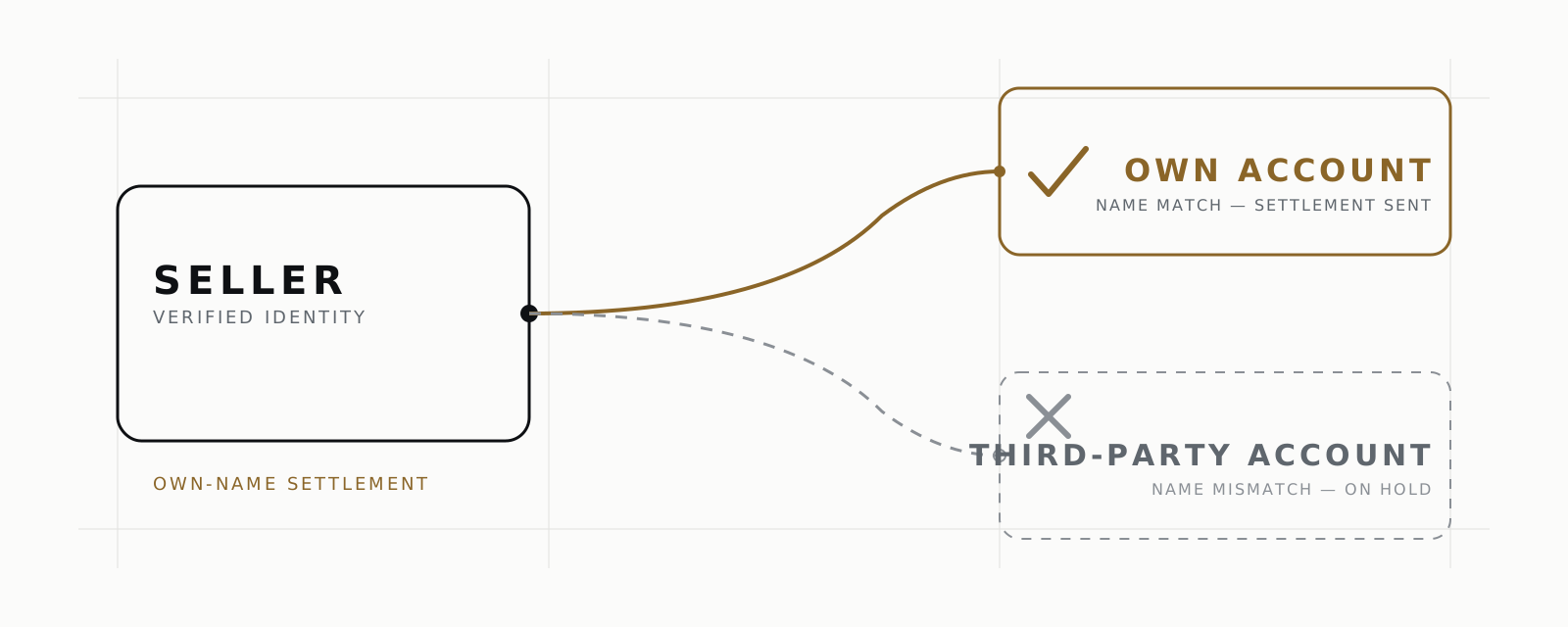
A licensed OTC desk in the UAE pays out only to a bank account in the seller's own name — own-name settlement. Payment to a spouse's account, a shared family account, a friend's account, or a company account when an individual sells rarely clears the desk's name-match check without extra paperwork.
KEY FACTS
| Settlement principle | Own-name settlement — payout account must match the seller's registered name |
|---|---|
| AED settlement rail | Same business day via UAEFTS |
| USD settlement rail | 2–5 business days via SWIFT |
| Documented joint-account exception | Seller is a registered co-holder, confirmed by a bank statement or letter |
| Documented company exception | Seller is the verified UBO or director-shareholder of the receiving company |
| Regulators | VARA (Dubai virtual asset licensing) and CBUAE (bank AML/CFT rules) |
Source: VARA Compliance and Risk Management Rulebook, as of September 2026.
What is own-name settlement?
Own-name settlement means the OTC desk wires the AED or USD proceeds of a crypto sale into a bank account registered in the same legal name as the person or company that sold the asset. IWGT applies own-name settlement on every trade, alongside the source-of-funds documentation collected at onboarding, so the client record that was checked and the account that gets paid are the same one.
The rule follows from how a licensed virtual asset service provider (VASP) is required to handle money it holds for a client. VARA's Client Money Rules state that client money must stay in the client account until it is paid to the client on whose behalf it is held, paid to the VASP itself, or paid in line with the client's own instruction to a party the VASP has itself verified (VARA Compliance and Risk Management Rulebook, Part IV, rulebooks.vara.ae, accessed 22 September 2026). Paying an unverified third party sits outside all three of those routes.
Why the payout name has to match the seller
A UAE bank or OTC desk insists on a name match because anti-money-laundering rules make the account holder — not whoever asked for the wire — the party whose identity and source of funds have already been checked. Under the VARA Compliance and Risk Management Rulebook, a VASP must identify each client and, where the client is a company, the natural persons behind it, before it executes a transaction (Rules III.E.6(b) and III.E.7(c), rulebooks.vara.ae, accessed 22 September 2026).
If proceeds land in someone else's account, the due diligence that was done belongs to a different name than the one behind the trade — the exact separation of identity from money that anti-money-laundering controls exist to catch. The Financial Action Task Force applies the same logic to the transfer itself through Recommendation 16, the "travel rule": a virtual asset service provider must obtain, hold and pass on accurate originator and beneficiary information before a transfer completes, so identity travels with the money rather than getting separated from it (FATF, Updated Guidance for a Risk-Based Approach to Virtual Assets and VASPs, fatf-gafi.org, accessed 22 September 2026).
Requests that usually fail the name-match check
Four payout requests come up often enough that a compliance team has a standard response for each, and the standard response is no without further documentation:
- A spouse's or partner's personal account — a joint tax filing or a shared mortgage does not make a bank account joint; the account register is what compliance checks.
- A shared family account not held under the seller's own name — a pooled household account is a bank product, not a compliance shortcut, unless the seller is on the account.
- A company account when an individual, not the company, sold the asset — the company has to be shown as the actual seller, not a convenient destination for someone else's proceeds.
- A friend's, business partner's or broker's account "to save time" — this is the fastest route to a held wire; see how a bank responds when it asks for source-of-funds evidence once a mismatched credit triggers a review.
| Request | Typical outcome | What can change it |
|---|---|---|
| Spouse's or partner's sole account | Declined as a third-party payment | Nothing — a sole account cannot become a name match after the fact |
| Shared family account, seller not registered | Declined as a third-party payment | Only if the seller is added as a co-holder before the trade, confirmed by the bank |
| Joint account, seller is a co-holder | Can be documented and accepted | Bank statement or letter confirming the seller's name is on the account |
| Company account, seller is its UBO or director | Can be documented and accepted | UBO declaration, trade licence and shareholder register naming the seller |
| Friend's, partner's or broker's account | Declined as a third-party payment | Nothing — the account holder must be the party who sold the asset |
Two of the five requests are workable, and both need a bank or corporate document the desk can check independently rather than a verbal assurance.
Can a joint account holder receive the payout?
A joint account is the one personal-account scenario compliance documents rather than simply refuses, provided the seller was already a registered co-holder before the trade — not added afterward to receive a single wire. A bank statement or an account-holding letter that names both holders is the evidence a desk can verify independently, in line with the reliable, independent-source documents the VARA client due diligence standard requires (Rule III.E, rulebooks.vara.ae, accessed 22 September 2026).
An account described as "joint" with no supporting bank document is treated as a third-party account, because the desk cannot verify a fact the client only asserts. The timing matters too: a co-holder added the week of the trade reads the same as a third-party request with extra steps.
Can the proceeds go to a company you own?
Paying a company for an individual's crypto sale needs the same standard of evidence a bank would ask for before crediting an account for any other reason: proof the company is genuinely entitled to the money, not a container the seller happens to control. VARA's client due diligence rules require a VASP to establish a corporate client's ownership and control structure, including the identity of each ultimate beneficial owner (UBO), before a transaction (Rule III.E.7(c), rulebooks.vara.ae, accessed 22 September 2026).
In practice that means the seller is the documented director-shareholder or UBO of the receiving company, the trade licence and shareholder register confirm it, and a board resolution or director's letter explains why the company is named as beneficiary. The same standard applies to selling through a company's own trading account from the start, and to family office structures that hold assets for a family group rather than one named individual: the entity paid has to be the entity the desk performed due diligence on, up to its UBO.
Documents compliance asks for in these cases
A compliance team facing a payout that might go to someone other than the seller usually asks for a short, specific document set rather than refusing outright:
- Letter of authorisation — a signed instruction from the account holder, checked against an independently verifiable signatory.
- UBO declaration — a signed statement naming every individual who ultimately owns or controls the receiving company, backed by shareholder documents.
- Joint account statement or bank letter — recent, bank-issued, and naming the seller as a registered holder.
- Corporate documents — trade licence, shareholder register and, where relevant, a board resolution naming the company as the party to the sale.
None of these documents guarantees approval; they give compliance something independently verifiable to check instead of a verbal assurance — the same standard applied throughout the onboarding document list for selling USDT in the UAE and at account onboarding.
How the FATF travel rule connects to the wire
The Financial Action Task Force set the wire-transfer standard known as the travel rule in Recommendation 16, and its 2021 guidance for virtual assets extends the same originator-and-beneficiary standard to VASP-to-VASP crypto transfers, requiring a sending VASP to obtain, hold and pass on accurate identifying information about both parties before a transfer completes (FATF, Updated Guidance for a Risk-Based Approach to Virtual Assets and VASPs, fatf-gafi.org, accessed 22 September 2026).
Recommendation 16 was written for the crypto transfer itself, not the final leg into a bank account, but a UAE bank applies an equivalent test at that final leg: it checks the incoming wire against the identity it already holds on file for the account, and a name that does not match forces a manual review rather than an automatic credit. Own-name settlement is how a licensed desk keeps both legs of that chain — the crypto transfer and the bank wire — attributable to one verified identity, with its own licence on record for exactly this reason.
Illustrative example: a joint account payout that clears compliance
A married couple in Dubai holds a joint personal account at a UAE bank, opened together five years earlier. The wife sells 250,000 USDT through a licensed OTC desk and asks for the AED proceeds to go to the joint account rather than a sole account in her own name. The desk requests a recent statement showing both names on the account and confirms the account was not amended in the weeks before the trade. Because she is a named co-holder rather than someone added at the last minute, the desk settles to the joint account.
This is a hypothetical walk-through of the documentation standard, not a case IWGT is reporting from its own client file.
The bottom line on third-party payments for crypto proceeds
Own-name settlement keeps the paper trail attributable to one verified identity from wallet to bank credit. A spouse's account, a shared family account or a friend's account will not receive the proceeds without a documented reason compliance can check independently; a joint account where the seller is a genuine co-holder, or a company where the seller's UBO position is documented, are the two exceptions that actually work. Run any desk's process against a checklist for vetting an OTC desk before assuming it will move money the way you expect.
FAQ
Can an OTC desk pay my spouse's account for my crypto sale?
Not unless the account is a joint account with your name as a registered co-holder, evidenced by a bank statement or letter. A spouse's sole account is a third-party account and will not clear a name-match check.
What is own-name settlement?
Own-name settlement is the practice of paying the proceeds of a crypto sale only into a bank account held in the same legal name as the person or company that sold the asset, so the identity checked at onboarding matches the identity that receives the money.
Can I sell crypto as an individual and have the proceeds paid to my company?
Only if you can document that the company is genuinely party to the sale, or that you are its verified director-shareholder or UBO, with a trade licence and shareholder records to match. Without that evidence, a desk treats the company as a third party.
What documents prove a joint account is genuine?
A recent statement or a bank-issued letter listing both account holders' names, showing the seller was already a registered co-holder before the trade rather than added afterward to receive one payment.
Does the FATF travel rule apply to the bank wire or only to the crypto transfer?
FATF Recommendation 16 sets the originator-and-beneficiary standard for the crypto transfer itself. A UAE bank applies an equivalent name-match check on the final wire into an account, so both ends of the trade stay attributable to one identity.
What happens if a desk agrees to pay a third party anyway?
The desk's own anti-money-laundering controls stop being attributable to the verified seller, and receiving banks in the UAE routinely hold or freeze wires that land for someone other than the account holder pending a review.
Sell USDT with settlement to your own account, every time
IWGT is a VARA-licensed Broker-Dealer in Dubai. Own-name settlement on every trade, AED by UAEFTS the same business day once your account is approved, spread published openly from 0.08% to 0.40% by size.
SOURCES
- VARA Compliance and Risk Management Rulebook — Client Due Diligence (Part III.E), accessed 22 September 2026.
- VARA Compliance and Risk Management Rulebook — Client Money Rules (Part IV), accessed 22 September 2026.
- FATF — Updated Guidance for a Risk-Based Approach to Virtual Assets and VASPs (Recommendation 16, the travel rule), accessed 22 September 2026.
- Central Bank of the UAE — payment systems (UAEFTS), accessed 22 September 2026.
This guide is informational and describes common bank and OTC-desk compliance practice — it is not legal, tax or investment advice, nor an invitation to buy or sell any virtual asset. It does not tell you how a specific bank or desk will treat a specific payment request. Rules and figures are as of September 2026 — re-check the sources before acting. Virtual assets may lose their value in full or in part and are subject to extreme volatility.