
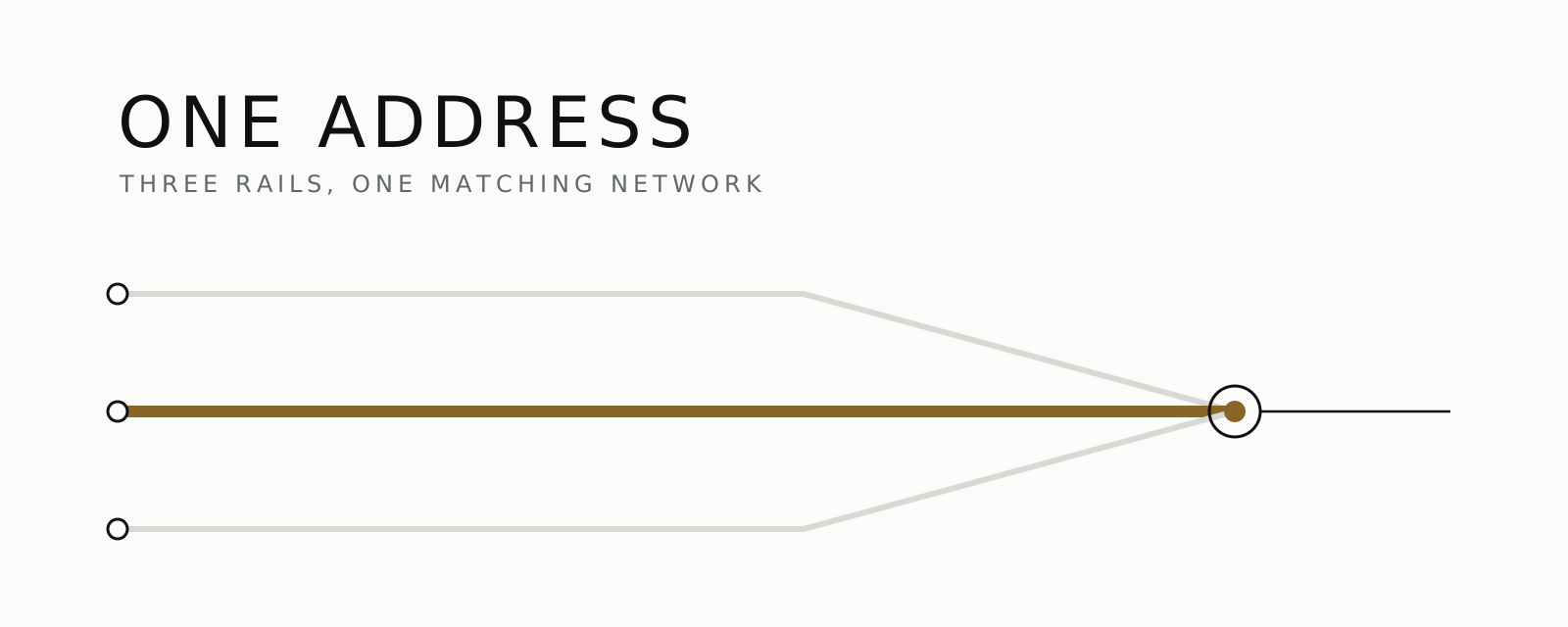
Which USDT network should you use when selling to an OTC desk in the UAE?
Use the network your dealer names in the written quote, because the deposit address works on that network only. The fee difference between networks is small next to the desk spread on a 100,000 USDT ticket or larger, so match first and save money second.
KEY FACTS
| Deciding rule | Send on the network named in your written quote |
|---|---|
| Sell-side spread, as of October 2026 | 0.40% at 100k, 0.25% at 500k, 0.15% at 2M USDT |
| Tron burn rate | 100 sun per Energy, 1,000 sun per Bandwidth |
| Ethereum fee formula | Gas units x (base fee + priority fee) |
| BNB Smart Chain standard gas price | 0.05 gwei, about US$0.005 or less per transaction |
| AED payout | Same day by UAEFTS on banking days, before the cut-off |
Source: Tron, Ethereum and BNB Chain documentation, as of October 2026.
Does the sending network have to match the deposit address?
Yes. A USDT deposit address belongs to one network, and the desk watches that network only. A transfer sent on any other network does not reach the desk's balance, whatever the token is called on the screen.
Tether issues USDT on many blockchains and treats the tokens on them as interchangeable in value, according to its supported protocols page (accessed October 2026). Interchangeable in value does not mean interchangeable in transit: each network keeps its own ledger and its own addresses. Your dealer states the network with the address when you complete onboarding, and that pair is what you copy.
Do not infer the network from the address alone. A Tron address is 34 characters starting with T, per the Tron developer documentation, but an Ethereum address is 42 characters starting with 0x, per ethereum.org. BNB Smart Chain is EVM-compatible according to the BNB Chain documentation, so Ethereum wallets work on it, and a 0x address alone does not tell you which EVM network it is for.
What happens if you send USDT on the wrong network?
The outcome depends on whether the address formats match. Across a Tron and an Ethereum-style network they differ, and most wallets and exchanges refuse the withdrawal before it leaves. Across two 0x networks they look identical, and the transfer can post to an address nobody on the receiving side controls.
- Recovery depends on who holds the keys to that address on the other network, and it is never guaranteed.
- Your whole ticket is exposed, not the fee: on 500,000 USDT the cost of an error is 500,000 USDT.
This asymmetry is the core of the decision. A wrong-network send risks 100% of the ticket, while a pricier network risks a few dollars.
How big is the network fee next to the desk spread?
On a ticket of 100,000 USDT or more, the network fee is a small fraction of the spread. The table assumes a deliberately generous network fee of US$20, an assumption rather than a market quote, and compares it with the sell-side spread as of October 2026.
| Ticket (USDT) | Spread | Spread cost (USDT) | US$20 fee as % of ticket | Fee that would equal the spread |
|---|---|---|---|---|
| 100,000 | 0.40% | 400 | 0.020% | US$400 |
| 500,000 | 0.25% | 1,250 | 0.004% | US$1,250 |
| 2,000,000 | 0.15% | 3,000 | 0.001% | US$3,000 |
Even at US$20 the network fee is 5% of the spread on 100,000 USDT and under 1% of it on 2,000,000 USDT.
The spread falls with size, yet the fee that would equal it stays in the hundreds or thousands of dollars. The published pricing bands show every tier.
How do network fees work on Tron, Ethereum and BNB Smart Chain?
Each network prices a transfer with its own formula, so none of them can be reduced to one number. Treat any quoted fee as a snapshot, and read the formula in the network's documentation if you need to estimate a cost before sending.
- Tron: a token transfer runs a smart contract and consumes Energy. When your account holds too little, TRX is burned at 100 sun per Energy, and Bandwidth is burned at 1,000 sun per unit, as of October 2026 per the Tron resources documentation. These are chain parameters that can change by proposal.
- Ethereum: the fee is gas units multiplied by (base fee + priority fee). The base fee can move by up to 12.5% per block and the tip depends on demand, per ethereum.org. A plain ETH transfer is 21,000 gas, and a token transfer calls a contract, so it costs more.
- BNB Smart Chain: the standard gas price is 0.05 gwei and a typical transaction costs around US$0.005 or less, as of October 2026 per BNB Chain documentation.
For crediting times, seeUSDT settlement times by network.
Why do withdrawal fees and limits at your exchange depend on the network?
An exchange sets its withdrawal fee, minimum and daily limit per coin and per network, so the network you choose changes what the exchange charges before the USDT even leaves. The fee shown on the withdrawal screen is the exchange's own tariff, separate from the blockchain fee in the section above.
Binance, for instance, publishes a crypto fee schedule with a deposit and withdrawal tab (accessed October 2026), and the figures change. Read the number for your exact network on the day. If the exchange also caps daily withdrawals, a large ticket may need several transfers, which is covered in exchange withdrawal limits for UAE sellers.
Which network should you pick for which ticket size?
Pick the network by three rules in this order: what the dealer confirms, where your USDT already sits, and only then the fee. The ticket size changes how much weight the fee deserves, not the order of the rules.
- At 100,000 USDT: dealer-confirmed network, then where the coins sit now. A US$20 fee is 0.020% of the ticket.
- At 500,000 USDT: dealer-confirmed network, then your exchange's per-transfer limits. The same fee is 0.004%.
- At 2,000,000 USDT: dealer-confirmed network, then a test transfer and a split plan. The same fee is 0.001%.
If your USDT sits on a network the dealer does not confirm, bridging or swapping it first adds fees and a new risk. Read the guide to selling 100,000 USDT or more for the checks that come with size.
Tether's own list also matters here. As of October 2026 its supported protocols page lists USD₮ contracts under Ethereum, Tron and other networks, while the BNB Smart Chain entry shows only XAU₮. If your balance is on BNB Smart Chain, ask your dealer to confirm what token it is and whether the desk quotes it, instead of assuming it is Tether-issued USDT.
Illustrative example: 500,000 USDT from an exchange
This is an illustrative example, not a record of a real client. A seller holds 500,000 USDT at an exchange, receives a written quote naming one network and an address, and the sell-side spread at that tier is 0.25%, or 1,250 USDT.
-
STEP 1
Match the network on the withdrawal screen
The exchange pre-selects a network. The seller changes it to the one in the quote, because the pre-selected one is the exchange's default, not the desk's.
-
STEP 2
Compare the figures, not the networks
The exchange shows a withdrawal fee for that network. Even if it is US$20, that is 0.004% of the ticket and about 1.6% of the 1,250 USDT spread, so the seller does not change network to save it.
-
STEP 3
Send a test amount, then the balance
A small first transfer proves the network and address pair. The remainder follows on the same pair.
What should you confirm before pressing send?
Confirm four things in writing before any USDT leaves your wallet, and request a quote through the IWGT quote form if you do not have one yet.
- The network, spelled out in the quote, and the matching deposit address.
- That the address is copied from the quote, not from a chat message.
- The exchange's own fee and limit for that exact network, read on the day.
IWGT's website does not list the networks it accepts, so confirm your deposit network with your dealer before sending rather than relying on any third-party list.
FAQ
Can I send USDT on any network to the desk's deposit address?
No. The network you send on must be the network the deposit address was issued for, as named in your written quote. Confirm the network with your dealer before sending.
Is a cheaper network worth it on a large USDT sale?
Rarely. Even a network fee of US$20 is 0.020% of a 100,000 USDT ticket and 0.001% of a 2,000,000 USDT ticket, while the desk spread is 0.40% and 0.15%. The network named in the quote matters more than the fee.
Does the network I pick change the price or the AED payout?
The spread depends on ticket size, not on the network. AED settles by UAEFTS on banking days before the cut-off once the desk has credited the USDT.
Why does my exchange show a different withdrawal fee per network?
Exchanges set withdrawal fees and minimums per coin and per network, and show them on the withdrawal screen. Read the figure for the exact network before you confirm.
What should I do if I already sent USDT on the wrong network?
Stop, keep the transaction hash and contact your dealer straight away. Recovery depends on who controls the receiving address on that network and is never guaranteed.
Get a written quote with the network named
IWGT is a VARA-licensed Broker-Dealer in Dubai. All-in sell-side spread 0.40% at 100k, 0.25% at 500k, 0.15% at 2M and 0.08% at 10M USDT, with AED by UAEFTS the same business day once your account is approved.
SOURCES
- Tether, supported protocols, accessed 22 October 2026.
- Tron developer documentation, paying for resources (burn rates), accessed 22 October 2026.
- Tron developer documentation, account (address format), accessed 22 October 2026.
- ethereum.org, gas and fees, accessed 22 October 2026.
- ethereum.org, accounts (address format), accessed 22 October 2026.
- BNB Chain documentation, BNB Smart Chain overview (gas price, EVM compatibility), accessed 22 October 2026.
- Binance, crypto fee schedule (exchange withdrawal tariffs), accessed 22 October 2026.
- IWGT published pricing bands: IWGT pricing, October 2026.
This guide is informational and is not legal, tax or investment advice, nor an invitation to buy or sell any virtual asset. Rules and figures are as of October 2026; network fees change, so re-check the sources before acting. Virtual assets may lose their value in full or in part and are subject to extreme volatility.