
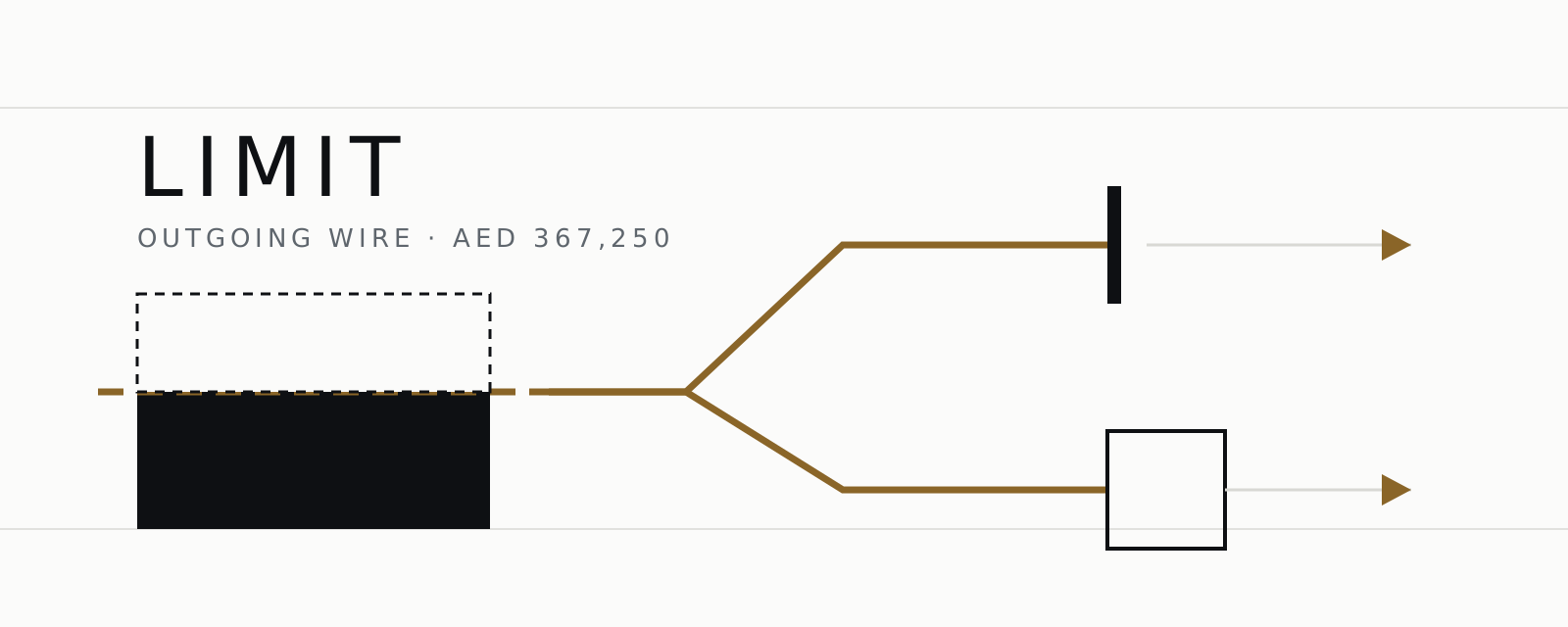
Bank transfer limit when buying USDT in the UAE
Raise the online limit through the app, the call centre or a branch (business accounts: through the authorisers on the mandate), or have a branch or relationship manager initiate the wire. A 100,000 USDT purchase is AED 367,250 at 3.6725, as of October 2026. The table shows which published limits it hits.
KEY FACTS
| Ticket in dirhams | 100,000 USDT = AED 367,250 at 3.6725, as of October 2026 |
|---|---|
| Two ways past a cap | Raise the online limit, or have the branch or relationship manager initiate the wire |
| Buy spread, 100k to 500k USDT | 0.40% then 0.25%, as of October 2026 |
| Buy spread, 2M to 10M USDT | 0.20% then 0.15%, as of October 2026 |
| Rate | Fixed before you send; the quote states how long it holds |
| Funds reaching the desk | 2 to 5 business days via a correspondent bank, not same-day UAEFTS |
| Sending account | In your own name |
Source: Central Bank of the UAE reference rate, accessed October 2026; bank pages listed under Sources.
Which bank limits stop a 367,250 dirham wire?
A purchase of 100,000 USDT is AED 367,250 at the 3.6725 peg, as of October 2026, and that is a single outgoing transfer from your account. Banks publish very different amounts for what an app or online banking session can send in one day. The table below lists only what each bank states on its own pages. A cell reading “Not published” means the bank does not print the figure in public.
| Bank | Personal: default and maximum online limit | Business: default and maximum online limit | How to raise it | New-beneficiary cooling-off | Source |
|---|---|---|---|---|---|
| Emirates NBD | Amount not published on the help pages. The daily limit can be raised or lowered at any time; per-transaction limits are fixed by banking package | Not published on the bank’s tariff pages as of October 2026 | Change the daily limit in online or mobile banking; above the digital limit, visit a branch | 2 hours on one help page, 4 hours on another | Emirates NBD help pages, accessed October 2026 |
| FAB | Default not published. Up to AED 2,000,000 per day on request | Not published on the bank’s tariff pages as of October 2026 | Retail limit increase form (steps of AED 250,000, 500,000, 1,000,000, 2,000,000), signed with a branch officer or relationship manager; Elite customers can change it in the app | 24 hours | FAB limit increase form, Elite page and security page, accessed October 2026 |
| ADCB | Not published on the bank’s tariff pages as of October 2026 | Not published on the bank’s tariff pages as of October 2026 | Not published; ask the bank | Not published on the bank’s tariff pages as of October 2026 | No public figure found, accessed October 2026 |
| Mashreq | Published as a daily and monthly table by segment (Gold, Private Banking, NEO and NEO PLUS); read your segment’s row on the sheet | Not published on the bank’s tariff pages as of October 2026 | Not published; ask the bank | Not published on the bank’s tariff pages as of October 2026 | Mashreq Mobile and Online limits sheet, accessed October 2026 |
| Wio | AED 300,000 per day (Standard plan); AED 500,000 per day (Plus and Salary plans) | AED 750,000 per day | Business: on customer request after a business activity review; personal: not published | Not published on the bank’s tariff pages as of October 2026 | Wio Personal KFS (April 2025) and Business KFS (January 2025), accessed October 2026 |
Wio states that a single transfer cannot exceed the daily limit and that the day’s total counts against it. Limits change; the bank’s current screen overrides any printed figure.
Read against the AED 367,250 ticket, a Wio Standard personal account falls short while the Plus and Salary plans clear it, and an FAB request needs at least the AED 500,000 step. For the other banks, the practical step is to read the limit in your own app before asking the desk for a quote. Wio’s limits on money coming in are a separate topic, covered in the guide to Wio Bank and crypto proceeds.
How do I raise the limit, and who has to approve it?
There are three routes for a personal account: change the limit in the app or online banking where the bank allows it, ask through the call centre, or go to a branch. Emirates NBD says the daily limit can be increased or decreased at any time, while the per-transaction limit tied to your package cannot be changed by you. FAB asks for a signed form countersigned by a branch officer or relationship manager, so allow time rather than expecting an instant change.
Business accounts follow the account mandate. Ask the bank how many authorisers a transfer of this size needs, whether a board resolution or a signed instruction must be on file, and whether the limit is set per user or per company. A second authoriser who is travelling can hold up the wire on the day the quote expires, so line these approvals up before you accept a price.
If the digital route stays closed, the second path is the branch or your relationship manager initiating the wire on your behalf. Emirates NBD’s help pages direct customers whose amount exceeds the daily online limit to a branch, and Wio’s business terms allow a higher limit after a business activity review. Whichever route you choose, it is the same wire from the same account to the same beneficiary details. The desk’s steps, from account approval to the onboarding section through to wallet delivery, do not change.
Will the bank call me back on a large outgoing wire?
It may. A bank can hold a large or first-time wire until it has confirmed the instruction with you, and a call-back is one way of doing that. Treat it as part of the transfer rather than a fault. Keep the phone that is registered with the bank reachable, have the beneficiary name, the purpose of the payment and the reference from the desk in front of you, and answer plainly that you are buying USDT through a licensed desk.
The new-beneficiary wait in the table matters here. Emirates NBD’s pages state a wait of 2 or 4 hours and FAB states 24 hours, as of October 2026, so add the beneficiary a day ahead and not minutes before the quote lapses. If the bank also asks where the money came from, the documents are the same ones the desk asks for.
Why must the sending account be in my own name?
The desk accepts a purchase wire only from an account in the name of the verified client, and a mismatched name is returned by the bank. The same rule applies on the buying side as on the selling side. It also means a limit problem cannot be solved by asking a relative, a partner or a different company to send the money for you. A personal buyer sends from a personal account. A company buyer onboards as a company and sends from the company’s account, which is where mandate and authoriser questions come in. The step-by-step version of the full process is in the guide to buying USDT with a bank wire.
Can I spread the purchase over several days instead?
Yes, if it is disclosed and agreed in advance, and no if it is an attempt to stay under a threshold. The difference is intent and transparency. A purchase planned in tranches, each priced and confirmed with the desk, sent from your own account and explained to the bank, is a schedule. Cutting a transfer into pieces so that no single wire triggers a review is the behaviour banks and regulators treat as structuring, and it tends to produce more questions, not fewer. The reasoning is covered in the guide on why splitting USDT transactions draws scrutiny.
There is also a pricing cost to splitting. The buy spread falls with ticket size, from 0.40% at 100,000 USDT to 0.25% from 500,000 USDT, as of October 2026, so several small tickets can cost more than one large one. A multi-day plan also gives up the single fixed quote, since each tranche needs its own.
When is the rate fixed, and what is the deadline?
The rate is fixed before you send, and the published buying steps say a dealer replies with a firm rate and how long it holds. Treat that hold period as the deadline for sending the wire, because the days the money spends in transit do not move your price. Ask the dealer to put the expiry in writing, and do not accept the quote until the limit or the branch route is confirmed.
The published buy bands are 0.40%, 0.25%, 0.20% and 0.15% by ticket size, as of October 2026, listed in the pricing section. On a 100,000 USDT purchase the 0.40% band is USD 400. If the limit forces a delay beyond the hold, the quote can lapse and you start again, so settle the bank side first.
How fast does the money reach the desk?
The inbound leg is slower than the outbound one. A purchase wire reaches the desk through a correspondent bank, AED and USD alike, and the published buying steps ask you to allow 2 to 5 business days from the day you send it, as of October 2026. It is not the same-day UAEFTS settlement that the desk uses when it pays dirhams out on a sale. A higher limit changes whether your bank lets you send, not how long the money takes to travel. USDT goes to your whitelisted wallet once the desk confirms the funds.
FAQ
Can I just send the wire in several smaller transfers on the same day?
Same-day splitting does not get around a daily cap, because the cap counts the day’s total. Splitting to stay under a threshold is the pattern banks treat as structuring. If you must spread a purchase over days, agree it with the desk first and tell the bank why.
Do I need the higher limit before I accept the quote?
Ideally yes. The quote states how long it holds, and that period is the deadline for sending the wire. Confirm the limit, or the branch route, before you accept.
Why does the bank call me back on a large outgoing wire?
A bank may hold a large or new-beneficiary wire until it has verified the instruction with you. Keep your phone reachable and be ready to state the purpose and the beneficiary.
Can my company account fund a purchase for me personally?
No. The sending account must be in the name of the verified client. A mismatched name is returned by the bank, so a company buying USDT onboards as a company and sends from its own account.
Is a bigger limit enough, or will the wire still take days to arrive?
The limit only decides whether the bank lets you send. The inbound wire still reaches the desk through a correspondent bank in 2 to 5 business days, not same-day over UAEFTS.
Check the bank side before you take a quote
IWGT is a VARA-licensed Broker-Dealer in Dubai (VL/24/12/002). Tell the dealer your amount and your sending bank, confirm the limit or the branch route, then accept a rate fixed before you send.
SOURCES
- Emirates NBD: Change your online and mobile banking daily limits, accessed October 2026.
- Emirates NBD: Transfer from one account to another (branch for amounts above the digital daily limit), accessed October 2026.
- Emirates NBD: Manage your transfers and payments (2-hour wait for a new beneficiary), accessed October 2026.
- Emirates NBD: Adding or removing a digital banking beneficiary (4-hour wait), accessed October 2026.
- FAB: Retail Internet and Mobile Banking Limit Increase Application Form (maximum AED 2,000,000), accessed October 2026.
- FAB: Elite banking on your phone, accessed October 2026.
- FAB: Online and offline security (24-hour cooling period for beneficiaries), accessed October 2026.
- Mashreq: Mashreq Mobile and Mashreq Online limits, accessed October 2026.
- Wio: Personal Key Fact Statement, April 2025, accessed October 2026.
- Wio: Business Key Fact Statement, January 2025, accessed October 2026.
- Central Bank of the UAE: exchange rate table (US dollar 3.6725), latest table reviewed dated November 2025, accessed October 2026.
- IWGT published pricing bands and buying steps: pricing and buying sections of the main site, as of October 2026.
This guide is informational and is not legal, tax or investment advice, nor an invitation to buy or sell any virtual asset. Bank limits and rules are as of October 2026 and change without notice; check your own bank’s current screen and terms before acting. Virtual assets may lose their value in full or in part and are subject to extreme volatility.