
Wio and the digital banks: receiving crypto-sale proceeds as a founder or freelancer
Wio, Zand, Liv and Mashreq Neo are fully licensed banks in the UAE, supervised by the same regulator as any traditional bank. A digital bank account can receive crypto-sale proceeds from a licensed OTC desk, but it runs the same source-of-funds checks — often with a narrower branch and relationship-manager option for large, one-off tickets.
KEY FACTS
| Bank supervisor | Central Bank of the UAE (CBUAE) — same for digital and traditional banks |
|---|---|
| Digital bank licence type | Full banking licence, not an e-money or payment-institution licence |
| Desk licensing | VARA (Dubai, outside the DIFC) |
| AED settlement rail | UAEFTS, same business day |
| USD settlement rail | SWIFT, 2–5 business days |
| IWGT spread | 0.08%–0.40%, by ticket size |
Source: Central Bank of the UAE licensed-institutions register and IWGT published pricing bands, as of September 2026.
Is Wio a licensed bank, or a fintech app with a banking sticker?
Wio Bank PJSC is a fully licensed bank in the UAE, chartered and supervised by the Central Bank of the UAE (CBUAE) in the same way as FAB, Emirates NBD or Mashreq, and it applies the same checks that UAE bank compliance teams use on any crypto inflow. Zand PJSC holds the same type of standalone digital banking licence. Liv and Mashreq Neo are digital brands operating under the existing licences of Emirates NBD and Mashreq, not separate banks.
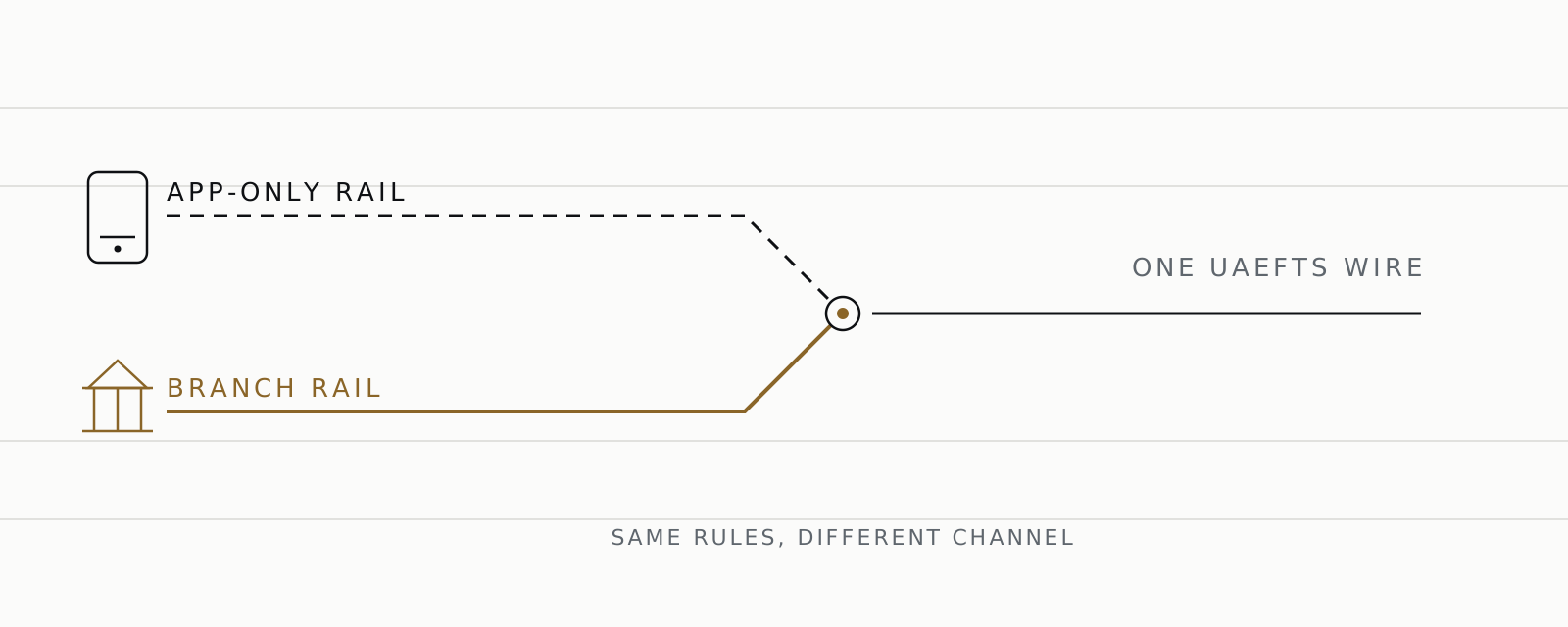
The distinction matters less for a depositor than the marketing suggests. Every one of these four falls under CBUAE supervision, the same anti-money-laundering law and the same reporting duties as a decades-old branch network — what changes is the delivery channel, not the rulebook.
Can a Wio or digital bank account receive crypto-sale proceeds?
Yes — a Wio, Zand, Liv or Mashreq Neo account can receive proceeds from a crypto sale, provided the sender is a licensed counterparty and the transfer lands in an account bearing your own name. Digital banks apply the same test any UAE bank uses on a crypto inflow: who sent the money, whether the sender is regulated, and whether the amount matches your declared profile.
Digital banks tend to run a smaller compliance team than a universal bank with decades of crypto-adjacent files, which cuts both ways. Routine transfers often clear faster because the process is templated end to end, while anything unusual is more likely to sit in a queue with no branch to visit in person.
How does a digital bank's review of crypto inflows differ from a traditional bank?
A digital bank reviews a crypto-derived inflow through the same app and chat channel used for every other service request, while a traditional bank can route a large or unusual credit to a dedicated relationship manager or private banking desk. Both outcomes rest on the same underlying CBUAE rules; the difference is mostly in who answers and how fast.
| Factor | Digital bank (Wio, Zand, Liv, Mashreq Neo) | Traditional bank |
|---|---|---|
| Onboarding | Fully in-app, minutes to a day | Branch or app, typically 1–3 business days |
| Relationship manager | Rare or none; support via in-app chat | Often available above a balance threshold |
| Escalation for a large inflow | In-app document upload, ticket-based | Dedicated compliance or private banking contact |
| Branch visit option | None | Available for original documents or urgent queries |
| AED settlement rail | UAEFTS, same business day | UAEFTS, same business day |
The settlement rail is identical either way; what differs is how a bank reaches you once a file needs a document you have not yet sent.
What transfer limits should you expect on a digital bank account?
Every UAE bank, digital or traditional, sets its own per-transaction and daily transfer limits inside the CBUAE's regulatory framework — there is no single published ceiling that applies to Wio, Zand, Liv or Mashreq Neo as a category. A digital bank's default limits are often set lower than a traditional bank's business or private tier, because the product is built for everyday spending rather than seven-figure settlements.
Domestic instant transfers in the UAE run over Aani, and Aani itself carries scheme-wide caps that sit well below a typical OTC ticket size. A UAEFTS wire, not an Aani payment, is the rail an OTC desk actually uses to settle AED, and it is not subject to the Aani cap.
What documents does a digital bank ask for on a crypto-sourced inflow?
A digital bank asks for the same documents a traditional bank would request on a crypto-derived credit: the trade confirmation from the OTC desk, a wallet or exchange statement showing the coins' origin, and — above a certain size — a short letter explaining the source of the underlying wealth. The request usually arrives as an in-app upload task rather than a phone call or a branch appointment.
Our guide to source-of-funds documents for crypto lists what to keep on file before you trade, and assembling it in advance is the single biggest speed-up for any bank, digital or not.
When does a digital bank escalate to enhanced due diligence?
A digital bank escalates a crypto inflow to enhanced due diligence on the same triggers as any UAE bank: a large or unusual amount, a sender name that does not match the account holder, or wallet history touching a sanctioned or high-risk address. Our guide to enhanced due diligence on large crypto conversions covers the process end to end.
The practical difference at a digital bank is the absence of an in-person route through escalation. Everything happens through the app's document centre and support chat, so response times depend heavily on how complete your first upload is.
When should a founder open a second account at a traditional bank?
A founder or freelancer should open a second account at a traditional bank once ticket sizes regularly exceed the digital bank's own transfer limits, once the business needs a named relationship manager for recurring six- or seven-figure settlements, or once a digital bank account sits under review with no clear timeline. Running one licensed OTC desk relationship into two receiving banks does not slow the trade down — the quote and the USDT transfer are unaffected either way.
If a digital bank does restrict or close an account that holds crypto-sale proceeds, the exit needs the same paper trail as the deposit did; our guide to closing a UAE bank account that holds crypto-sale proceeds covers that process. Keeping a second bank relationship warm before you need it is cheaper than opening one under pressure.
What is the practical route from selling USDT to money in a Wio-type account?
The route from a USDT sale to money in a digital bank account has four steps, and the account-opening step is the one worth doing before the trade, not after.
-
STEP 1
Open the desk account early
Passport and proof of address for an individual, or licence and ownership documents for a company; the full document list is in our onboarding section. Approval takes one business day in most cases.
-
STEP 2
Check your bank's own transfer limits
Open your digital bank's app or fee schedule and confirm the per-transaction ceiling before you request a quote for a large ticket, so the settlement does not stall on the receiving end.
-
STEP 3
Request a quote and send USDT
State the amount; the desk returns one all-in price held for a defined window, and you send USDT only after accepting the quote in writing. Check the desk's licence number in the licence section before you send anything.
-
STEP 4
Receive AED or USD in your own account
AED goes out by UAEFTS the same business day; USD goes by SWIFT and takes 2 to 5 business days. A licensed desk pays only to an account in your own name, digital or traditional.
The bottom line on Wio and digital banks for crypto proceeds
Wio, Zand, Liv and Mashreq Neo are real, CBUAE-supervised banks that can receive crypto-sale proceeds under the same rules as any traditional bank. Prepare the same source-of-funds file, check your digital bank's own transfer limits before a large ticket, and keep a traditional bank relationship warm for the day a seven-figure settlement needs a human on the phone.
FAQ
Is Wio Bank actually regulated like a traditional UAE bank?
Yes — Wio Bank PJSC holds a full banking licence from the Central Bank of the UAE, the same regulator that supervises FAB, Emirates NBD and Mashreq. It is not an e-money or payment-institution licence, and it carries the same anti-money-laundering obligations as any other UAE bank.
Can I receive USDT sale proceeds directly into a Wio or Zand account?
You receive AED or USD, not USDT itself — a licensed OTC desk converts your USDT and wires the fiat proceeds to your bank account. Wio and Zand can both receive that wire, provided the account is in your own name and the sender is a regulated counterparty.
Are digital bank transfer limits lower than a traditional bank's?
Often, yes, because digital banks are built around everyday spending rather than large one-off settlements, though exact limits vary by bank and account tier and change over time. Check your bank's current schedule of limits in the app before requesting a large quote.
Does a digital bank report large crypto inflows to the authorities?
Any UAE bank, digital or traditional, can file a suspicious transaction report with the Financial Intelligence Unit when a file does not close cleanly, and it is legally barred from telling you it did. A documented, licensed-sender inflow rarely reaches that point.
Should a freelancer use a digital bank or a traditional bank for crypto income?
Either works for routine amounts under the bank's own limits; the deciding factor is ticket size and whether you want a named relationship manager for larger or recurring settlements. Many founders keep a digital bank for daily operations and add a traditional account once volumes grow.
Settle crypto-sale proceeds to any UAE bank, digital or traditional
IWGT is a VARA-licensed Broker-Dealer in Dubai (VL/24/12/002). All-in spread 0.08–0.40% by size, a written trade confirmation on every deal, and AED by UAEFTS the same business day to the account you choose.
SOURCES
- Central Bank of the UAE — Licensed Financial Institutions register, accessed 17 September 2026.
- Central Bank of the UAE — payment systems (UAEFTS), accessed 17 September 2026.
- VARA public register — licence status check, accessed 17 September 2026.
- UAE Government portal — combatting money laundering (Federal Decree-Law No. 20 of 2018), accessed 17 September 2026.
- IWGT published pricing bands and onboarding requirements — IWGT published pricing bands, September 2026.
This guide is informational and is not legal, tax or investment advice, nor an invitation to buy or sell any virtual asset. It is not an official statement, endorsement or product description from Wio Bank PJSC, Zand PJSC, Liv, Mashreq Neo or any other bank named here — check current terms, limits and requirements directly with your own bank. Rules and figures are as of September 2026 — re-check the sources before acting. Virtual assets may lose their value in full or in part and are subject to extreme volatility.