
Virtual and named IBANs in the UAE: can an OTC desk settle to one?
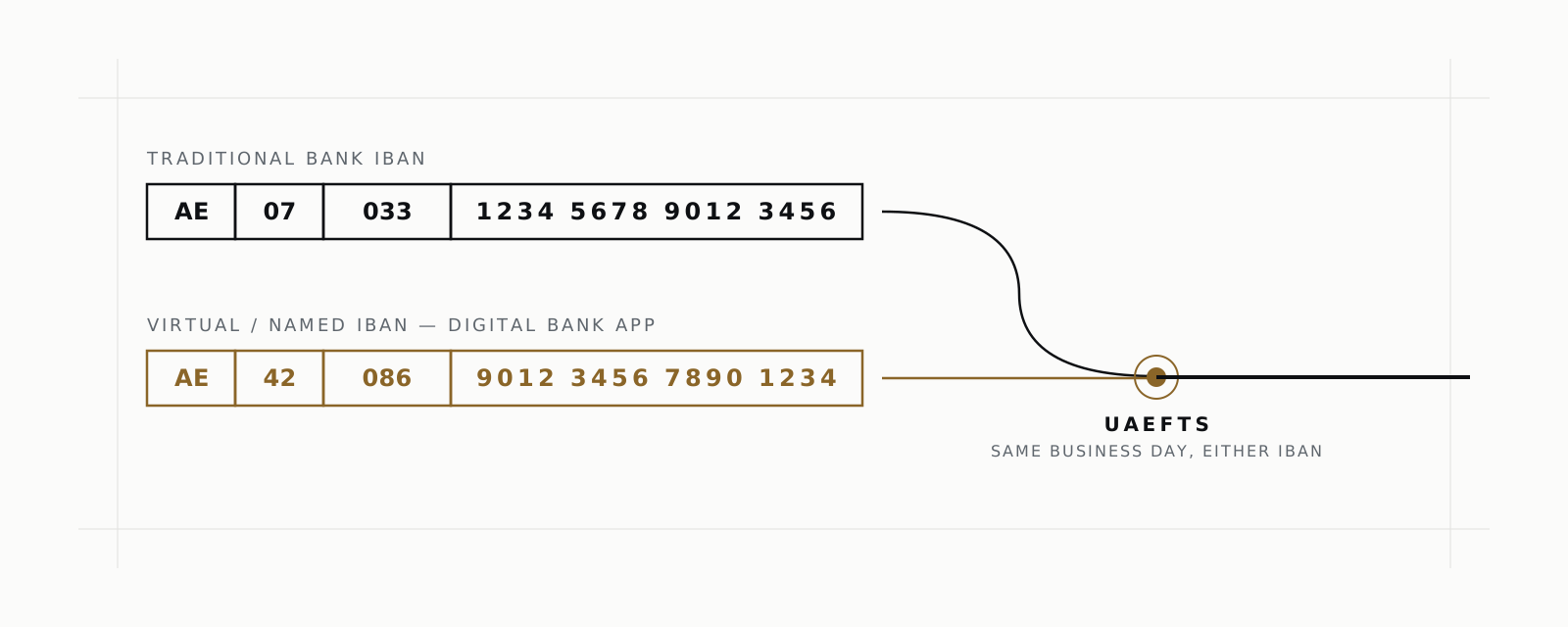
A virtual or named IBAN at Wio, Zand or a similar UAE digital bank is a standard 23-character UAE IBAN issued in your name, not a separate account type. A licensed OTC desk can settle a USDT sale to it exactly as it would to a traditional bank account, once the name on the account matches your verified identity.
KEY FACTS
| UAE IBAN format | 23 characters: AE + 2 check digits + 3-digit bank code + 16-digit account number |
|---|---|
| Digital banks referenced | Wio Bank PJSC, Zand Bank PJSC |
| Bank licence type | Full CBUAE banking licence — not an e-money or payment-institution licence |
| AED settlement rail accepted | UAEFTS, same business day |
| USD settlement rail accepted | SWIFT, 2–5 business days |
| IWGT spread | 0.08%–0.40%, by ticket size |
Source: Central Bank of the UAE licensed-institutions register, Wio and Zand official sites, and IWGT published pricing bands, as of September 2026.
What is a virtual or named IBAN at a UAE digital bank?
A virtual or named IBAN at a UAE digital bank such as Wio Bank or Zand Bank is a standard International Bank Account Number issued to one specific account holder — the "virtual" label describes how the account is opened and managed, entirely inside an app, not a lesser or shared account structure. Our wider look at Wio and other digital banks handling crypto-sale proceeds covers what these banks check on an inbound transfer.
The IBAN itself follows the same structure as any UAE bank account: 23 characters, starting with the country code AE, built from a bank identifier and an account number under the format our glossary entry on the UAE IBAN explains in full. A digital bank does not print a different kind of number — it prints the same ISO-standard string a branch-based bank would.
Not every "virtual IBAN" on the UAE market carries equal weight. Some payment institutions issue an account they market as a virtual IBAN as a sub-account of one pooled master account, under a payment-institution licence rather than a full banking licence. The Central Bank of the UAE's public register of licensed financial institutions shows which category a provider holds, and it is worth checking before treating any account as equivalent to a bank IBAN.
Are Wio and Zand licensed the same way as a traditional UAE bank?
Wio Bank PJSC and Zand Bank PJSC hold full banking licences from the Central Bank of the UAE (CBUAE), the same category of licence held by long-established banks such as FAB and Emirates NBD. Wio states on its own site that it is licensed and regulated by the CBUAE; Zand describes itself as the UAE's first fully licensed, all-digital bank, and received its banking licence in 2022.
The licence category matters more than the delivery channel. A full banking licence carries the same anti-money-laundering obligations, the same payment-system access and the same CBUAE supervision as any branch network — the app is the interface, not a separate regulatory perimeter.
Can a licensed OTC desk settle a USDT sale to a virtual or named IBAN?
Yes — a licensed OTC desk can settle a USDT sale to a virtual or named IBAN at Wio, Zand or a similar digital bank on the same terms as a payout to a traditional bank account. What the desk checks is the account, not the bank behind it: the IBAN must belong to an account held in the seller's own name, and it must clear the same anti-money-laundering screening as any other beneficiary.
A licensed desk pays only to an account in the client's own name, whichever bank issued the IBAN. Mashreq applies this same own-name rule on the traditional-bank side, and a digital bank applies it identically to its app-based account. Check the desk's own licence number in the licence section before sending anything to any counterparty.
What is a name-match check, and why does it apply to a virtual IBAN?
A name-match check compares the legal name on a settlement instruction against the name registered on the receiving IBAN, and it applies to a virtual or named IBAN exactly as it applies to a traditional bank account. UAE anti-money-laundering law requires regulated entities to identify the parties to a transaction and verify that funds move between established identities, under Federal Decree-Law No. 20 of 2018 on combatting money laundering.
A mismatch is the most common reason a settlement instruction gets queried, at a digital bank or a traditional one. An IBAN opened by an individual but funded on behalf of a company, or an account belonging to a relative rather than the seller, will not pass the check regardless of which bank issued it.
Keeping the paper trail ready helps either way. Our guide to source-of-funds documents for crypto lists what to prepare, and the same file works whether the receiving IBAN sits at a digital bank or a branch network.
How does a UAEFTS payment to a virtual IBAN differ from a card top-up?
A UAEFTS payment to a virtual IBAN is a bank-to-bank wire settled the same business day, while a card top-up credits a Visa or Mastercard card number directly through Visa Direct or Mastercard Send. Both can reach a Wio or Zand customer, but they move over different rails with different rules on size and finality.
| Rail | Settles to | Practical ceiling | Reversal risk |
|---|---|---|---|
| UAEFTS wire | Bank IBAN, digital or traditional | No practical cap | Not reversible by network rule |
| Card top-up (Visa Direct / Mastercard Send) | Card number, not an IBAN | Low thousands USD per transaction | Can be held or reversed during issuer review |
A wire settles to the account holder's own IBAN with no practical ceiling; a card top-up settles to a card number with a low cap and a softer, reversible credit — the full figures sit in our push-to-card guide.
Why do OTC desks use the bank rail rather than card top-up for large settlements?
A licensed OTC desk uses the bank rail rather than a card top-up for large settlements because a card credit is capped low, priced as a percentage fee and reversible under network rules, while a wire to a named IBAN carries none of those constraints. Push-to-card payouts are priced and capped for small, urgent retail payments, not six- and seven-figure trades.
A card top-up also settles to a card number rather than to an account holder's IBAN, which weakens the own-name settlement check a licensed desk relies on. A UAEFTS wire to a virtual or named IBAN keeps that check intact, because the IBAN is tied to one verified account holder from the moment the issuing bank creates it.
What is the practical route from a USDT sale to a virtual IBAN?
The route from a USDT sale to money in a Wio- or Zand-type account has four steps, and confirming the account name is the step worth doing before you request a quote, not after.
-
STEP 1
Open the desk account and add your IBAN
Passport and proof of address for an individual, or trade licence and ownership documents for a company; the full list is in our onboarding section. Add the IBAN from your Wio or Zand app exactly as it appears on your statement.
-
STEP 2
Confirm the account name matches your KYC record
The name registered on the IBAN must match the name on your passport or trade licence. A mismatch stalls the settlement instruction before any money moves.
-
STEP 3
Request a quote and send USDT
State the amount; the desk returns one all-in price held for a defined window, and you send USDT only after accepting the quote in writing.
-
STEP 4
Receive AED or USD in your own account
AED goes out by UAEFTS the same business day; USD goes by SWIFT and takes 2 to 5 business days. Digital or traditional, the desk pays only to an account in your own name.
The bottom line on virtual IBANs and OTC settlement
A virtual or named IBAN at Wio, Zand or a similar UAE digital bank is a full 23-character UAE IBAN held in your name, and a licensed OTC desk can settle to it exactly as it would to a traditional bank account. Confirm the account name matches your KYC record, keep your source-of-funds file ready, and use the bank rail rather than a card top-up for anything beyond a small, urgent amount.
FAQ
Is a virtual IBAN at Wio or Zand a real bank account?
Yes. Wio Bank PJSC and Zand Bank PJSC both hold full banking licences from the Central Bank of the UAE, and the IBAN each issues is a standard 23-character UAE IBAN held in the customer's own name, not a pooled or sub-account structure.
Can IWGT pay AED into a Wio or Zand IBAN?
Yes, provided the IBAN belongs to an account in your own name and it passes the same name-match and source-of-funds checks IWGT applies to any beneficiary. The payment goes out by UAEFTS the same business day, exactly as it would to a traditional bank account.
Why can't I just receive crypto-sale proceeds as a card top-up?
A card top-up through Visa Direct or Mastercard Send is capped in the low thousands per transaction and priced as a percentage fee, and issuers can hold or reverse an inbound credit during a review. A UAEFTS wire to your named IBAN has no such practical cap and is not reversible by network rule.
Does using a named IBAN at a digital bank change settlement time?
No. UAEFTS settles AED the same business day regardless of whether the receiving IBAN sits at a digital bank or a traditional one — the rail and the timing are identical; only the account-opening channel differs.
What is a name-match check and why does it apply to a virtual IBAN?
A name-match check confirms the legal name on a settlement instruction matches the name on the receiving IBAN, as required under UAE anti-money-laundering law. It applies identically at a digital bank and a traditional bank — the check looks at the account holder, not the app the account lives in.
Settle to any own-name UAE IBAN, digital or traditional
IWGT is a VARA-licensed Broker-Dealer in Dubai (VL/24/12/002). All-in spread 0.08–0.40% by size, a written trade confirmation on every deal, and AED by UAEFTS the same business day to the account you choose.
SOURCES
- Wio Bank — official site, licensing statement, accessed 22 September 2026.
- Zand Bank — official site, licensing statement, accessed 22 September 2026.
- Central Bank of the UAE — Licensed Financial Institutions register, accessed 22 September 2026.
- Central Bank of the UAE — payment systems (UAEFTS), accessed 22 September 2026.
- UAE Government portal — combatting money laundering (Federal Decree-Law No. 20 of 2018), accessed 22 September 2026.
- IWGT published pricing bands and onboarding requirements — IWGT published pricing bands, September 2026.
This guide is informational and is not legal, tax or investment advice, nor an invitation to buy or sell any virtual asset. It is not an official statement, endorsement or product description from Wio Bank PJSC, Zand Bank PJSC or any other bank named here — check current terms and account types directly with your own bank. Rules and figures are as of September 2026 — re-check the sources before acting. Virtual assets may lose their value in full or in part and are subject to extreme volatility.