
EMI accounts for VASPs: banking options for a virtual asset business in the UAE
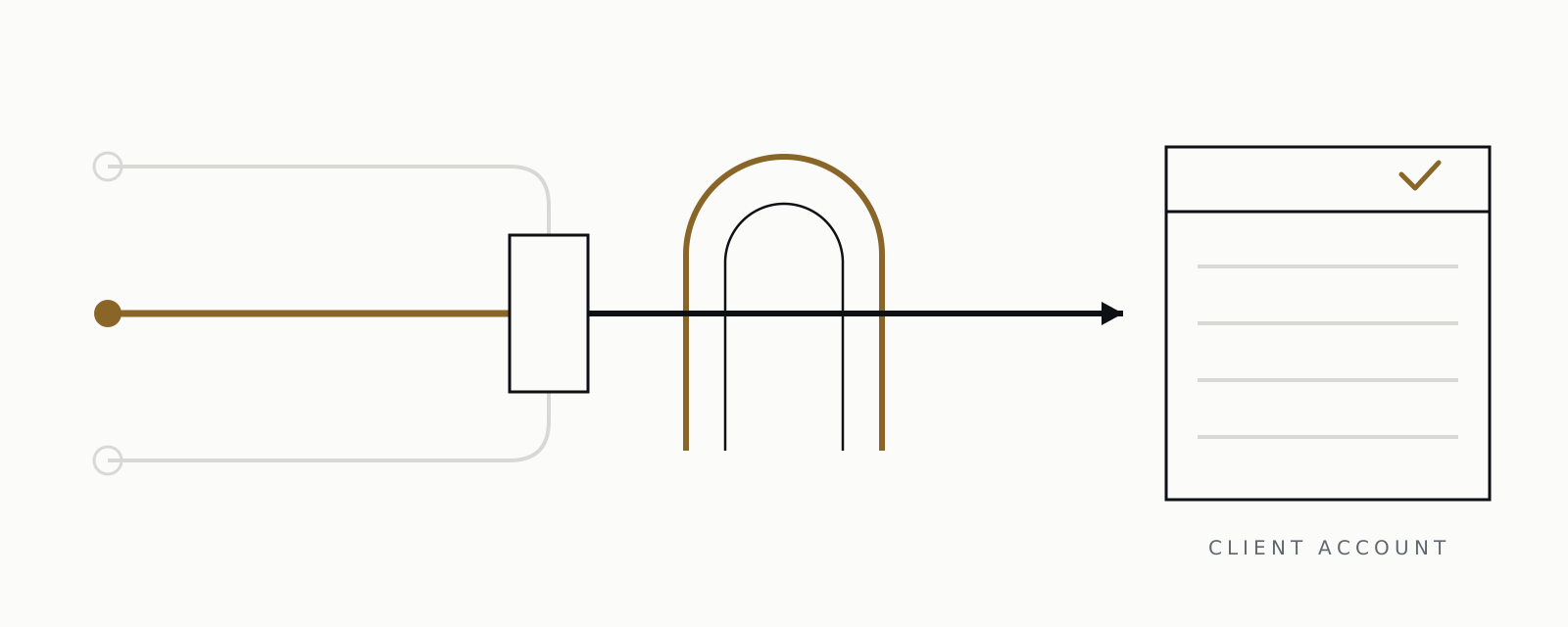
In the UAE, "EMI" is not a Central Bank licence category. E-money style products are regulated as stored value facilities and retail payment services, and neither is a bank deposit account. VARA's Client Money Rules send client funds to Client Accounts at UAE banks authorised to take deposits, so the account type matters.
KEY FACTS
| "EMI" as a CBUAE licence name | Not used; see SVF and Retail Payment Services regulations |
|---|---|
| SVF Regulation | Circular C 6/2020, in force since 30 October 2020 |
| Retail Payment Services and Card Schemes Regulation | Circular C 15/2021 |
| SVF licence | Prior CBUAE licence required, with an exception for single-purpose facilities |
| VARA client money deadline | Client Account within 1 calendar day of receipt |
| Desk AED settlement (IWGT) | UAEFTS, same business day |
Source: CBUAE Rulebook and VARA Rulebooks, as of October 2026.
What does "EMI" mean for a business in the UAE?
An electronic money institution (EMI) is a UK and EU licence category, and the Central Bank of the UAE (CBUAE) does not use it as a licence name. The CBUAE regulates comparable products under two instruments: the Stored Value Facilities (SVF) Regulation and the Retail Payment Services and Card Schemes Regulation.
The SVF Regulation is Circular C 6/2020 and has been in force since 30 October 2020, according to the CBUAE Rulebook as of October 2026. It requires a prior CBUAE licence to issue or operate a stored value facility, with an exception for single-purpose facilities.
The Retail Payment Services and Card Schemes Regulation is Circular C 15/2021. It covers payment account issuance and other retail payment services, and it also licenses card schemes. Neither regulation turns the provider into a bank, so a deposit-style balance with such a provider is not a bank deposit. For how a full bank account behaves with crypto proceeds, see our note on virtual and named IBANs at UAE digital banks.
How do an SVF, a payment account and a bank account differ?
A bank account, a stored value facility and a payment account differ in who licenses the provider, what protects your balance and what the rules allow it to hold. The table sets out the three routes using the CBUAE Rulebook as of October 2026.
| Route | Governing rules | How customer money is protected | Fits |
|---|---|---|---|
| Bank deposit account | Banking licence from the CBUAE | Deposit with a licensed bank | Own-name IBAN, UAEFTS receipts |
| Stored value facility | SVF Regulation, C 6/2020 | Float kept apart from the licensee's own funds; segregated accounts at licensed banks, or a guarantee or insurance alternative | Wallet and prepaid style balances |
| Payment account | Retail Payment Services and Card Schemes Regulation, C 15/2021 | Segregation if settled within 24 hours; escrow, insurance or guarantee if later | Funds in transit only |
The takeaway is that the protection model changes with the route. The Rulebook describes a payment account as a place for funds in transit, not for storing balances, which is a poor match for a business that needs to hold money.
SVF licensees also face capital requirements set by the CBUAE, which you can read in the Rulebook before choosing a provider. These are conditions on the provider, not features of your account.
What do VARA rules say about where client money sits?
The VARA Compliance and Risk Management Rulebook, Part IV (Client Money Rules), requires a VASP holding client money to hold it in a Client Account. The page version is dated 19 May 2025 and was accessed on 24 October 2026. The framework itself is covered in our overview of the VARA regulatory framework.
- Account title. Every Client Account must include the words "Client Account" in its title (IV.B.3).
- Timing. Client money goes into a Client Account within one calendar day of receipt, subject to listed exceptions (IV.B.5).
- Location. Money held for UAE clients goes to Client Accounts at UAE third-party banks. Money for clients outside the UAE may first sit with foreign banks but must reach a UAE bank within 24 hours (IV.B.5).
- Bank eligibility. The bank must be validly authorised to accept deposits and must not be in the VASP's group (IV.C.1).
- Acknowledgement. The VASP must promptly obtain a written acknowledgement that the bank may not combine the account with other accounts or set off against it (IV.C.3). Without it, deposits stop and balances are withdrawn (IV.C.4).
- Reconciliation. Client Accounts are reconciled daily against client ledgers, the cash book and bank balances (IV.E.1 to IV.E.3).
The Rulebook adds that a VASP may not use one client's money to meet another client's obligation or for its own liquidity (IV.B.10).
Can a VASP use an EMI-style account for client money?
The VARA rule text names banks authorised to accept deposits as the place for Client Accounts, and a stored value or payment provider is licensed under a different CBUAE regulation, not as a bank. A VASP therefore cannot assume that an EMI-style account satisfies the Client Money Rules.
This is a reading of the published wording, not a VARA ruling. Whether any particular arrangement is acceptable is a question for VARA and the firm's compliance officer. The same caution applies to a provider's marketing: only its own terms, plus the CBUAE and VARA texts, tell you what the account is.
Operating accounts are a separate matter. Paying suppliers or staff does not involve client money, so the Client Money Rules do not decide that choice. A provider's own fees, limits and onboarding terms do, and those are published on its own site.
How do you check a provider before opening an account?
Checking a provider means confirming what it is licensed to do, who holds the money and what you receive in your own name. Work through these steps in order.
- Find the licence. Look the provider up in the CBUAE register of licensed institutions and note the licence type: bank, SVF or payment service provider.
- Read the safeguarding terms. Ask where customer funds are held and under which regulation, using the table above as a checklist.
- Ask for the IBAN. A UAE IBAN issued in your entity's name matters for settlement. An IBAN certificate from the provider is the usual proof.
- Check the counterparty rules. Banks review inbound crypto proceeds on documented source of funds, as covered in what UAE bank compliance teams look for.
- Document the choice. Keep the licence evidence and safeguarding terms in your compliance file.
What does this mean when you sell USDT to a licensed desk?
A seller receiving AED needs an account that accepts a UAEFTS transfer and carries the seller's own name. IWGT settles AED the same business day via UAEFTS, with a spread of 0.08% to 0.40% by ticket size, as published on the pricing bands as of October 2026.
Beneficiary requirements and checks are described under onboarding. IWGT operates under VARA licence VL/24/12/002, and the entity detail is shown in the licence section. This article does not say which provider any desk or client uses, and no account type is recommended here.
FAQ
Is there an EMI licence in the UAE?
Not under that name. The Central Bank of the UAE licenses stored value facilities under its SVF Regulation and payment service providers under its Retail Payment Services and Card Schemes Regulation. "EMI" is the UK and EU label for a comparable e-money business.
Is an EMI-style account the same as a UAE bank account?
No. A bank account is a deposit with a bank licensed by the Central Bank. A stored value or payment account is held with a provider licensed under a different regulation, with its own safeguarding rules for customer funds.
Can a VASP keep client money in a payment or SVF account?
The VARA Client Money Rules say Client Accounts may only be held at banks authorised to accept deposits, and that money held for UAE clients goes to UAE banks. Confirm any other structure with VARA and your compliance officer before relying on it.
How fast must a VASP place client money in a Client Account?
Within one calendar day of receipt, subject to the listed exceptions, per Part IV of the VARA Compliance and Risk Management Rulebook (version dated 19 May 2025, accessed 24 October 2026). Money held for clients outside the UAE must move to a UAE bank within 24 hours.
Does the account type change how I receive AED from an OTC desk?
The practical test is the same: an account in your own name that can receive a UAEFTS transfer. A provider that cannot show a UAE IBAN in your name, or that you cannot verify on the Central Bank register, is a reason to pause.
Settle AED to an own-name UAE account
IWGT is a VARA-licensed Broker-Dealer in Dubai (VL/24/12/002). All-in spread 0.08% to 0.40% by size, and AED by UAEFTS the same business day to an account in your own name.
SOURCES
- VARA Rulebooks: Compliance and Risk Management Rulebook, Part IV Client Money Rules, Section B (Treatment of Client Money), accessed 24 October 2026.
- VARA Rulebooks: Compliance and Risk Management Rulebook, Part IV, Sections C (Third-Party Bank) and E (Reconciliation), accessed 24 October 2026.
- CBUAE Rulebook: Stored Value Facilities (SVF) Regulation, C 6/2020, including Article 11 on safekeeping of the float, accessed 24 October 2026.
- CBUAE Rulebook: Retail Payment Services and Card Schemes Regulation, C 15/2021, including Article 14, accessed 24 October 2026.
- Central Bank of the UAE: licensed financial institutions register, accessed 24 October 2026.
- IWGT published pricing bands and licence details: pricing and licence, October 2026.
This guide is informational and is not legal, tax or investment advice, nor an invitation to buy or sell any virtual asset. Rules and figures are as of October 2026 — re-check the sources before acting. Virtual assets may lose their value in full or in part and are subject to extreme volatility.