
What is an Emirates ID? The UAE identity card explained
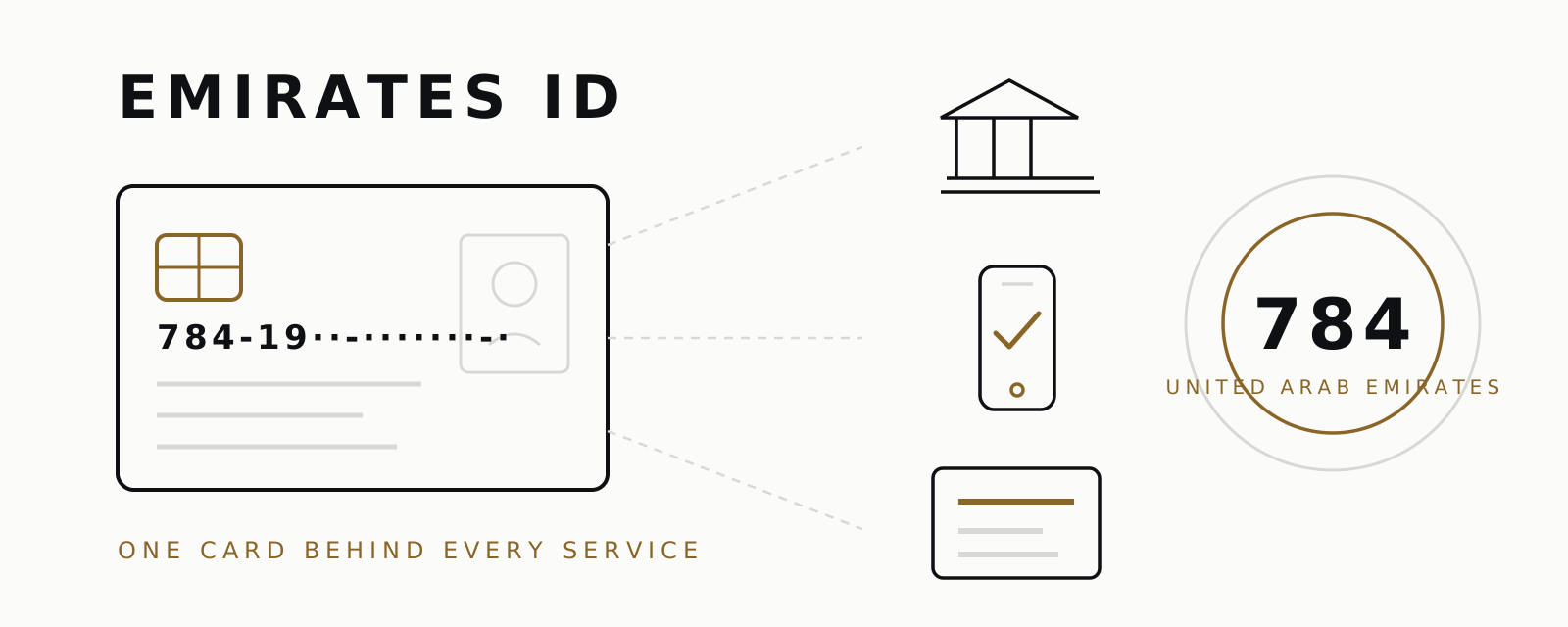
The Emirates ID is the UAE's mandatory identity card for citizens and residence-visa holders, issued by the Federal Authority for Identity, Citizenship, Customs and Port Security (ICP). It carries a 15-digit number, a biometric chip, and anchors your bank account, your KYC checks and your settlement details.
KEY FACTS
| What it is | Mandatory identity card for UAE citizens and residents |
|---|---|
| Issued by | ICP, the Federal Authority for Identity, Citizenship, Customs and Port Security |
| Number format | 15 digits, starting 784 and embedding the birth year |
| Validity (residents) | Matches the residence visa (1, 2, 3, 5 or 10 years by visa type) |
| Used for | Bank accounts, KYC, telecom, tenancy, government services |
Source: ICP and the UAE Government portal, as of September 2026.
How does the Emirates ID work in the UAE?
The card is the identity record behind banking, telecom, tenancy and government portals. Its 15-digit number starts with 784, the UAE's country code, then the holder's birth year, a serial and a check digit; the chip stores photograph, signature and fingerprints. The same record powers UAE PASS, the national digital login, and doubles as a payment address on Aani, the instant payment rail. For residents its validity matches the residence visa, so a visa renewal means a card renewal through the ICP.
What role does it play in KYC?
Banks open a resident's account against the Emirates ID, and licensed institutions verify it during KYC. A resident selling USDT provides a passport plus the Emirates ID, because the payout account is registered to that card, so name, ID number and account holder must match exactly; non-residents are identified on a passport. At size the desk also asks for source-of-funds evidence; see the onboarding section.
Why it matters when selling USDT in the UAE
A licensed desk pays only to an IBAN in your own name, and UAE banks can restrict an account whose Emirates ID on file has expired until the renewed card is registered; see how to avoid a bank freeze on crypto proceeds.
Illustrative example
A resident sells 400,000 USDT at a 0.15% spread: gross AED 1,469,000 at the 3.6725 peg, spread AED 2,203.50, net AED 1,466,796.50, wired the same day by UAEFTS. The client's Emirates ID expired the previous month, so the bank holds the transfer pending the renewed card: days of renewal instead of same-day funds. Check the expiry date before you schedule the trade.
FAQ
Can I sell USDT in the UAE without an Emirates ID?
Yes, if you are not a UAE resident — a licensed desk onboards non-residents on a passport and proof of address. Residents should expect the Emirates ID to be requested alongside, because their bank account is tied to it.
Does an expired Emirates ID affect my bank account?
Yes. UAE banks can restrict or freeze an account once the Emirates ID on file expires, until you register the renewed card. Check the expiry date before scheduling a large settlement.
Is the Emirates ID the same as UAE PASS?
No. The Emirates ID is the physical card with a chip; UAE PASS is the national digital identity app built on the same record. Banks and government services accept UAE PASS as a login, but the card remains the underlying document.
Do tourists need an Emirates ID?
No. The card is mandatory only for UAE citizens and residence-visa holders. Visitors trade and bank on their passport, with a home-country proof of address for onboarding.
KYC once, then same-day settlement on every trade
IWGT is a VARA-licensed Broker-Dealer in Dubai. Account approval takes one business day in most cases; after that, AED settles the same business day you trade, to an account in your own name. All-in spread 0.08–0.40% by size, published openly.
SOURCES
- Federal Authority for Identity, Citizenship, Customs and Port Security (ICP) — issuing authority for the Emirates ID, accessed 11 September 2026.
- UAE Government portal — Emirates ID — card purpose, number and services, accessed 11 September 2026.
- UAE Government portal — general provisions for the residence visa (Emirates ID expires with the visa; visa terms of 1, 2, 3, 5 or 10 years), accessed 14 September 2026.
- IWGT onboarding requirements and published pricing bands — IWGT published pricing bands, September 2026.
This guide is informational and is not legal, tax or investment advice, nor an invitation to buy or sell any virtual asset. Rules and figures are as of September 2026 — re-check the sources before acting. Virtual assets may lose their value in full or in part and are subject to extreme volatility.