
Can a crypto off-ramp app cash out 100k+ USDT to a UAE bank, or do you need an OTC desk?
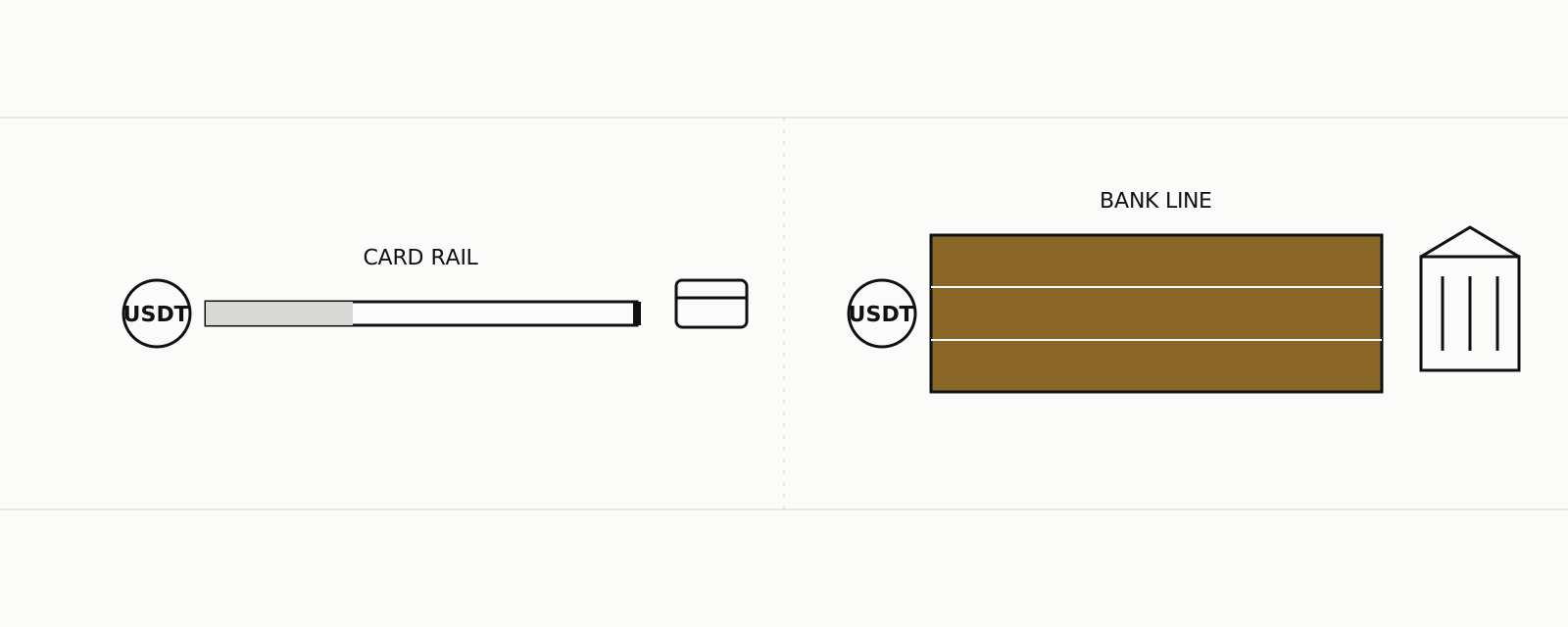
Off-ramp apps are built for retail tickets. They carry per-transaction and monthly caps, pay out by card or SEPA, and often have no route from AED to a UAE IBAN. Above about 100,000 USDT, a VARA-licensed desk paying AED by UAEFTS the same business day is the working route.
KEY FACTS
| Size where desks take over | From about 100,000 USDT |
|---|---|
| IWGT sell spread, 100k / 500k / 2M / 10M | 0.40% / 0.25% / 0.15% / 0.08% |
| AED settlement | Same business day by UAEFTS, before bank cut-off |
| USD settlement | 2 to 5 business days by SWIFT |
| Provider data checked | 15 October 2026 |
Source: IWGT published pricing bands and the provider pages listed under Sources, as of October 2026.
Can a crypto off-ramp app in the UAE handle 100,000 USDT or more?
A crypto off-ramp app is a retail product, and its published terms are written for retail tickets. Searches for a crypto off ramp UAE or crypto off ramp Dubai usually mean one of two things: a card-or-bank widget inside a wallet, or the sell button on an exchange. Both can move small amounts well. Neither publishes a ceiling that a six-figure ticket can rely on.
The term on-ramp and off-ramp covers every service that converts between crypto and bank money, OTC desks included. The practical split is rail and size, set out below provider by provider.
What do MoonPay, Transak, Banxa and an exchange button publish for the UAE?
The table lists only what each provider's own pages and the VARA public register state on 15 October 2026. It is not a ranking, and it says nothing about what a verified account sees behind the login screen.
| Provider | VARA register, 15 Oct 2026 | Payout rails stated for the UAE | Published limits | Fee basis |
|---|---|---|---|---|
| MoonPay | No entry under this name among the 59 entries | UAE is on its Visa Direct card payout list. Bank transfer is listed for the US (ACH), UK (Faster Payments) and euro area (SEPA); none for rest of world | Minimum sell of 15 USDT (ERC-20 or TRON) on its support page. No maximum published | Percentage by payout method: "as low as 1%" for bank transfers and 4.5% for Visa cards on its sell page |
| Transak | No entry under this name among the 59 entries | Its off-ramp documentation says cards, bank transfers and Apple or Google Pay, with no UAE or AED mention. Other Transak pages returned an access error when fetched on 15 October 2026, so UAE coverage is not confirmed here | Not published on the documentation page | Integrating partners set a fee percentage in the dashboard; no end-user figure on that page |
| Banxa | No entry under this name among the 59 entries | Its UAE sell page says "Payout in AED via UAEFTS or card". Receiving account name must match the verified ID | No figure. The page says limits are "set by verification level and payout method" | No percentage published; the page says the price is locked at checkout |
| Binance (exchange sell button) | Binance FZE, VL/24/04/001, active | Sell to card runs through a third-party partner (Paymonade) in the currency you select. Binance Dubai FAQ: "Fiat Withdrawals is not available at the moment" | No figure on the sell-to-card page. Card limits tie to identity verification level, and banks may restrict crypto card transactions | No fee figure on the sell-to-card page |
Only one of the four rows publishes a UAE bank rail, and none publishes a maximum that a 100,000 USDT ticket could be planned around.
A provider absent from the register under its own name may still serve UAE users through a licensed partner or another group entity. The table claims no more than the register lists.
Why does ticket size break card-rail off-ramp apps?
Ticket size breaks card-rail off-ramp apps because several of the rails they use are card payouts and regional bank schemes (ACH, Faster Payments, SEPA) rather than a UAE dirham bank route. MoonPay's payout table, for example, lists the UAE only on a Visa card route, with timing of "instant up to 1 business day". Our guide to push-to-card limits covers how those per-payout ceilings behave in practice.
The second brake is verification. Banxa states that limits move with verification level and payout method, and Binance ties account limits to identity verification level. A cap that rises as you submit more documents is a cap you discover mid-trade, one verification tier at a time.
The third is the bank on the receiving end. Binance's own FAQ notes that some banks and card providers restrict crypto transactions under internal policy. That is a separate brake from the app's own cap: even a payout the app allows can be held at the receiving end.
Does an exchange's sell-to-bank or sell-to-card button solve it?
An exchange's sell-to-bank or sell-to-card button solves it only if the exchange itself has an AED bank rail open to you at the size you need. The Binance row shows why: the card option is partner-run, and its Dubai FAQ says fiat withdrawals are not available at the moment.
Exchange ceilings are covered in exchange withdrawal limits in the UAE. The full comparison of routes is in the best way to cash out crypto in the UAE; this page deals only with the app-versus-desk decision.
When is a licensed OTC desk the working route, and what does it cost?
A licensed OTC desk is the working route for a fiat off-ramp at 100,000 USDT or more because it prices the whole ticket at once and pays out by bank transfer. IWGT is the VARA-licensed Broker-Dealer behind this site (VL/24/12/002; the licence section of the main page links the register entry).
| Ticket (USDT) | Spread | AED payout | USD payout |
|---|---|---|---|
| 100,000 | 0.40% | UAEFTS, same business day | SWIFT, 2 to 5 business days |
| 500,000 | 0.25% | UAEFTS, same business day | SWIFT, 2 to 5 business days |
| 2,000,000 | 0.15% | UAEFTS, same business day | SWIFT, 2 to 5 business days |
| 10,000,000 | 0.08% | UAEFTS, same business day | SWIFT, 2 to 5 business days |
The spread falls as the ticket grows; the bands are in the published pricing section.
Illustrative example. Selling 500,000 USDT at the 0.25% tier costs 1,250 USDT in spread, about AED 4,590 at the 3.6725 peg. Same-day AED applies on banking days and before the receiving bank's cut-off. The figures are arithmetic on the published band, not a quote.
Does the same logic apply to an OTC on-ramp in Dubai?
An OTC on-ramp in Dubai works in reverse: you send a bank transfer in AED and receive USDT. The buy-side spread is 0.40%, 0.25%, 0.20% and 0.15% at 100k, 500k, 2M and 10M, so it matches the sell side to 500k and is higher above it, because the desk has to source the coin. From 10M the price is by request.
What should you confirm before sending 100,000 USDT through any route?
- The legal entity paying you, and its entry in the VARA public register.
- The payout rail to your own IBAN in AED, in writing, not a card or a euro account.
- A maximum per transaction and per month for your verification tier, in numbers.
- Whether the price is fixed for a window before you send, or set at arrival.
- Whether the account name on the receiving bank must match your verified identity.
FAQ
What is a fiat off-ramp?
A fiat off-ramp is any service that converts crypto into bank money and pays it out. Apps, exchanges and OTC desks are all off-ramps; they differ in ticket size, payout rail and who holds the licence.
Is there a minimum size at which an OTC desk makes sense?
IWGT quotes from about 100,000 USDT and publishes tiers at 100k, 500k, 2M and 10M. Below that size an exchange or app is usually the simpler route.
Does an OTC desk also work as an on-ramp in Dubai?
Yes. On the buy side you send a bank transfer and receive USDT. IWGT's buy spread is 0.40%, 0.25%, 0.20% and 0.15% at the 100k, 500k, 2M and 10M tiers, with price on request from 10M.
How fast does AED arrive from an OTC desk?
AED goes out by UAEFTS the same business day, before the bank cut-off. USD goes by SWIFT and takes 2 to 5 business days.
Why do the apps publish no maximum?
Several providers tie the cap to verification level and payout method and show it only inside the order flow. The absence of a published maximum is not the same as having no maximum.
Quote for a 100k+ USDT cash-out
IWGT is a VARA-licensed Broker-Dealer in Dubai. Spread 0.08% to 0.40% by size, published openly, with AED by UAEFTS the same business day on approved accounts.
SOURCES
- VARA public register, 59 entries reviewed for provider names, accessed 15 October 2026.
- MoonPay, supported payment methods (payout rails, Visa Direct country list), accessed 15 October 2026.
- MoonPay, supported withdrawal methods for selling, accessed 15 October 2026.
- MoonPay, how can I sell cryptocurrency (minimum sell amounts), accessed 15 October 2026.
- MoonPay, sell Tether (fee range by method), accessed 15 October 2026.
- Transak documentation, off-ramp, accessed 15 October 2026.
- Banxa, sell USD Coin in the United Arab Emirates, accessed 15 October 2026.
- Binance, what products does Binance Dubai offer, accessed 15 October 2026.
- Binance, sell crypto to card via Paymonade, accessed 15 October 2026.
- Binance, buy crypto with card (limits and bank restrictions), accessed 15 October 2026.
- IWGT published pricing bands: IWGT pricing, October 2026.
This guide is informational and is not legal, tax or investment advice, nor an invitation to buy or sell any virtual asset. Rules and figures are as of October 2026, so re-check the sources before acting. Virtual assets may lose their value in full or in part and are subject to extreme volatility.