
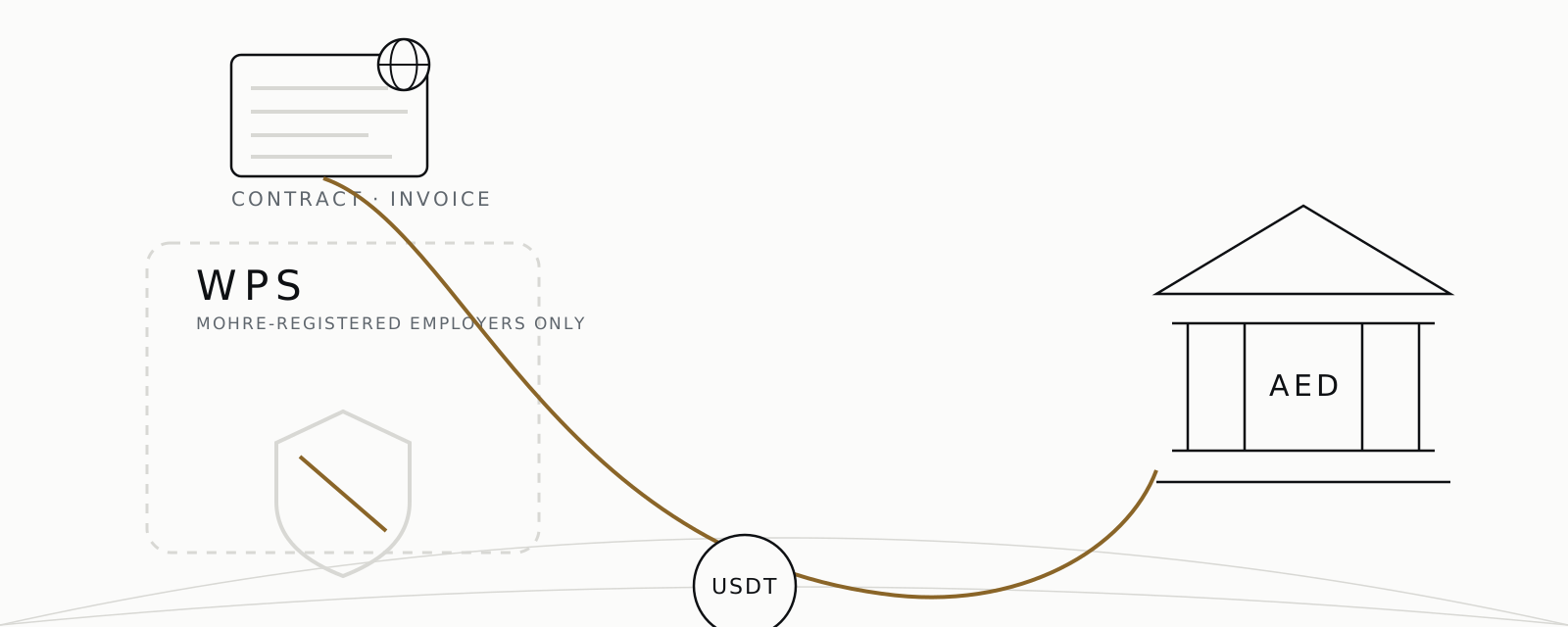
Paid in USDT by a foreign employer: cashing out without WPS in the UAE
If your USDT salary or invoice comes from an employer or client that is not registered with MOHRE in the UAE, the Wage Protection System does not apply. That is a different case, not a violation. Your contract, invoices and payment records take the place of a WPS payslip when a bank or licensed desk asks for source of funds.
KEY FACTS
| WPS covers | Private-sector establishments registered with MOHRE in the UAE |
|---|---|
| Your situation | Employer or client has no UAE registration: outside WPS, not a breach of it |
| Payslip substitute | Employment/service contract, invoices, payment correspondence |
| Conversion regulator | VARA (Dubai), licence VL/24/12/002 |
| IWGT spread (selling USDT) | 0.08%–0.40%, by ticket size |
| Settlement | AED same business day (UAEFTS); USD 2–5 business days (SWIFT) |
Source: UAE Government portal (u.ae), MOHRE and IWGT published pricing bands, as of October 2026.
Why doesn't the Wage Protection System apply to a foreign employer's payment?
The Wage Protection System (WPS) is a MOHRE-run framework that covers only private-sector establishments registered with the Ministry of Human Resources and Emiratisation in the UAE. A company incorporated abroad, with no UAE trade licence and no MOHRE establishment file, sits outside that system by definition. There is no registration for it to comply with, and no WPS record for you to produce.
This is a different question from getting a salary in crypto in the UAE, which looks at a MOHRE-registered UAE employer choosing to pay part of a locally regulated wage in tokens while the dirham portion still runs through WPS. Here the employer itself is never inside MOHRE's system, so there is no WPS leg to reconcile against at all. Neither case is irregular; they just answer different questions.
Who actually falls into this no-WPS case?
Three groups of UAE residents typically receive USDT with no WPS record behind it: remote employees on a payroll run by a company with no UAE entity, independent contractors invoicing an overseas client directly, and consultants retained under a service agreement with a foreign firm. In each case the payer never files anything with MOHRE, so the absence of a WPS record describes the structure, not a problem with it.
The dividing line is the payer's registration, not your visa or residency. A UAE resident and a UAE company can both pay you in a way that never touches WPS if the paying entity itself has no UAE establishment file.
What documents replace a WPS payslip for source of funds?
A signed contract, your invoices and the correspondence confirming each payment replace a WPS payslip when a bank or desk asks where USDT income comes from. Where a MOHRE-registered employee's bank statement shows a WPS-matched credit, yours shows a wire or token transfer that these documents explain.
| WPS-registered employee has | You have instead | What it proves |
|---|---|---|
| Salary Information File entry | Signed employment or service contract | Who pays you, how much, in what currency |
| MOHRE-registered labour contract | Offer letter or engagement email from the employer/client | The relationship exists outside a bank statement |
| Monthly WPS-matched payslip | Invoices or payout statements from the payer's own system | Each payment ties to a specific period of work |
| Bank credit labelled "salary" | Desk's written trade confirmation for each conversion | The USDT-to-AED leg is accounted for, not just the inflow |
None of these documents is optional on its own; together they cover what a WPS record covers in one line.
Keep the file before you need it, not after a bank asks. Our general guide to source of funds for crypto in the UAE covers how banks read this file for any crypto-funded account, and the KYC documents a licensed desk itself requires to open your conversion account are a separate, shorter list.
Will a UAE bank question a USDT-funded credit with no WPS behind it?
A UAE bank can question any unusual or large inflow under its own anti-money-laundering checks, regardless of whether a WPS record exists. What a bank is actually looking for is an explained pattern: a recurring wire from a named, licensed counterparty that matches a contract and invoice trail reads as ordinary income. An unexplained lump sum with no paper behind it is what prompts a hold or a request for more information.
The absence of WPS is not itself a red flag to a bank that handles crypto-funded accounts routinely; a missing explanation is. Settling only into an account in your own name, through a desk that issues a written trade confirmation for every conversion, is what keeps the inflow legible on the bank's side.
How do you cash out a foreign-employer USDT payment through a licensed desk?
Cashing out a foreign-employer or foreign-client USDT payment follows the same four-step process as any OTC sale: account approval, a written quote, the USDT transfer, and the bank wire. The source-of-funds file above is what you bring to the first step.
-
STEP 1
Open the account with your contract and invoices ready
An individual registers with a passport and proof of address; the desk's compliance review for a foreign-paid income stream also wants the contract and recent invoices on file. The full document list sits in our onboarding section. Doing this before the next payment lands avoids a delay at the point you need the money.
-
STEP 2
Request a quote for your size
State the amount; the desk returns one all-in price held for a defined window. Below the typical desk minimum of around 100,000 USDT, accumulate several payments into one ticket or use a regulated exchange instead.
-
STEP 3
Send USDT only after accepting the quote in writing
TRC20 is the common, cheaper USDT rail in the UAE; ERC20 also works. Send against a written quote, never against a verbal rate or an address sent over an unlicensed channel.
-
STEP 4
Receive AED or USD in your own account
AED goes out by UAEFTS the same business day you trade; USD goes by SWIFT and takes 2 to 5 business days. A licensed desk settles only to an account in your own name, which is itself part of the paper trail your bank will see.
How much does cashing out cost without a WPS record?
Cashing out USDT from a foreign employer or client costs the same published spread as any other sale. The absence of a WPS record does not change the price, only the documents you bring to onboarding. IWGT's spread runs 0.08% to 0.40% depending on ticket size, published in our pricing bands.
| Ticket size (USDT) | Spread | Settlement |
|---|---|---|
| 100,000 | 0.40% | Same business day (AED) |
| 500,000 | 0.25% | Same business day (AED) |
| 2,000,000 | 0.15% | Same business day (AED) |
| 10,000,000 | 0.08% | Same business day (AED) |
Consolidating smaller payments into a larger ticket moves you down the band; the trade-off is holding USDT for longer before converting.
Illustrative example
A UAE resident works remotely for a software company incorporated outside the UAE, with no local entity and no MOHRE file, paid 42,000 USDT a month under a signed employment contract. Each payout alone sits below the roughly 100,000 USDT desk minimum, so the payments are banked and converted once a quarter: 126,000 USDT at the 0.40% tier costs 504 USDT (about AED 1,851 at the 3.6725 peg) and settles to AED the same business day. Holding six months of payouts to reach the 500,000 USDT tier instead would cost 0.25% of the larger amount, cheaper proportionally, at the cost of carrying more USDT for longer before converting it.
The bottom line on a foreign-employer USDT payment
A USDT salary or invoice from an employer or client with no UAE registration sits outside the Wage Protection System because the payer sits outside MOHRE's system, not because anything has gone wrong. Build the source-of-funds file from your contract, invoices and trade confirmations, open your conversion account before the next payment lands, and the lack of a WPS record stops being a question anyone needs to ask. Whether your visa or contract terms permit working for a non-UAE employer is a separate matter from how the payment is settled, and depends on your specific visa and contract. Check it against your own documents rather than against this guide.
FAQ
Does the UAE's Wage Protection System apply to a salary from a foreign employer?
No. WPS only covers private-sector establishments registered with MOHRE in the UAE. A company with no UAE registration is outside the system by definition, not in breach of it.
What proves my income without a WPS-matched payslip?
Your signed employment or service contract, invoices or payout statements from the employer or client, and payment correspondence naming the amount and date. Together they do the job a WPS record does for a MOHRE-registered employee.
Will a UAE bank question a large USDT-funded credit?
A bank can ask about any unusual or large inflow, with or without a WPS record. A recurring wire from a licensed desk with a contract and invoice trail behind it is treated as explained income; an unexplained lump sum is what triggers a review.
Do I pay UAE tax on a salary paid in USDT by a foreign employer?
The UAE levies no personal income tax, as of October 2026, whatever the payer's location or the settlement currency. A tax home in another country can still apply its own rules to the same income.
Can a foreign employer register me for WPS voluntarily?
No. WPS registration runs through an establishment's MOHRE file and labour card, which only exists for employers registered in the UAE. A foreign employer with no UAE entity has no WPS file to register you under.
Cash out a foreign-paid USDT income with same-day AED settlement
IWGT is a VARA-licensed Broker-Dealer in Dubai, licence VL/24/12/002. All-in spread 0.08–0.40% by size, published openly; AED by UAEFTS the same business day once your account and documents are approved.
SOURCES
- UAE Government portal (u.ae) — payment of salaries/wages: Wage Protection System, coverage of MOHRE-registered establishments, accessed 12 October 2026.
- Ministry of Human Resources and Emiratisation (MOHRE) — Wage Protection System, accessed 12 October 2026.
- IWGT published pricing bands and onboarding requirements, October 2026.
This guide is informational and is not legal, tax or investment advice, nor an invitation to buy or sell any virtual asset. Rules and figures are as of October 2026 — re-check the sources before acting. Virtual assets may lose their value in full or in part and are subject to extreme volatility.