
Why does a VARA-licensed desk ask about your income and net worth?
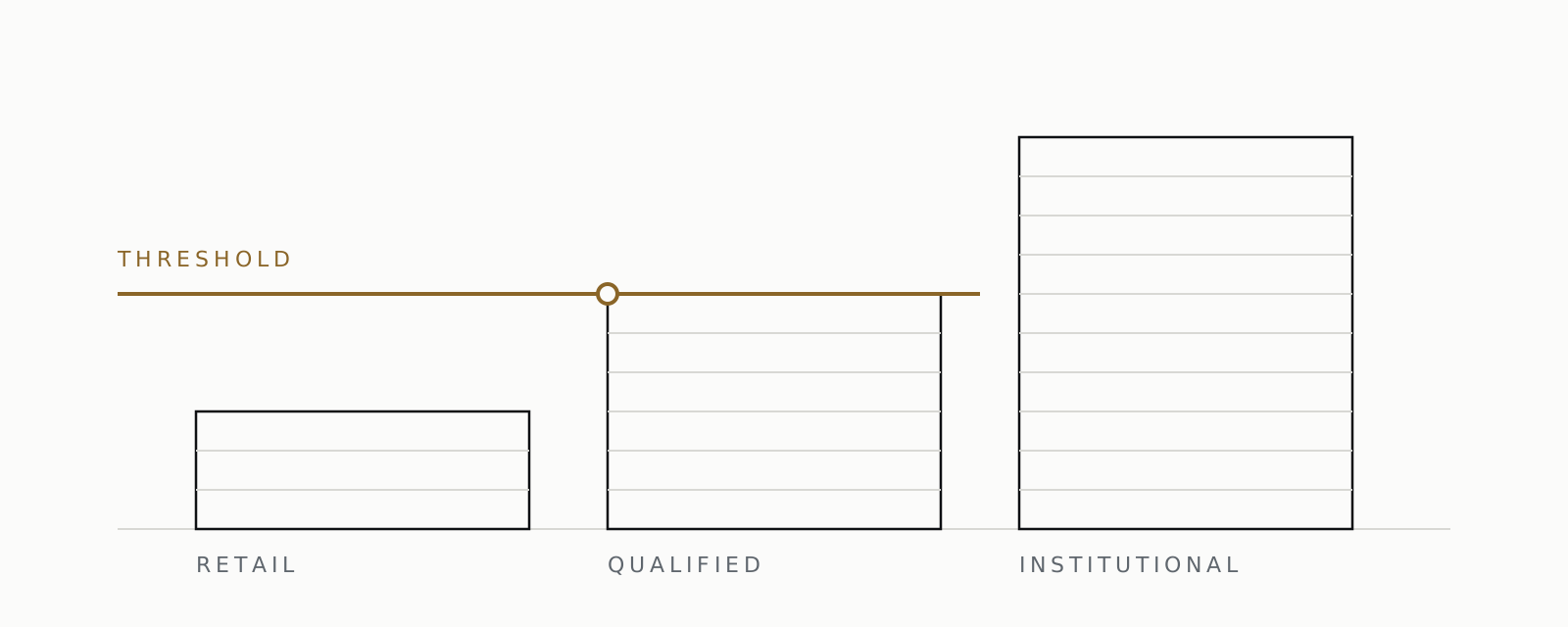
VARA requires every licensed provider to classify each client as Retail, Qualified or Institutional before dealing. An individual can opt up to Qualified with net assets of at least AED 3.5 million, excluding the primary residence, or income of at least AED 700,000. A company needs AED 3.5 million in net assets (as of October 2026).
KEY FACTS
| Client | Test for Qualified | Threshold (AED) | Approx. USDT |
|---|---|---|---|
| Individual | Net assets, excluding primary residence | 3,500,000 | approx. 953,000 |
| Individual | Annual income (alternative) | 700,000 | approx. 190,600 |
| Company | Net assets, directors with VA knowledge | 3,500,000 | approx. 953,000 |
| Regulated entity, VASP | Status, no financial test | n/a | n/a |
Sources: VARA Market Conduct Rulebook, Part IV, Section A; CBUAE exchange-rate sheet showing USD at 3.6725. Accessed 23 October 2026.
Why does a licensed desk ask about income and net worth?
A VARA-licensed desk asks about income and net worth because the Market Conduct Rulebook, Part IV, lets a provider deal only with investor classes VARA permits for the activity in question. A circular titled "Onboarding and Classification of Qualified Investors", dated 8 January 2026, restates how providers must run that sorting at onboarding.
The question is a regulatory classification step, separate from the identity checks described in the KYC requirements to sell USDT in the UAE. Identity checks establish who you are. Classification establishes which products the provider may offer you, and it sits inside the wider VARA framework for Dubai.
What are the three VARA investor classes?
The VARA rulebook defines three classes: Retail, Qualified and Institutional. Retail is defined by exclusion: any entity that is neither Institutional nor Qualified. Without a completed upgrade, a client is Retail.
Institutional covers entities regulated by a competent financial services regulator, such as the CBUAE, SCA, DFSA or FSRA, any virtual asset service provider, a government or an institution performing central bank functions, and a multilateral agency. Governments and multilateral agencies must also show relevant virtual asset knowledge. Institutional status depends on who the entity is, so it has no AED threshold.
What are the Qualified Investor thresholds in AED and USDT?
The Qualified Investor threshold for an individual is AED 3,500,000 in net assets or AED 700,000 in annual income, as of October 2026. At the AED 3.6725 peg that is approx. 953,000 USDT and approx. 190,600 USDT. The table at the top of the page sets out all rows.
Net assets are measured with exclusions. The rulebook leaves out the primary residence, including equity in it, qualifying insurance rights, and termination, pension or retirement benefits. For virtual assets, only 50% of market value counts. The documentary proof of liquid assets must be checked periodically.
Money alone is not enough. An individual also needs relevant knowledge of virtual assets or complex structured products for the activities offered, and a company needs directors with that knowledge. The provider chooses how knowledge is demonstrated and must show VARA that method on request.
Illustrative example. An individual holds AED 2,000,000 in bank deposits and USDT worth AED 2,000,000, plus a home. The home is excluded, and only half the USDT value counts: AED 2,000,000 plus AED 1,000,000 equals AED 3,000,000. That is below AED 3,500,000, so the net asset test fails. The income test (AED 700,000 a year) would still be open.
How does opting up to Qualified work?
Opting up to Qualified is a choice, not an automatic reclassification. Public summaries of the January 2026 circular say a client who meets the thresholds must be offered the choice of staying Retail, and that the provider needs a documented upgrade process. Until the process is complete, the client remains Retail.
The provider has to obtain and verify source of wealth when Qualified status is chosen, and complete a suitability assessment before confirming it. The assessment looks at knowledge and experience, defined objectives, and the capacity to absorb sudden or significant losses. If the client does not pass, a cooling-off period applies before any retest, and the retest must be substantively different from the first. Read the circular text itself for the exact period and wording.
Which documents sit behind the source-of-wealth evidence?
VARA's published classification text does not list specific documents, so the evidence is whatever convincingly shows where the net assets or income came from. The categories below are illustrative, not a VARA list, and the provider decides what it accepts.
- Income: employment contract and payslips, or tax and dividend records.
- Business wealth: audited or management accounts, share sale agreements.
- Liquid assets: bank and brokerage statements dated recently enough to be checked periodically.
- Property and inheritance: title deeds, sale contracts, probate documents.
Wealth and funds are different questions, and the source-of-wealth versus source-of-funds comparison separates them. Deals large enough to trigger extra checks follow enhanced due diligence for large crypto deals, which is a separate track from classification.
What does classification change for a USDT-for-AED trade?
Classification changes which products and services a provider may offer you; it does not change the price of a plain USDT-for-AED trade. Opting up to Qualified is aimed at higher-risk products that are closed to Retail clients, not at a better spread.
IWGT publishes its spread by ticket size on the pricing bands. Selling USDT runs 0.40%, 0.25%, 0.15% and 0.08% from 100,000, 500,000, 2 million and 10 million USDT. Buying USDT with a bank transfer runs 0.40%, 0.25%, 0.20% and 0.15% over the same tiers, with the price on request from 10 million. The tiers are keyed to size, not to investor class. Settlement stays AED same business day by UAEFTS, USD in 2 to 5 days by SWIFT.
This article does not describe any IWGT classification procedure. What IWGT publishes about account opening is in the onboarding steps.
When is the classification question reopened?
The classification question is reopened whenever the basis for it may have changed. The rulebook requires documentary proof of liquid assets to be checked periodically, so a Qualified status rests on evidence that goes stale.
Public summaries of the circular add three triggers: a request for a Qualified-only or high-risk product, updated financial data that meets the thresholds, and trading behaviour that points to a material change in financial profile. The client can also ask to be reviewed. A provider that cannot show current evidence for a Qualified client is exposed to the regulator, which can ask for proof of compliance at any time.
FAQ
Do I have to become a Qualified Investor to sell USDT?
No. Under the VARA rulebook a client who meets the thresholds may still stay Retail. Published IWGT spread bands depend on ticket size, not on investor class.
Does my home count towards the AED 3.5 million?
No for an individual. The VARA rulebook excludes the primary residence, including equity in it, and also excludes qualifying insurance rights and termination, pension or retirement benefits.
Does the USDT I hold count in full?
No. For the net asset test the rulebook counts only 50% of the market value of virtual assets, so USDT holdings are halved in the calculation.
What happens if I fail the suitability test?
You stay Retail. Public summaries of the January 2026 circular describe a mandatory waiting period before a retest, and the retest must differ substantively from the first test.
Is a regulated company automatically Institutional?
Entities regulated by a competent financial services regulator, such as the CBUAE, SCA, DFSA or FSRA, fall in the Institutional class under the rulebook, as does any VASP. A trading company without such a licence does not.
Ask for a written quote at your size
IWGT is a VARA-licensed Broker-Dealer in Dubai. Spread 0.08% to 0.40% by size and direction, published openly. AED by UAEFTS the same business day once your account is approved.
SOURCES
- VARA Market Conduct Rulebook, Part IV, Section A: Investor Classifications, accessed 23 October 2026.
- VARA circular: Onboarding and Classification of Qualified Investors, dated 8 January 2026, accessed 23 October 2026.
- Central Bank of the UAE: exchange-rate sheet, June 2026 (US dollar 3.6725), accessed 23 October 2026.
- IWGT published pricing bands and onboarding steps: pricing and onboarding, October 2026.
This guide is informational and is not legal, tax or investment advice, nor an invitation to buy or sell any virtual asset. Rules and figures are as of October 2026; check the VARA circular and rulebook before acting. Virtual assets may lose their value in full or in part and are subject to extreme volatility.