
UAE Corporate Tax on crypto held or sold by a company
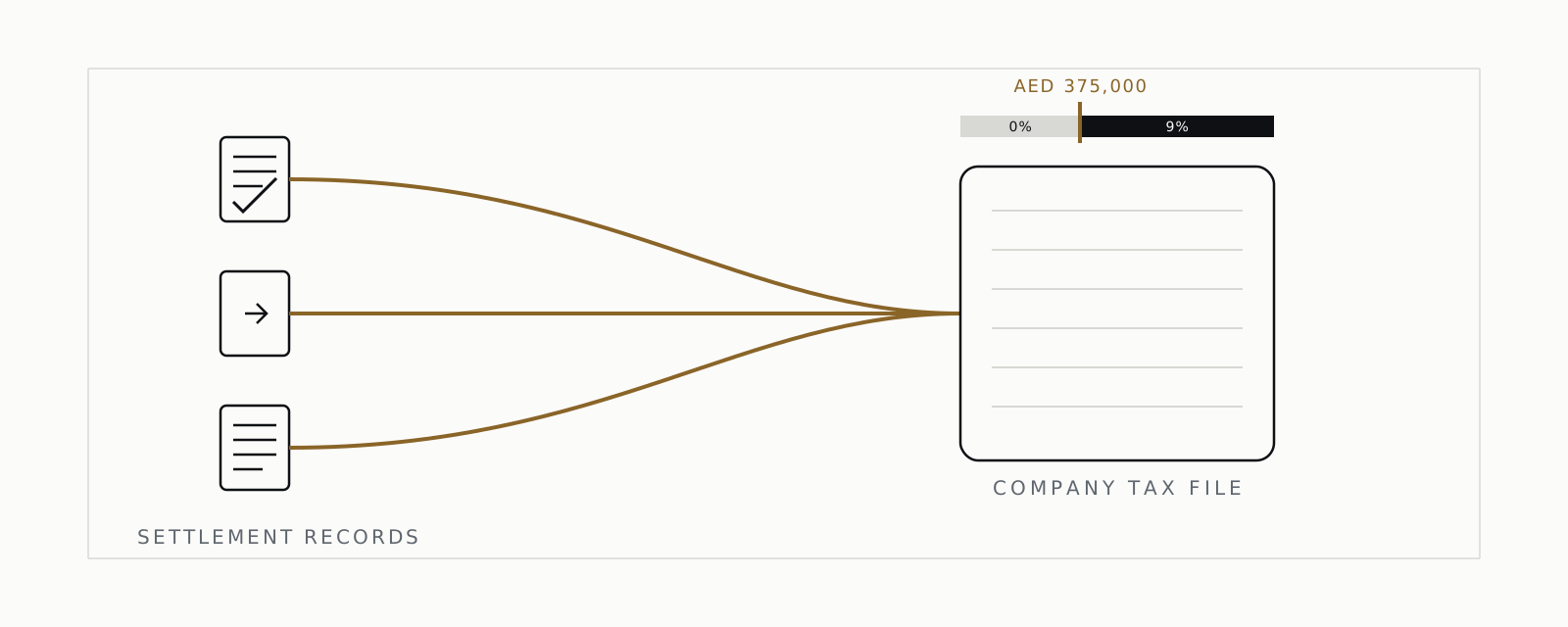
A UAE company's profit from holding or selling crypto is taxed like any other business profit: 9% Corporate Tax above AED 375,000 of taxable profit, 0% below it, for financial years starting on or after 1 June 2023. A free zone company may qualify for 0% on different terms, subject to conditions.
KEY FACTS
| Regulator(s) | FTA (Corporate Tax) · VARA (virtual asset dealing, Dubai) |
|---|---|
| Standard Corporate Tax rate | 9% on taxable profit above AED 375,000; 0% up to that threshold |
| In force since | Financial years starting on or after 1 June 2023 |
| Qualifying Free Zone Person | 0% possible on Qualifying Income, conditions apply |
| Record retention (Corporate Tax) | At least 7 years after the tax period ends |
| Return filing deadline | Within 9 months of the tax period end |
Source: Federal Tax Authority and UAE Ministry of Finance, as of October 2026.
Does a UAE company pay Corporate Tax on crypto profit?
A UAE company pays Corporate Tax on crypto profit the same way it pays tax on any other business profit — there is no separate crypto tax regime, as of October 2026. Gains and losses from holding, trading or accepting crypto as payment sit inside the company's total taxable profit, taxed at 9% above AED 375,000 and 0% up to that threshold, for financial years starting on or after 1 June 2023. Individuals face a different rule entirely; our UAE crypto tax guide for individuals covers that side of the question.
The Federal Tax Authority treats a gain on crypto like a gain on any other asset held for trading or investment: it adds to taxable income once realised, under the ordinary accounting rules the company already uses. Nothing in the Corporate Tax Law singles out virtual assets for a higher rate or an extra filing.
How does the AED 375,000 threshold apply to a company's crypto gains?
The AED 375,000 Corporate Tax threshold applies to a company's total taxable profit for the period, not to crypto gains counted on their own. A company with a crypto gain and a trading loss elsewhere nets the two together before checking which band the combined profit falls into.
Can a free zone company pay 0% Corporate Tax on crypto income?
A free zone company can pay 0% Corporate Tax on its Qualifying Income if it meets the conditions to be a Qualifying Free Zone Person under Article 18 of the Corporate Tax Law — adequate substance in the free zone, income inside the defined Qualifying Income categories, and compliance with transfer-pricing rules, among other tests set out in Cabinet Decision No. 100 of 2023.
Whether proprietary crypto dealing or treasury gains count as Qualifying Income is a facts-and-circumstances question that decision answers activity by activity, not a blanket yes for every free zone entity. Confirm your own position with an auditor before filing, and re-check it whenever activity changes — this is general information, not a ruling on any company's facts. Selling crypto through a free-zone company covers the separate VARA licensing side of operating from a free zone.
What records does a UAE company need for its Corporate Tax position on crypto?
A UAE company must keep records that let the Federal Tax Authority verify its taxable income: transactions, assets bought or disposed of, liabilities, and any shares held at the end of the tax period, under Article 56 of the Corporate Tax Law. The Authority confirmed in August 2025 that both taxable and exempt persons must retain these records for at least seven years after the tax period ends.
For crypto, that means a dated entry for every trade: the counterparty, the quantity, the AED value at the transaction date, and the cost basis of whatever was sold. A company that only reconciles this at year end often finds gaps its auditor has to chase; reconciling on a fixed schedule avoids that. Our source-of-funds file guide covers a closely related document a bank may ask for on the same transfer.
What does an OTC desk's settlement package give you for that file?
A licensed OTC desk's settlement package gives a company three documents that map onto its Corporate Tax record-keeping duty: a trade confirmation with the date, quantity and agreed price; a payment reference — UAEFTS for AED, SWIFT for USD — showing the exact amount and value date; and, on request, a statement of trading history with that counterparty. None of this is tax advice; it is paperwork a company's own accountant uses to support its return. Our own VARA licence is listed in the licence section of our main page, in the format a bank or auditor expects from a regulated counterparty.
| Document | What it shows | Where it helps in the tax file |
|---|---|---|
| Trade confirmation / contract note | Date, quantity, agreed price | Dated value for the register (Article 56) |
| UAEFTS or SWIFT payment reference | Amount and value date credited | Matches the ledger to the bank statement |
| Counterparty trade-history statement | Running record with that counterparty | Supports the cost basis of a gain or loss |
| Licence and KYB confirmation | Proof the counterparty is regulated | Backs a source-of-funds question from a bank or auditor |
None of these four documents replaces the company's own transaction register — they are the evidence an auditor checks it against.
Does a company need to register for Corporate Tax even if it rarely trades crypto?
Yes. Every UAE company is a taxable person for Corporate Tax purposes and must register with the Federal Tax Authority through the EmaraTax platform, regardless of profit level, and even if it only converts crypto occasionally. A company with no revenue in a tax period is not exempt from registering — only from paying, if its profit sits under AED 375,000.
Registration deadlines were set by licence-issuance month for companies already operating when the rules took effect; new companies register within a set window of incorporation. Missing the deadline risks an administrative penalty on top of any Corporate Tax due. Crypto activity does not create a separate filing track — it follows the company's normal registration timeline.
How does this differ from how individuals are taxed on crypto?
An individual trading crypto in the UAE owes no personal income tax and no capital gains tax on the profit, while a company doing the same conversion owes Corporate Tax on its taxable profit above AED 375,000. The dividing line is the legal person making the trade, not the asset — the same USDT sale is untaxed through a personal wallet and taxable through a company account.
This matters for structuring, not only for filing: moving crypto activity into a company changes the tax outcome, and moving it back out does too. Our dedicated guide to crypto tax for individuals in the UAE covers the personal side in full; this article covers only the company side.
The bottom line on UAE Corporate Tax for crypto companies
A UAE company's crypto profit is taxed exactly like its other business profit: 9% above AED 375,000 of total taxable profit, 0% below it, with a possible 0% route for free zone companies meeting the Qualifying Free Zone Person conditions. None of that changes how carefully the company documents each trade.
Registering on time, keeping seven years of records, and settling through a counterparty whose confirmations line up with the company's own ledger are entirely within the company's control. Request a quote from a VARA-licensed desk when it is time to convert, and keep the confirmation with the rest of the file.
FAQ
What Corporate Tax rate applies to a company's crypto profit in the UAE?
A UAE company pays 0% Corporate Tax on taxable profit up to AED 375,000 and 9% on the amount above that threshold, for financial years starting on or after 1 June 2023. Crypto gains and losses are included in that total like any other business income.
Can a free zone company pay 0% Corporate Tax on its crypto income?
A Qualifying Free Zone Person can pay 0% on its Qualifying Income under Article 18 of the Corporate Tax Law, but whether proprietary crypto dealing counts as Qualifying Income depends on conditions set out in Cabinet Decision No. 100 of 2023. Confirm your company's position with a UAE tax adviser before relying on it.
How long must a UAE company keep records of its crypto trades?
At least seven years following the end of the relevant tax period, under Article 56 of the Corporate Tax Law. The file should cover transactions, assets bought or disposed of, liabilities and shares held at the period end, the same record an auditor asks for first.
Does a company have to register for Corporate Tax if it only holds crypto occasionally?
Yes. Every UAE company is a taxable person and must register for Corporate Tax through EmaraTax regardless of profit level or how often it trades, even where the 0% band means no tax is actually due.
Settle your company's crypto trade with a full paper trail
IWGT is a VARA-licensed Broker-Dealer in Dubai. Every trade settles to your company's own bank account with a trade confirmation and payment reference, ready for your tax file.
SOURCES
- UAE Government portal — Corporate Tax (rate, threshold, effective date), accessed 12 October 2026.
- Federal Tax Authority — record-keeping and filing deadline announcement, accessed 12 October 2026.
- Federal Tax Authority — Corporate Tax registration reminder (EmaraTax), accessed 12 October 2026.
- UAE Ministry of Finance — Federal Decree-Law No. 47 of 2022 on the Taxation of Corporations and Businesses (Articles 18 and 56), accessed 12 October 2026.
- UAE Ministry of Finance — Cabinet Decision No. 100 of 2023 on Qualifying Income for the Qualifying Free Zone Person, accessed 12 October 2026.
- Central Bank of the UAE — payment systems (UAEFTS), accessed 12 October 2026.
- IWGT published pricing bands — IWGT published pricing bands, October 2026.
This guide is informational and is not legal, tax or investment advice, nor an invitation to buy or sell any virtual asset. It is not a substitute for advice from a qualified tax adviser or auditor on your company's specific facts. Rules and figures are as of October 2026 — re-check the sources before acting. Virtual assets may lose their value in full or in part and are subject to extreme volatility.