
How does a UAE company book USDT under IFRS?
Under the IFRS Interpretations Committee's June 2019 agenda decision, crypto a company holds is an IAS 38 intangible asset, or IAS 2 inventory for a broker-trader, not cash. Whether a redeemable stablecoin such as USDT can be a financial asset or cash equivalent is unsettled, because redemption is open only to Tether-verified customers, so the auditor's view decides.
KEY FACTS
| Governing decision | IFRS Interpretations Committee, Holdings of Cryptocurrencies, June 2019 |
|---|---|
| Default treatment | IAS 38 intangible; IAS 2 inventory if held for sale in the ordinary course |
| USDT redemption with the issuer | Verified Tether customers only (Tether terms, as of October 2026) |
| AED/USD peg | 3.6725 (CBUAE rate table, as of August 2026) |
| Corporate Tax starting point | Accounting income under IFRS (FTA) |
Source: IFRS Foundation, Tether, Central Bank of the UAE, Federal Tax Authority, as of October 2026.
Is USDT cash, a financial asset, an intangible or inventory?
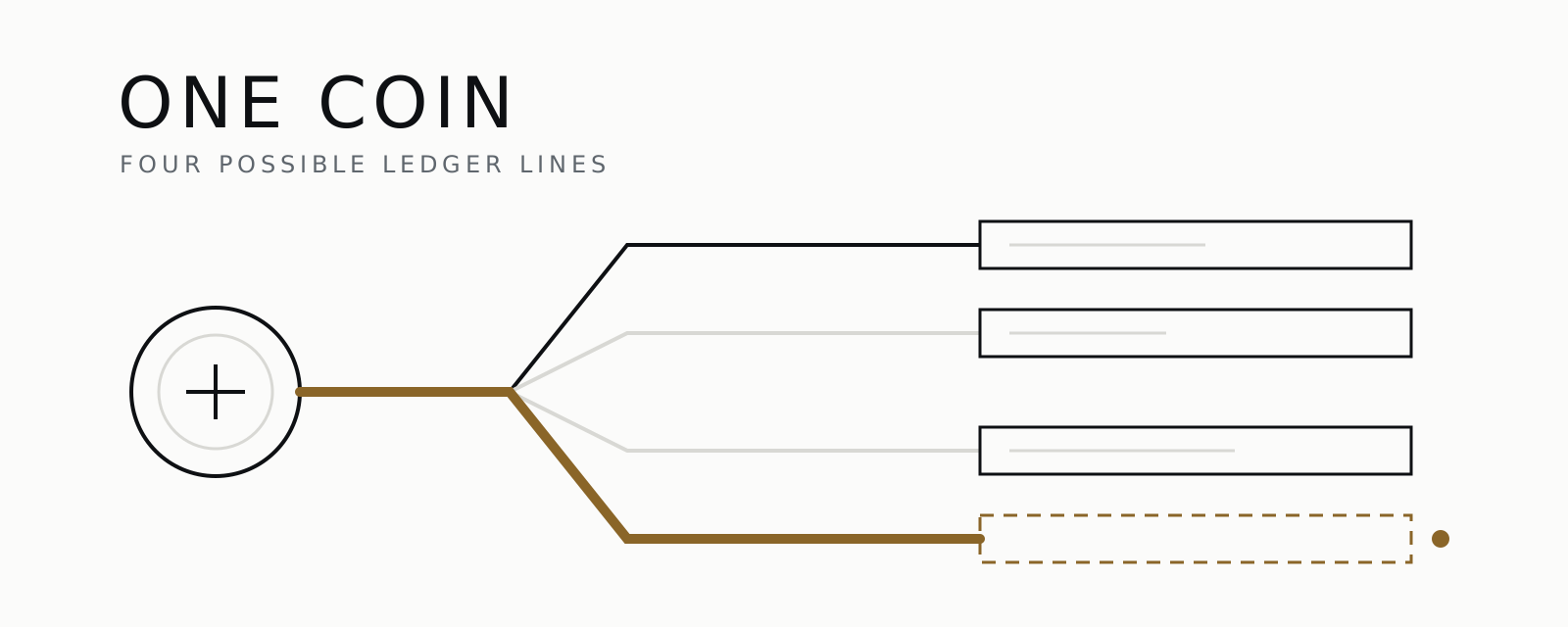
A company's USDT can land in four places on the balance sheet, and only two are settled by published IFRS guidance. The table sets out each option against its criteria, its measurement and what happens in profit or loss when the USDT is converted to AED. Treasury teams that already keep the transaction ledger described in our guide to crypto in a UAE company treasury have the inputs for any of the four.
| Classification | Criteria | Measurement | P&L effect at conversion |
|---|---|---|---|
| IAS 38 intangible asset | Default for crypto not held for sale in the ordinary course | Cost less impairment; revaluation only with an active market | Cost model: proceeds less carrying amount. Revaluation: rises to OCI, falls to P&L |
| IAS 2 inventory | Held for sale in the ordinary course of business | Broker-traders: fair value less costs to sell (para 3(b)) | Changes already in P&L each period; conversion adds little |
| IFRS 9 financial asset (argument) | Needs a contractual right to receive cash from the issuer | Per IFRS 9 classification; not settled for USDT | Depends on that classification |
| Cash equivalent, IAS 7 (argument) | Short-term, highly liquid, known cash amount, insignificant value risk | Carried at the AED amount | Spread or price gap only; unsettled for USDT |
The two arguments in the bottom rows are judgements, not published conclusions; the auditor decides whether either can be supported.
What did the IFRS Interpretations Committee decide in 2019?
The IFRS Interpretations Committee decided in June 2019 not to add a cryptocurrency standard-setting project, and published how existing standards apply. It limited its analysis to a "cryptocurrency" with three features: a digital currency recorded on a distributed ledger and secured by cryptography, not issued by a jurisdictional authority or other party, and giving rise to no contract between the holder and another party.
For that subset it concluded the holding is an intangible asset because it is separable and gives no right to a fixed number of currency units. IAS 2 applies instead if the holding is for sale in the ordinary course. It also found that such a holding is not a financial asset and not cash, because cryptocurrencies did not then have the characteristics of cash.
Why is the USDT classification still open?
USDT is open because it sits outside the 2019 definition: it is issued by a party, and its terms give some holders a redemption claim. The decision's own wording excludes assets that arise from a contract between holder and issuer, and it does not say how those are treated. That silence is why stablecoin treatment is a judgement, not a lookup.
Tether's terms state that to have tokens issued or redeemed by Tether, a person must be a verified customer. Its FAQ describes a verification process and a non-refundable fee of 150 USDT, as of October 2026. A company holding USDT bought on a desk or exchange may therefore have no direct contractual claim on the issuer. A company that is itself verified may be able to argue it does. The facts differ by holder, so the answer can too.
What is the cost basis of USDT bought from a desk?
The cost basis of USDT is the AED actually paid, taken from the trade confirmation at the price agreed, spread included. It is not the peg value of the coins and not a screen mid-price. Whether network fees paid on top form part of cost is a question for the auditor.
The published spread bands show how the desk component varies with ticket size. The trade confirmation is the document that carries the actual rate.
How does AED functional currency affect USDT?
An AED-functional company records USDT in AED at the transaction date, using the price paid. The Central Bank of the UAE publishes the dirham rate to the US dollar as 3.6725, as of its August 2026 table, so dollar amounts translate to a near-fixed figure. The peg does not fix the price of USDT itself, and the dirham's peg history is separate from any stablecoin's reserve and redemption risk.
If USDT is a non-monetary intangible, the AED cost is not retranslated at later dates. If it were a financial asset or cash equivalent, translation and fair value would be reconsidered. Another reason to settle classification first.
What must a company disclose about USDT holdings?
The 2019 decision points to specific disclosures. Inventories need IAS 2 paragraphs 36 to 39 and intangible holdings need IAS 38 paragraphs 118 to 128. Fair-value measurements add IFRS 13 paragraphs 91 to 99, and significant judgements are disclosed under IAS 1 paragraph 122.
The classification of a redeemable stablecoin is such a judgement, so the note should say which view was taken and why. Material post-period fair value changes fall under IAS 10 paragraph 21.
How does Corporate Tax follow the accounting treatment?
Corporate Tax starts from accounting income: the net profit or loss in financial statements prepared under Article 20 of the Corporate Tax Law. The FTA accepts IFRS, or IFRS for SMEs where revenue is AED 50 million or less (Ministerial Decision 114 of 2023). Adjustments for exemptions, reliefs and non-deductible items are then applied.
The classification therefore moves taxable income through the starting figure. For rates, free zone treatment and records, see UAE Corporate Tax on crypto held or sold by a company.
What has the IASB said on stablecoins in 2026?
As of October 2026, no new IASB requirement on stablecoins is confirmed on ifrs.org, and this guide relies on none. The IFRS Foundation calendar lists a stablecoins and transfers item at a joint FASB and IASB education meeting on 5 June 2026, with a paper presented by the FASB staff. An agenda item is not a standard, so the 2019 decision remains the reference.
FAQ
Is USDT cash under IFRS?
Not on the evidence in the 2019 decision, which found that cryptocurrencies do not currently have the characteristics of cash. Whether a redeemable stablecoin can be a cash equivalent is an open judgement for the company and its auditor.
Can a UAE company use fair value for USDT?
Under IAS 38 the revaluation model needs an active market for the asset. Under IAS 2, a broker-trader can measure inventory at fair value less costs to sell. Confirm which applies with your auditor.
Which exchange rate sets the AED cost of USDT?
The AED amount actually paid, as shown on the trade confirmation, including the spread. The CBUAE peg of 3.6725 AED per USD is a reference for translating dollar amounts, not the price paid.
Does Corporate Tax follow the IFRS treatment of USDT?
The FTA starts taxable income from accounting income in financial statements prepared under IFRS, then applies the adjustments in the law. So the classification flows into the tax computation before those adjustments.
Does the IASB have a new rule for stablecoins?
As of October 2026 this guide relies on no new IASB requirement. The IFRS Foundation listed a stablecoins item at a joint FASB and IASB education meeting on 5 June 2026, but an agenda item is not a standard.
Get a trade confirmation your auditor can use
IWGT is a VARA-licensed Broker-Dealer in Dubai (licence VL/24/12/002). Sell tiers from 100k USDT: 0.40%, 0.25%, 0.15% and 0.08% at 100k, 500k, 2M and 10M. Buy tiers: 0.40%, 0.25%, 0.20% and 0.15%, with 10M and above on request. AED settles same day by UAEFTS on banking days, before the cut-off.
SOURCES
- IFRS Foundation, IFRIC Update June 2019: Holdings of Cryptocurrencies, accessed 26 October 2026.
- IFRS Foundation, IAS 38 Intangible Assets, accessed 26 October 2026.
- IFRS Foundation, IAS 38 text (paragraphs 85 and 86, revaluation), accessed 26 October 2026.
- IFRS Foundation, IAS 2 Inventories (paragraph 3(b)), accessed 26 October 2026.
- IFRS Foundation, IAS 7 Statement of Cash Flows, accessed 26 October 2026.
- IFRS Foundation, FASB-IASB education meeting, 5 June 2026, accessed 26 October 2026.
- Tether, terms of service (section 4.1, redemption) and Tether FAQ, company pages on its own terms, accessed 26 October 2026.
- Central Bank of the UAE, monthly exchange rate table, August 2026 (US dollar 3.6725), accessed 26 October 2026.
- Federal Tax Authority, Accounting Standards and Interaction with Corporate Tax, accessed 26 October 2026.
- IWGT published pricing bands, main page, October 2026.
This guide is informational and is not legal, tax, accounting or investment advice, nor an invitation to buy or sell any virtual asset. Confirm the treatment of your own holdings with your auditor. Rules and figures are as of October 2026, so re-check the sources before acting. Virtual assets may lose their value in full or in part and are subject to extreme volatility.