
Receiving crypto-sale proceeds at Emirates NBD: what the bank checks
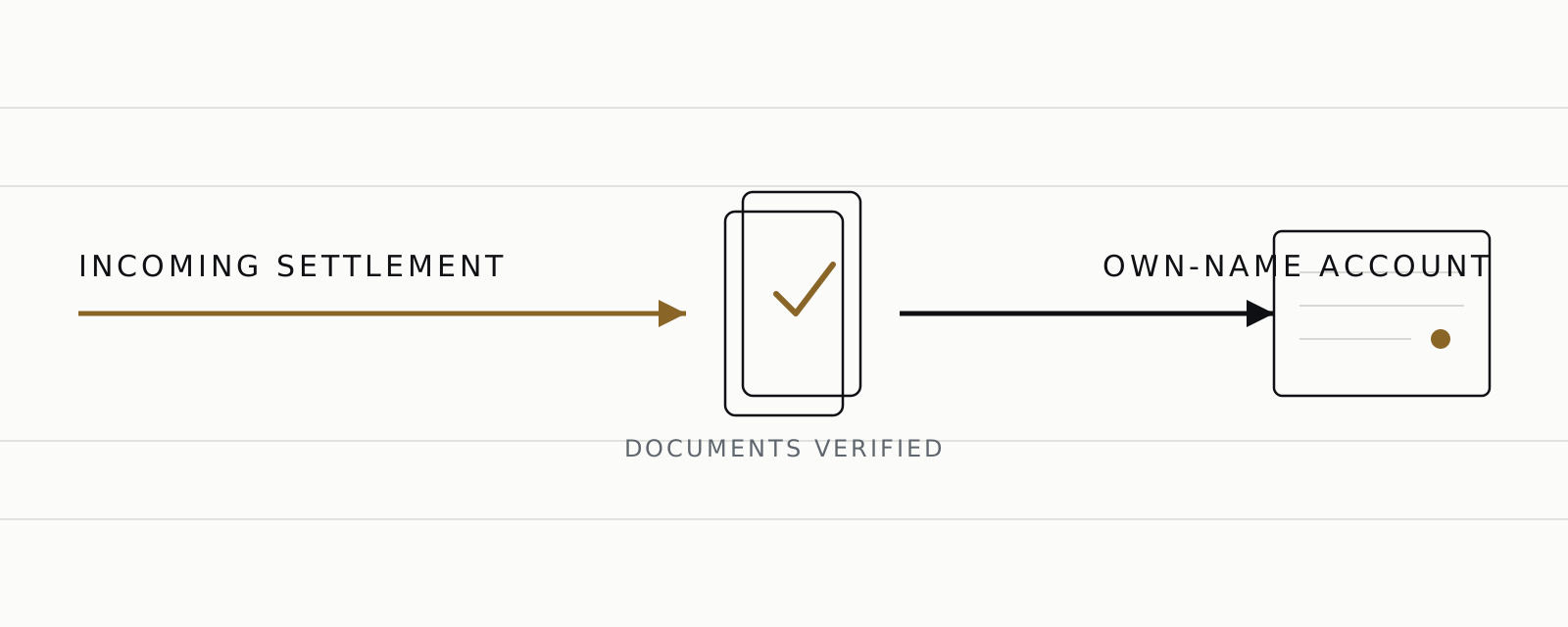
Emirates NBD screens an incoming crypto-sale settlement the way it screens any large, non-salary credit: sender identity, source of funds, and whether the amount fits your declared profile. A wire from a licensed OTC desk, paid to your own-name account with documents ready, is the profile that clears fastest. This is general practice, not an Emirates NBD policy statement.
KEY FACTS
| Bank supervisor | Central Bank of the UAE (CBUAE) |
|---|---|
| Desk licensing | VARA (Dubai, outside the DIFC) |
| Emirates NBD crypto-specific policy | Not publicly published — case-by-case review |
| Clean settlement profile | Licensed desk, own-name account, documents on file |
| AED settlement rail | UAEFTS, same business day |
| USD settlement rail | SWIFT, 2–5 business days |
Source: CBUAE published payment-systems material and IWGT desk observation, as of September 2026.
What Emirates NBD checks on an incoming crypto-sale settlement
Emirates NBD, like every bank supervised by the Central Bank of the UAE (CBUAE), applies standard anti-money-laundering and know-your-customer checks to any large, unexplained credit — a crypto-sale settlement is reviewed the same way as the liquidation of any other asset. The review looks at who sent the money, whether the sender is a regulated entity, where the underlying funds came from, and whether the amount fits your declared income and account activity. Our guide to how UAE banks generally screen crypto inflows covers the fuller picture across the sector.
None of this is specific to one bank. A CBUAE-regulated bank has to be able to explain, on file, why a large, non-standard credit appeared in an account it holds, and that duty exists regardless of which bank you use.
Documents to prepare before the settlement lands
The documents Emirates NBD is likely to request are the same set any CBUAE-regulated bank asks for on a large non-salary credit: the trade confirmation from your OTC desk, a wallet or exchange statement showing where the USDT came from, and a short letter describing the source of the underlying funds. Our source-of-funds documents for a crypto sale guide lists the full set desk clients typically assemble.
Preparing this pack before the wire is sent, not after the bank asks, is the change that shortens a review. A desk that issues a written trade confirmation carrying its VARA licence number gives the bank the first document it needs without a follow-up email.
How to fill in the SWIFT or UAEFTS transfer details
The SWIFT or UAEFTS message carrying your crypto-sale proceeds should name the actual paying entity — your OTC desk's registered legal name — in the ordering-customer field, not a wallet address or a personal contact. Emirates NBD's compliance screening reads this field before it looks at anything else attached to the credit.
A payment reference that matches your trade confirmation, and a short factual purpose line, remove the two most common reasons a payment gets queried: an unexplained sender and a blank narrative.
| Field | What supports smooth processing | What raises questions |
|---|---|---|
| Ordering customer (sender name) | Your OTC desk's registered legal entity name | A wallet address, exchange sub-account or a third party's name |
| Payment reference | A deal or trade reference matching your confirmation | Left blank or unrelated to any document you hold |
| Purpose / remittance description | A short factual line, e.g. "Settlement of digital asset sale" | No description, or one contradicting your declared income |
| Beneficiary account | An account already held in your own name | A request to pay a different person's account |
A wire with a matching name, a real reference and a plain purpose line reads as routine; a blank or mismatched field is what a compliance analyst opens first.
Why the sender name must match your own account name
Own-name settlement — the OTC desk paying proceeds into an account held in the same legal name as the seller — is the detail a bank's compliance team checks before anything else on a crypto-sale credit. A desk that offers to pay a third party, or an account under a different name, creates the exact mismatch that triggers a hold.
IWGT pays proceeds only to an account in the client's own name for this reason — a rule applied before the trade, not a fix applied after the bank raises a question.
What can trigger extended due diligence or a hold
Extended due diligence at a CBUAE-regulated bank is triggered when a credit breaks the expected pattern: a mismatched sender name, amounts split into several transfers, wallet history touching sanctioned or anonymous services, or an amount inconsistent with the declared profile. Larger conversions can move into a more formal enhanced due diligence review for large crypto conversions, which adds documents and time rather than an automatic refusal.
A bank cannot confirm mid-review whether it has filed a suspicious-activity report — "tipping off" a customer is an offence under UAE anti-money-laundering law. Silence during a review is normal and is not itself a sign the transfer has failed.
Step by step: receiving the proceeds without a hold
Receiving a crypto-sale settlement cleanly is four steps, completed before the trade. Each step removes a question a compliance analyst would otherwise raise afterwards.
-
STEP 1
Open the OTC desk account before you need it
Passport and proof of address for an individual, or trade licence and ownership documents for a company — see the full list in our onboarding section. Approval takes one business day in most cases.
-
STEP 2
Tell Emirates NBD before the wire lands
A short message to your relationship manager with the expected amount, sender and date turns a surprise credit into an expected one. There is no legal duty to pre-notify, but expected inflows are reviewed faster than unexplained ones.
-
STEP 3
Match the wire to your trade confirmation
Keep the trade confirmation, the payment reference and the amount aligned across every document, so nothing in the file contradicts anything else.
-
STEP 4
Keep the settlement pack ready to send on request
The wallet statement and source-of-funds letter should already exist before the bank asks. Sending them within the deadline, in full, is what closes a query in one round.
The bottom line on receiving crypto proceeds at Emirates NBD
Emirates NBD is not an obstacle to crypto-sale proceeds; an undocumented, mismatched or unexplained credit is. Use a licensed counterparty, settle to your own name, and have the trade confirmation and source-of-funds file ready before the wire arrives. You can request a quote from a licensed desk once that pack is in place.
FAQ
Does Emirates NBD have a published policy on crypto-sale proceeds?
No — Emirates NBD has not published a crypto-specific settlement policy. It applies the same CBUAE anti-money-laundering and know-your-customer rules that cover any large, non-salary credit, on a case-by-case basis.
What documents should I have ready before the transfer arrives?
A trade confirmation from your OTC desk, a wallet or exchange statement showing where the USDT came from, and a short source-of-funds letter. Assembling this before the wire is sent is faster than producing it after the bank asks.
Does it matter whether the proceeds arrive by SWIFT or UAEFTS?
The rail affects speed, not the documents a compliance team wants: AED by UAEFTS lands the same business day, USD by SWIFT takes two to five business days. On both rails, the sender name and payment reference matter equally.
Can Emirates NBD hold or reject an incoming crypto-sale transfer?
Yes. Any CBUAE-regulated bank can hold, query or decline an inflow it cannot immediately explain. A wire from a licensed desk to an account in your own name, with documents ready, is the profile least likely to be held.
How long does a compliance review of the incoming wire take?
There is no published fixed timeframe. A complete document set submitted promptly typically closes a query in one round; missing or contradictory documents are what stretch a review.
Settle to Emirates NBD with the paper trail already in place
IWGT is a VARA-licensed Broker-Dealer in Dubai (VL/24/12/002). All-in spread 0.08–0.40% by size, a written trade confirmation on every deal, AED by UAEFTS the same business day to an account in your own name.
SOURCES
- Central Bank of the UAE — payment systems (UAEFTS), accessed 17 September 2026.
- VARA public register — licence status check, accessed 17 September 2026.
- UAE Government portal — combatting money laundering (Federal Decree-Law No. 20 of 2018), accessed 17 September 2026.
- Emirates NBD — personal banking (general terms and conditions; no published crypto-specific settlement policy identified), accessed 17 September 2026.
- IWGT desk observations on client settlement handling, September 2026.
This guide is informational and is not legal, tax or investment advice, nor an invitation to buy or sell any virtual asset. It is not a statement of Emirates NBD's official policy, and IWGT is not affiliated with or endorsed by Emirates NBD. Rules and figures are as of September 2026 — re-check the sources before acting. Virtual assets may lose their value in full or in part and are subject to extreme volatility.