
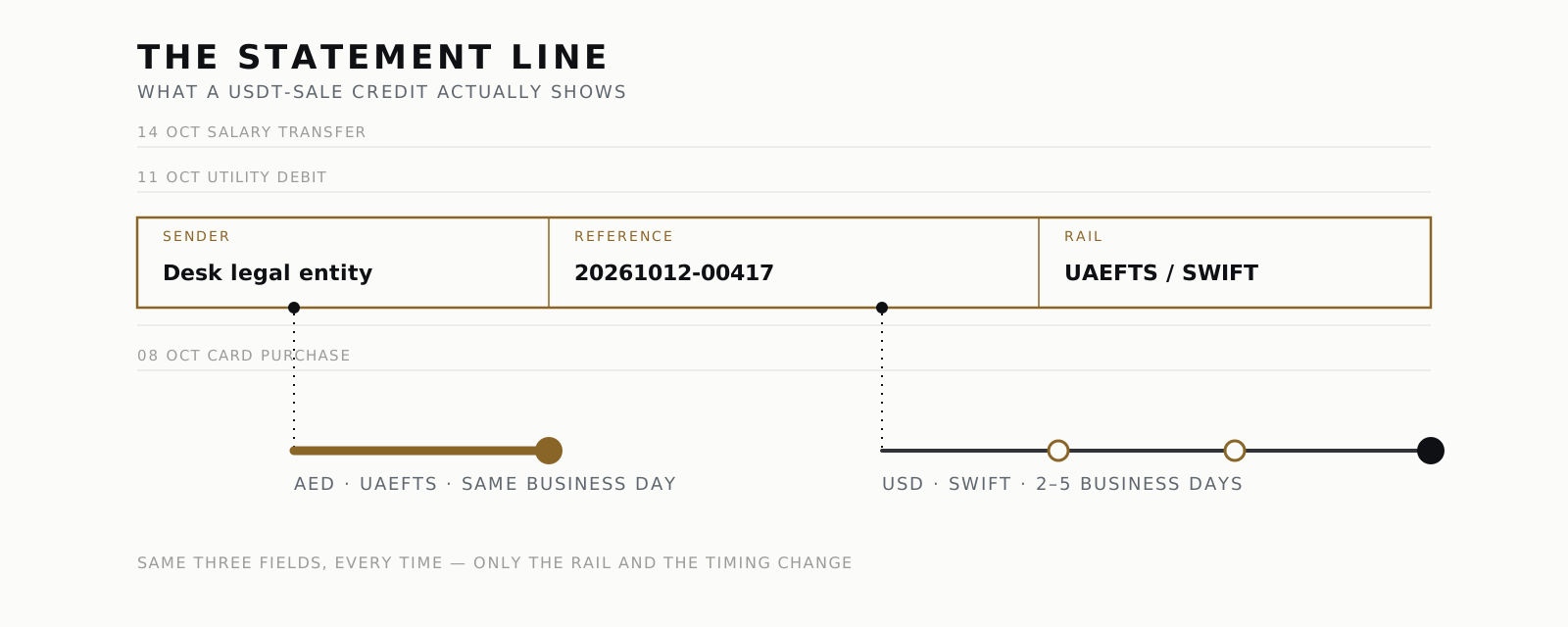
What the credit from a USDT sale looks like on your UAE bank statement
After a licensed desk settles a USDT sale, your UAE bank statement shows an AED or USD credit with the desk's legal company name, a payment reference, and the rail used — UAEFTS for same-day AED or SWIFT for USD. That record matters if your bank later asks about source of funds.
KEY FACTS
| AED settlement rail | UAEFTS — Central Bank of the UAE real-time gross settlement, same business day |
|---|---|
| USD settlement rail | SWIFT via correspondent banks, 2–5 business days |
| UAE IBAN format | 23 characters, starts "AE" (country code, 2 check digits, 3-digit bank code, 16-digit account number) |
| Sender shown on the credit | The paying company's registered legal name — never "crypto" or a wallet label |
| Settlement account | Own-name only — a licensed desk pays to an account held by the client, not a third party |
Source: Central Bank of the UAE, as of October 2026.
What exactly prints on the statement after a USDT sale settles?
A USDT-sale credit lands on your UAE bank statement as an incoming wire carrying the same fixed fields as any other bank transfer: the paying company's legal name, a payment reference, and the UAEFTS or SWIFT rail it travelled on. Nothing about the statement entry marks it as a crypto-linked payment — it reads like a wire from any other corporate counterparty.
Banks structure every incoming wire the same way, whatever generated it: a client refund, a supplier payment, or a licensed desk settling a USDT sale. The content differs, the structure does not. That consistency is useful later, because it means the credit from your trade sits in your statement in the same shape as every other traceable payment you have ever received.
Why does the sender show as a company, not "crypto"?
The sender name on a USDT-sale credit is the paying company's own registered legal name, populated from the payment instruction exactly as it would be for any corporate wire. A licensed OTC desk settles a trade through its own corporate bank account, so the credit you receive shows that company's name as the remitter — not the token you sold, not an exchange brand, and not a generic label such as "crypto".
This is also why the settlement account matters on the receiving side: a licensed desk pays only to an account held in the client's own name, never to a third party, which keeps the chain from the trade to the credit to one clean hop. The document list for opening that account before you trade is in our onboarding section.
A credit that cannot be tied to a named, traceable company is the harder case for a bank to read, whatever the underlying sale. A cash handover or a transfer from an individual's personal account carries no equivalent company name to anchor the entry, which is one reason a bank-settled trade produces an easier record than those routes.
What is the payment reference, and why keep it?
The payment reference on a USDT-sale credit is the identifier the paying bank attaches to the wire so both banks can reconcile the instruction against their own records. It is generated by the payment system, not chosen by either party, and it stays attached to the transaction through to settlement.
Keep the reference together with the trade confirmation from the desk that executed the sale. If a reviewer — at your bank, or your own accountant — later needs to match the fiat credit back to a specific trade, the reference is the fastest way to do it, faster than matching on amount and date alone when several payments land close together.
Save the statement itself as the bank issues it — a PDF e-statement or an original paper copy — rather than a screenshot of the mobile app. An official statement carries the bank's own formatting and, usually, a reference number for the document itself; a screenshot can be cropped or edited, so it carries less weight if anyone needs to rely on it later.
How does the entry differ for an AED credit against a USD credit?
An AED credit from a USDT sale settles over UAEFTS, the Central Bank of the UAE's domestic payment system, and can land the same business day the trade happens. Because the payment never leaves the UAE's domestic banking network, there are no correspondent banks taking a cut along the way, so the amount on your statement matches what was quoted, in full.
A USD credit takes a different path. It leaves the paying bank as a cross-border wire and moves through one or more correspondent banks before it reaches your account — the mechanics are covered in our guide to SWIFT transfers from the UAE. That route commonly takes 2 to 5 business days, and an intermediary bank can deduct a handling fee before the credit posts, so the amount that arrives can be a little lower than the amount sent.
Either way, the statement still carries the same three fields — sender name, reference, rail — the difference is in how long the credit takes to post and whether anything was deducted along the way.
Does the IBAN on the account change anything?
Every UAE IBAN is 23 characters long and starts with the country code "AE", regardless of the currency the account holds. The fixed structure — country code, two check digits, a three-digit bank code and a 16-digit account number — is set by the Central Bank of the UAE, and only the bank code and account number inside it are specific to your account.
That fixed length is why a receiving bank can match an inbound credit to the right account even when the narrative text on the wire is short. The IBAN, not the narrative field, is what actually routes the payment; the narrative is there for a human reading the statement afterwards, not for the systems moving the money.
Why does this record matter if your bank later asks about source of funds?
A bank that opens a source-of-funds request after a crypto-linked credit is asking you to connect the dots between where the money came from and where it landed. The statement entry from a bank-settled USDT sale already carries two of the pieces a reviewer needs: a named, traceable company as sender, and a reference that ties the credit to one specific transaction.
Without those two pieces, you are reconstructing the story from memory weeks or months later. With them, you are pointing at a line on an official document. The gap between those two positions is usually what decides whether a request closes quickly or drags into a longer review.
If your account is not yet set up for this, opening it and requesting a quote before you need the money gives you a trade confirmation to pair with the eventual bank credit from day one, rather than trying to assemble the pairing afterwards.
FAQ
Does my bank statement say "crypto" after I sell USDT?
No. A bank statement shows the paying party's registered legal name, the same as any corporate wire. A licensed desk's credit carries the desk's own company name, not the word crypto, USDT or a wallet address.
What is the payment reference on a USDT-sale credit for?
It is the identifier the paying bank attaches to the wire so both banks can reconcile it against their own records. Keep it with your trade confirmation — it is what a reviewer uses to match the bank leg back to the trade.
Is an AED credit really faster than a USD credit?
Yes. AED moves over UAEFTS, the Central Bank of the UAE's domestic real-time gross settlement system, and can settle the same business day. USD leaves the UAE on SWIFT through correspondent banks and typically takes 2 to 5 business days.
Does the IBAN format change between an AED and a USD account?
No. Every UAE IBAN is 23 characters starting with the country code "AE", whatever currency the account holds. The structure is fixed by the Central Bank of the UAE; only the bank code and account number inside it differ.
What should I keep from a USDT sale in case my bank asks about it?
Keep the trade confirmation from the desk, the full official bank statement or e-statement showing the credit (not a cropped screenshot), and the payment reference. Together they let you answer a source-of-funds request without reconstructing anything from memory.
Get a traceable bank credit for your next USDT sale
IWGT is a VARA-licensed Broker-Dealer in Dubai. Settlement is own-name only, with AED by UAEFTS the same business day and USD by SWIFT in 2–5 business days. All-in spread 0.08–0.40% by size, published openly.
SOURCES
- Central Bank of the UAE — UAE Funds Transfer System (UAEFTS): RTGS model, same-day domestic settlement, accessed 12 October 2026.
- Central Bank of the UAE — IBAN standard: 23-character structure, country code "AE", accessed 12 October 2026.
- IWGT published pricing bands and onboarding requirements — this site, October 2026.
This guide is informational and is not legal, tax or investment advice, nor an invitation to buy or sell any virtual asset. Rules and figures are as of October 2026 — re-check the sources before acting. Virtual assets may lose their value in full or in part and are subject to extreme volatility.