
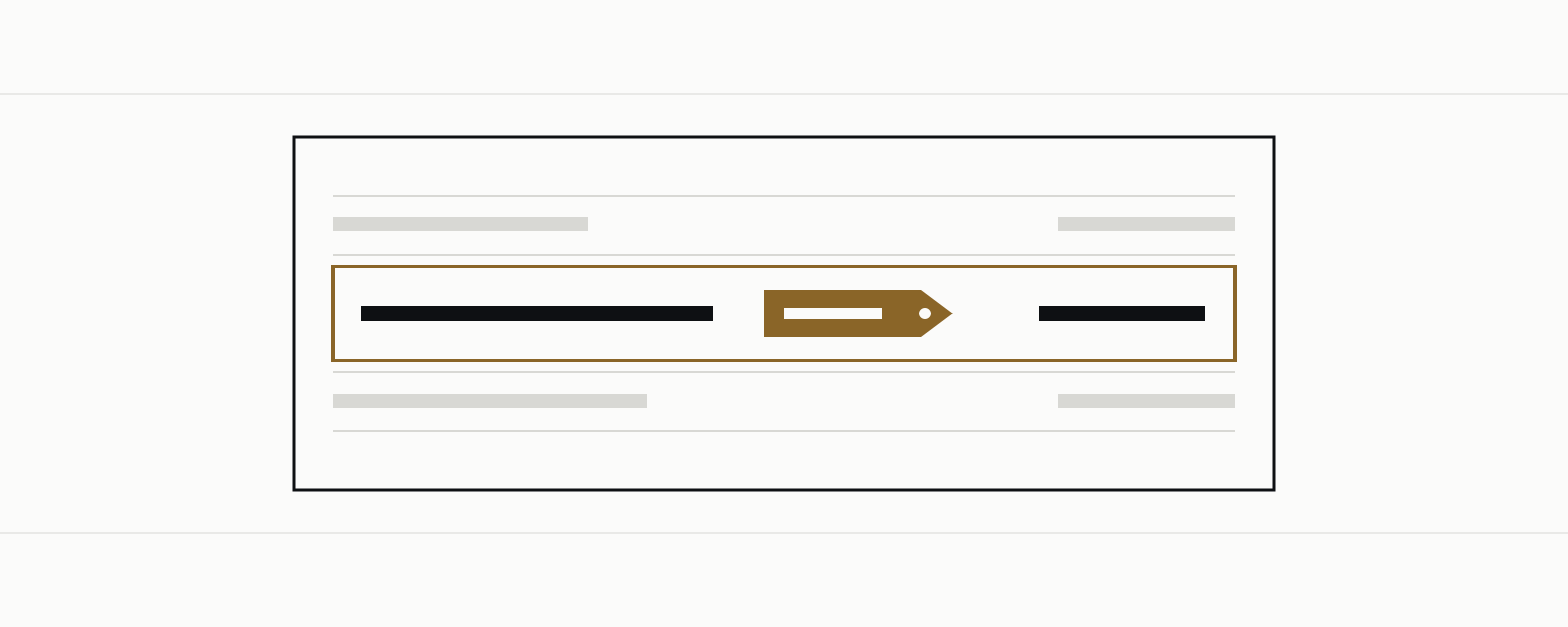
UAEFTS codes on your AED statement: what GOS and the other labels mean
GOS is a purpose-of-payment code meaning government goods and services. It states why money moved, not how. CRDC, BT and CCL are not defined in the Central Bank of the UAE material reviewed here, as of October 2026, so treat them as your bank's own labels.
KEY FACTS
| GOS | Purpose code: government goods and services |
|---|---|
| CRDC, BT, CCL | Not found in Central Bank of the UAE material, as of October 2026 |
| Purpose field, cross-border | Mandatory since 1 September 2018 outward, 1 January 2019 inward |
| Who sets the code | The paying bank, on the sender's instruction |
| System operator | Central Bank of the UAE |
Sources: Central Bank of the UAE notice CBUAE/BSD/N/2018/759 and the code table published as mandated by it, accessed 22 October 2026.
What are the codes you see on a UAEFTS credit?
Three different things get mixed up on a dirham credit: the rail, the message format, and the purpose code. The rail is UAEFTS, the Central Bank's real-time gross settlement system. The message format is the technical layout the banks exchange. The purpose code is a short field inside the payment that says why the money moved. When you sell USDT and the proceeds arrive, the line on your statement can carry any of these, plus a free-text narrative. The narrative a USDT sale leaves on a UAE statement is covered separately; this guide is about the short codes.
The only code family that the Central Bank itself publishes for domestic dirham payments is the purpose-of-payment table. Its introduction states that the codes are mandated by the Central Bank of the UAE. Codes for message types, by contrast, sit in the technical documentation that banks and the operator share, and that documentation is not public in the sources checked.
| Label | Confirmed meaning | Status |
|---|---|---|
| GOS | Government goods and services (purpose code) | Confirmed in the published code table |
| TOF | Transfer of funds between persons (purpose code) | Confirmed, domestic UAEFTS list |
| OAT | Own account transfer (purpose code) | Confirmed, domestic UAEFTS list |
| PMS | Professional and consulting services (purpose code) | Confirmed, usable in all scenarios |
| CRDC, BT, CCL | No definition found | Not confirmed; ask the issuing bank |
What does GOS mean, and why would it appear on a credit?
GOS stands for government goods and services in the code table. The table sits in the group of codes that can be used in all scenarios, next to codes for trade in goods, travel, financial services and professional services. A GOS credit would normally describe a payment tied to a government body or an embassy. On a credit from a private party it is an unusual label, and it is fair to ask the sender what they selected and why.
The code says nothing about the asset behind the payment. A dirham credit that follows a USDT sale is not a government payment, so the code that matches a desk settlement is a question for the paying side. The reliable approach is to match the label to the trade confirmation rather than guess from the letters.
Who decides which code is attached to your payment?
The paying side decides. For cross-border payments the Central Bank of the UAE made a purpose field mandatory in a notice to all banks dated 23 May 2018 (reference CBUAE/BSD/N/2018/759). It applied to outward messages from 1 September 2018, with a grace period to 31 December 2018, and to inward messages from 1 January 2019. The notice covers both SWIFT and the non-SWIFT UAEFTS upload for transfers between resident and non-resident accounts inside the UAE banking system.
For domestic dirham payments, the published table says its codes are mandated by the Central Bank and that the sender's side uses them to describe the payment purpose. A recipient cannot edit the code. What a recipient can do is ask for the sender's reference and compare it with the credit. For the mechanics of how a payment travels and when the credit lands, how a same-day UAEFTS settlement moves sets out the stages.
Is a message type the same thing as a purpose code?
No. A message type is the format of an instruction that passes between banks or between a bank and the operator. A purpose code is data carried inside the instruction. A statement is built by your bank from the instruction it received, and each bank chooses what to print: some show the purpose code, some show only a narrative, some print an internal transaction label.
That last group is why labels such as CRDC, BT or CCL can appear. They read like abbreviations for a credit, a bank transfer and a clearing item, but that reading is a guess and not something the Central Bank material supports. Banks are free to use internal labels on a statement, and an internal label is defined only by the bank that prints it.
How do you read a USDT sale credit line step by step?
Treat the line as five fields and check each against your trade confirmation. The steps below work for any AED credit, whatever label the bank prints.
-
STEP 1
Match the amount and the value date
The credited amount should equal the confirmed AED total. The value date should be a UAE banking day, since UAEFTS settles on banking days only.
-
STEP 2
Match the sender name
The ordering party should be the entity named on your confirmation. A different name is a reason to pause before booking the credit; see the note on third-party payments for crypto proceeds.
-
STEP 3
Separate the label from the narrative
Short capital letters are either a purpose code from the Central Bank table or a bank label. Free text is the sender's narrative. Record both as they appear.
-
STEP 4
Look the code up in the right table
If the three letters appear in the Central Bank purpose table, the table gives the meaning. If they do not, ask the bank that printed the statement.
-
STEP 5
File the pair together
Keep the statement line, the trade confirmation and the quote together. Onboarding documents for your own account are listed in the onboarding section.
What does an illustrative statement line look like?
Illustrative example, not a real client record. A credit of AED 1,836,250 appears on a business account on a banking day, from a sender whose name matches the desk's confirmation. The line carries a short label and the narrative "settlement per confirmation". The account holder checks the amount, the sender and the date against the confirmation, finds the label is not in the Central Bank purpose table, and sends the bank a one-line question asking what the label stands for. The credit is booked against the trade only after the reply is filed.
The arithmetic is a plain check: 500,000 USDT at an agreed rate of 3.6725 AED gives AED 1,836,250 before the spread, so the amount on the statement should sit close to that figure minus the quoted spread. Pricing bands are on the pricing section of the main page, and the AED figure is a worked illustration only.
When should you ask the bank or the sender?
Ask when the label is not in the Central Bank table, when the code does not fit the trade (a government code on a private settlement, for example), or when the sender name differs from the confirmation. Ask in writing and keep the reply. If the question concerns timing rather than labels, the rail comparison in how UAE bank rails differ is the better starting point, and an account request can be started on the quote page.
FAQ
What does GOS mean on a UAEFTS transfer?
GOS is a purpose-of-payment code defined as government goods and services, as listed in the code table published as mandated by the Central Bank of the UAE. It describes why the money moved, not which system carried it.
What do CRDC, BT and CCL mean on a statement?
None of the three appears in the Central Bank of the UAE material reviewed for this guide, as of October 2026. They are most likely labels a bank prints for its own purposes, so the bank that issued the statement is the only reliable source for their meaning.
Is a purpose code the same as a message type?
No. A message type describes the technical format of a payment instruction between banks. A purpose code is a field inside the payment that states the reason for it. A statement can show either, or a bank-specific label of its own.
Who chooses the purpose code on an incoming AED transfer?
The paying side. The Central Bank of the UAE made a purpose field mandatory for cross-border payments, and the domestic code table is listed as mandated by the Central Bank, so the sender's bank supplies the code, not the recipient.
What should I do if a code on my statement looks wrong?
Ask the sender to confirm the purpose code and narrative they used, and ask your own bank what the printed label stands for. Keep the trade confirmation with the statement so the two can be matched.
Sell USDT with same-day bank settlement
IWGT is a VARA-licensed Broker-Dealer in Dubai. All-in spread 0.08–0.40% by size, published openly. AED by UAEFTS the same business day once your account is approved, on banking days before the bank cut-off.
SOURCES
- Central Bank of the UAE, notice CBUAE/BSD/N/2018/759, 23 May 2018 (mandatory purpose field, effective dates, SWIFT and UAEFTS non-SWIFT scope), accessed 22 October 2026.
- National Bank of Fujairah, UAEFTS transaction code list (reproduces the table introduced as mandated by the Central Bank of the UAE: GOS, TOF, OAT, PMS), accessed 22 October 2026.
- Central Bank of the UAE, UAE Funds Transfer System (UAEFTS), accessed 22 October 2026.
- IWGT published pricing bands and onboarding requirements, pricing section, October 2026.
This guide is informational and is not legal, tax or investment advice, nor an invitation to buy or sell any virtual asset. Rules and figures are as of October 2026, so re-check the sources before acting. Virtual assets may lose their value in full or in part and are subject to extreme volatility.