
UAEFTS vs SWIFT after a USDT sale: AED or USD, cost and cut-offs
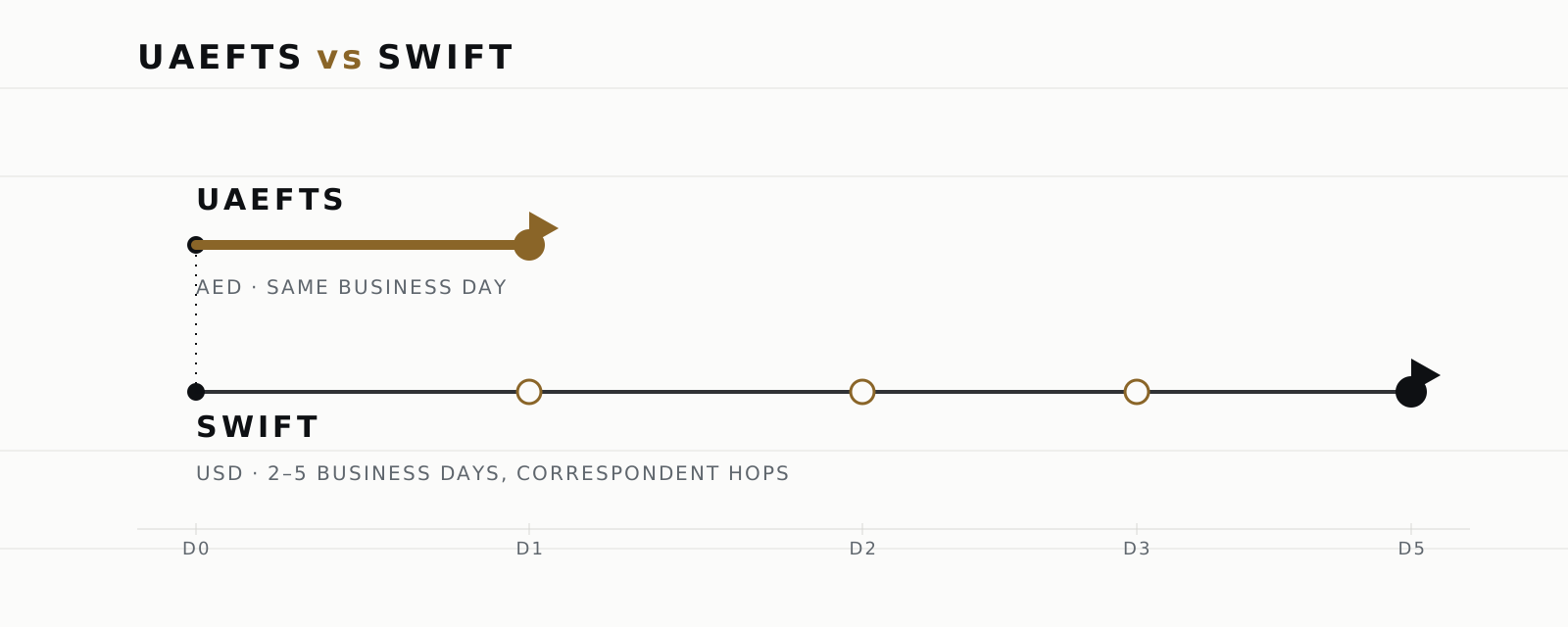
UAEFTS and SWIFT solve two different problems after a USDT sale. UAEFTS pays AED into a UAE bank account the same business day, with no correspondent banks in the chain. SWIFT pays USD, or another currency, through one to three correspondent banks in two to five business days. The right rail depends on where the money needs to end up.
KEY FACTS
| UAEFTS currency | AED only |
|---|---|
| UAEFTS speed | Same business day, no correspondent banks |
| SWIFT currency | USD and other SWIFT-connected currencies |
| SWIFT speed | 2–5 business days, one to three correspondent hops |
| IWGT spread | 0.08%–0.40% by ticket size, identical on either rail |
| Settlement account | Own-name accounts only |
Source: Central Bank of the UAE and SWIFT, as of September 2026.
What do UAEFTS and SWIFT actually do?
UAEFTS is the Central Bank of the UAE's domestic real-time gross settlement system, and it moves dirhams between UAE bank accounts only. SWIFT is a messaging network, not a payment system itself — it carries the instruction that tells correspondent banks to move US dollars, or another currency, between accounts in different countries.
For the mechanics of each rail on its own, read our UAEFTS explainer and SWIFT from the UAE. This page starts where those two finish, and compares the rails head-to-head for one decision: which one should carry the proceeds of a USDT sale.
The spread a licensed desk charges does not change with the rail. What changes is the currency you receive, what happens to the money in transit, and who can receive it at all.
Which currency do you actually receive?
The currency you receive is the largest practical difference between UAEFTS and SWIFT, not the exchange rate. UAEFTS only moves AED, so a desk paying through UAEFTS credits dirhams to a UAE bank account. SWIFT can move USD or other currencies, so a desk paying by SWIFT credits US dollars to any account that accepts a SWIFT wire, inside or outside the UAE.
The conversion barely matters at the point of the trade: the dirham has held its 3.6725 peg to the US dollar since 1997, and USDT tracks the dollar, so the two currencies are close to interchangeable in value at settlement. We cover the currency-choice question on its own — property payments, payroll, treasury balances — in AED vs USD settlement; this page is about the rail that carries whichever currency you pick.
UAEFTS vs SWIFT for a USDT payout, side by side
UAEFTS and SWIFT differ on more than speed. Currency, network structure, who can receive the payment and what happens to it in transit all change with the rail.
| Attribute | UAEFTS | SWIFT |
|---|---|---|
| Currency moved | AED only | USD and other SWIFT-connected currencies |
| Network | Direct — Central Bank of the UAE | One to three correspondent banks per payment |
| Typical time to credit | Same business day | 2–5 business days |
| Amount ceiling | None from the rail; bank policy applies | None from the rail; bank policy applies |
| Recipient account | UAE bank account only | Any bank connected to SWIFT, in the UAE or abroad |
| Deductions in transit | None | Each correspondent may deduct its own handling fee |
UAEFTS wins on speed and certainty for anyone who can use a UAE dirham account; SWIFT is the only rail of the two that reaches a foreign bank account at all.
What does each rail actually cost?
The desk's price is the same regardless of rail. Our spread runs 0.08% to 0.40% of the ticket by size — 0.40% at 100,000 USDT, 0.25% at 500,000, 0.15% at 2 million and 0.08% at 10 million, published in our pricing bands. The rail changes what happens after the spread is charged, not the spread itself.
A UAEFTS payment has no correspondent bank in the chain, so the amount that leaves the desk's account is the amount that lands in yours. A SWIFT payment can pass through one to three correspondent banks, and any of them may deduct its own handling fee before the payment reaches the beneficiary. That deduction is not published by SWIFT or by any single bank in advance — the fee mechanics and how to trace them are covered in our SWIFT from the UAE guide, linked above.
How do cut-offs decide same-day AED versus two-to-five-day USD?
UAEFTS settles a payment within seconds once it reaches the Central Bank of the UAE, but each bank sets its own customer cut-off for accepting same-day instructions, and a payment received after that cut-off moves to the next business day. Licensed entities are required to settle domestic AED transactions through UAEFTS, according to the Central Bank of the UAE Rulebook — it is not an optional rail for AED, which is part of why every bank in the chain is already built to use it fast.
Neither UAEFTS nor SWIFT settles on Saturdays, Sundays or UAE public holidays. A SWIFT payment additionally pauses on public holidays anywhere along the correspondent chain — commonly the United States for a USD wire, since dollar payments typically clear there.
For the full breakdown of cut-offs, weekends and how a trade's timing interacts with every UAE rail, including the much faster Aani rail for small amounts, see our rail-by-rail timing guide.
Which rail fits your situation as a USDT seller?
The right rail depends on four things: whether you hold a UAE bank account, where you plan to spend the money, whether you are based in the UAE or abroad, and whether you think in AED or USD terms.
| Seller situation | Rail | Why |
|---|---|---|
| UAE resident with an AED account, spending locally | UAEFTS | Same-day credit, no correspondent deductions |
| UAE resident who values or spends in dollars | SWIFT | Same spread; skips a conversion back to USD later |
| Non-resident without a UAE bank account | SWIFT | UAEFTS only reaches accounts at UAE banks |
| Recipient bank account based outside the UAE | SWIFT | Only SWIFT connects to a foreign bank |
A UAE bank account is a precondition for UAEFTS, not a preference — without one, SWIFT is the only rail that can pay out at all.
A resident who banks with Mashreq or FAB and needs the money the same day should ask for AED settlement — what each bank checks on an inbound crypto-sale credit is covered in our Mashreq and FAB guides. Requirements for the account to be approved before the trade are in our onboarding section.
A non-resident seller without a UAE account has no UAEFTS option at all: the rail only reaches accounts held at UAE banks. Valuation preference works the same way in reverse — a seller who already holds dollar obligations gains nothing from converting to AED and back, so SWIFT settlement keeps the trade in the currency the seller already uses.
Can you split one sale between AED and USD, or switch mid-trade?
Splitting one sale between AED and USD is usually possible if you state it before accepting the quote: the desk prices one ticket and wires each currency to an account in your own name. Switching after a quote is accepted is not — the settlement instruction is fixed once you confirm the trade.
Decide the rail and currency when you request the quote, not after. If same-day AED matters, the requirements for hitting that window are in our same-day AED guide.
The bottom line on UAEFTS vs SWIFT for a USDT sale
UAEFTS and SWIFT are not competing for the same job. UAEFTS is the faster, cheaper rail whenever a UAE dirham account can receive the money; SWIFT is the only rail that reaches an account outside the UAE, or that keeps the proceeds in US dollars. Pick the rail by where the money needs to land, state it in the quote request, and trade before the sending bank's cut-off if same-day AED matters.
FAQ
Is UAEFTS faster than SWIFT after a USDT sale?
Yes. UAEFTS settles AED between UAE bank accounts the same business day once the payment is instructed before the sending bank's cut-off. SWIFT moves USD or other currencies through correspondent banks and typically takes two to five business days, as of September 2026.
Can a non-resident receive AED through UAEFTS?
No. UAEFTS only credits accounts held at UAE banks, so a seller without any UAE bank account has no UAEFTS option regardless of residency. SWIFT is the rail that can pay out to an account anywhere else, in USD or another currency the receiving bank accepts.
Is UAEFTS or SWIFT cheaper for a USDT sale?
The desk's spread is identical on either rail — 0.08% to 0.40% by ticket size. UAEFTS has no correspondent banks to deduct further fees, so it is usually the cheaper leg; a SWIFT payment can lose an unpublished amount to correspondent handling fees along the way.
Can I choose SWIFT even if I already hold a UAE bank account?
Yes. Holding a UAE bank account does not require settling in AED. A resident who wants US dollars, or who is paying an obligation denominated in dollars, can ask the desk for SWIFT settlement on the same trade.
What happens if a payment misses the UAEFTS cut-off?
The payment moves to the next UAE business day. Cut-off times are set by each bank rather than by UAEFTS itself, and neither UAEFTS nor SWIFT settles on Saturdays, Sundays or UAE public holidays.
State the rail when you request your quote
IWGT is a VARA-licensed Broker-Dealer in Dubai. AED settles by UAEFTS the same business day; USD settles by SWIFT in two to five, to own-name accounts only. Spread 0.08–0.40% by size, published openly, identical on either rail.
SOURCES
- Central Bank of the UAE — payment systems (UAEFTS), accessed 22 September 2026.
- Central Bank of the UAE Rulebook — 4.28 AED Settlement via UAEFTS, accessed 22 September 2026.
- SWIFT — gpi payment tracking, accessed 22 September 2026.
- BIS Committee on Payments and Market Infrastructures — correspondent banking, accessed 22 September 2026.
- IWGT published pricing bands and settlement terms — this site, September 2026.
This guide is informational and is not legal, tax or investment advice, nor an invitation to buy or sell any virtual asset. Rules and figures are as of September 2026 — re-check the sources before acting. Virtual assets may lose their value in full or in part and are subject to extreme volatility.