
UAEFTS transfer time: when does a sent AED transfer count as late?
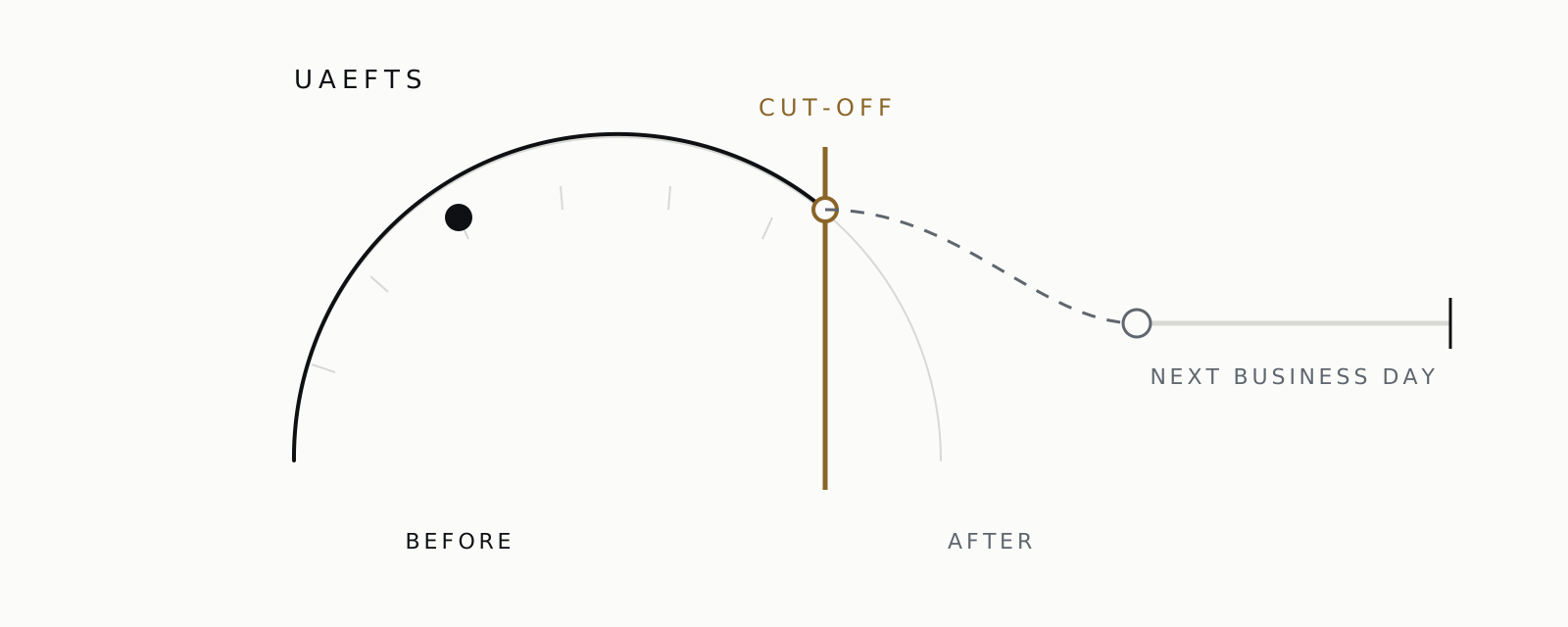
A UAEFTS transfer instructed before the sending bank's cut-off on a business day is normally credited that same day. It counts as late only when the business day ends with no credit. Banks quote different clocks, so check whether yours means cut-off, value date or a longer turnaround window.
KEY FACTS
| What sets the credit date | The sending bank's cut-off and the business-day calendar, not a number of hours |
|---|---|
| Example AED cut-off, same-day value | 19:00 (RAKBANK, published AED cut-off) |
| After the cut-off or on a public holiday | Next business day (Emirates Islamic, online and mobile channels) |
| Wider bank windows | 24 hours for requests received on a working day (ADIB); up to 2 to 3 working days for money transfers (Emirates Islamic) |
| After submission | Cancellation or amendment may not be possible; a cancellation request can take up to 30 working days (ADIB) |
| Government working week | Monday to Friday (u.ae) |
Source: bank fund-transfer pages and terms (RAKBANK, Emirates Islamic, ADIB) and the UAE Government portal, as of October 2026. Banks change cut-offs, so confirm with your own bank.
What do banks mean by "same day" for an AED transfer?
Banks use at least three different clocks for one AED transfer, and mixing them up is the usual reason a payment looks late when it is not. The first is the cut-off, the time of day after which an instruction moves to the next business day. The second is the value date, the date the bank books the money. The third is a processing or turnaround window, a promise measured in hours or working days.
The wording in the table below comes from the banks' own pages. It is not a ranking and it is not a quote: each row describes one bank, one channel and one date. Read it as a map of the vocabulary you will meet, and check your own bank for the current figure. If you want the rail itself first, start with the entry on UAEFTS in the glossary.
| Bank | Clock it uses | Wording on its page | What it tells you |
|---|---|---|---|
| RAKBANK | Cut-off and value date | AED: cut-off 19:00, value date same day; processing period subject to change on holidays | Instruct before 19:00 on a business day and the bank books it that day |
| Emirates Islamic | Cut-off by channel | Online and mobile: same-day processing for domestic transfers up to 17:00; branch: 14:30; later requests and public holidays go to the next business day | The same bank has different cut-offs for different channels |
| Emirates Islamic | Turnaround window | Up to 2 to 3 working days as a turnaround time for processing money transfers | A general window that sits beside, not instead of, the cut-off rule |
| ADIB | Processing window | Requests received on a working day are processed within 24 hours; actual time can depend on the working days of the recipient or beneficiary bank | A 24-hour promise is a ceiling for processing, not a statement about the credit time |
Read together, the pages say the same thing three ways: the sending bank decides when an instruction counts as received, and the receiving side adds its own calendar.
At what point is a UAEFTS transfer actually late?
A transfer is late when the clock that applies to it has run out, and which clock applies depends on when and how it was instructed. The test is the instruction time, not the time you started waiting. A payment instructed at 18:55 and a payment instructed at 19:05 can have the same sender, the same amount and different credit dates, which is normal under the cut-off rule and is not a fault.
The table sorts the common cases by instruction time. It uses the RAKBANK figure only as an example of a published cut-off, as of October 2026; your sending bank's number will differ.
| When it was instructed | Expected credit date | Late if |
|---|---|---|
| Business day, before the cut-off | Same business day | No credit by the end of that day |
| Business day, after the cut-off | Next business day | No credit by the end of the next business day |
| Public holiday | Next business day | No credit by the end of the next business day |
| Held for a compliance or detail check | Open: the clock stops until the check clears | The bank cannot tell you what it is waiting for |
| Receiving bank has its own holiday | Can slip past the sender's date | Still no credit one working day after the holiday ends |
Two edges deserve a note. The first is the Friday-to-Monday gap: the UAE Government portal lists the government working week as Monday to Friday as of October 2026, and a weekend between instruction and credit adds calendar days without adding business days. The weekend case is worked through in our guide to selling USDT on a Friday or at the weekend. The second is the receiving bank. ADIB notes that timing can depend on the working days of the recipient or beneficiary bank, so a holiday on that side can move the date even when the sender did everything on time.
Where can a sent payment be waiting?
A sent AED payment can wait in one of four places: at the sending bank before release, in the central settlement layer, at the receiving bank before posting, or in a review queue at either bank. UAEFTS itself is described by the Central Bank of the UAE as a real-time gross settlement system, so the central step is the shortest part of the journey. Most of the waiting happens at the banks on either side.
-
STEP 1
At the sending bank
The instruction is recorded, checked and released. An instruction after the cut-off waits here until the next business day starts. This is the stage where the cut-off rule bites, and it is the one the sender can confirm in seconds by checking the status in their banking app.
-
STEP 2
In the interbank settlement
After release the payment settles between the two banks' accounts at the central bank. If the sender's app shows the payment as released or completed, the money has left the sending bank and this stage is behind it.
-
STEP 3
At the receiving bank
The receiving bank matches the credit to your account and posts it. Matching depends on the name and account details in the instruction, so a mismatch stops the credit here even though the interbank step is done.
-
STEP 4
In a review queue
Either bank can hold a payment for review. A large first-time credit, an unusual sender or an unclear reference are typical triggers. The clock in the previous table stops while a review is open, which is why the right question to a bank is what it is waiting for, not how long it will take.
What should you ask, and who should you ask first?
Ask the sender first, because only the sender sees stages one and two. Request the confirmation that shows the payment reference, the amount, the instruction time and the status. If the status says released, ask your own bank whether a credit is posted, pending or held, quoting the sender's name, the amount, the date and the reference. A bank can search a credit far faster with those four items than with a description.
Two details trip people up. The first is the amount: ADIB states that fees charged by other banks are deducted from the transfer amount, so a credit smaller than the instruction is a fee question before it is a timing question. The second is the account name. When the credit shows a sender you did not expect, the reference on the statement is what ties it back to the payment; the statement narrative guide shows what the line looks like after a USDT sale.
- Get the sender's confirmation with reference, amount and instruction time.
- Check whether the instruction time was before the sending bank's cut-off for that channel.
- Check the calendar on both sides for a public holiday.
- Ask your own bank whether a credit is posted, pending or held, using the four items above.
- Ask what a held payment is waiting for, and for any document the bank wants.
Should you try to cancel or recall a transfer that has not arrived?
Usually not as a first move. ADIB states that once a transfer request is submitted, it is processed and cancellation or amendment may not be possible, and that cancellation requests can take up to 30 working days to process, as of October 2026. A cancellation request on a payment that is merely waiting for the next business day can therefore cost more time than it saves.
The better order is trace, then wait for the end of the applicable business day, then escalate with a reference in hand. Recall is for a wrong account or a wrong amount, which is a different problem from a slow credit. Check the beneficiary details before you send; with a final payment the details are the control you actually have.
How does this apply when a USDT sale is paid out in AED?
When you sell USDT through a licensed desk, the AED leg is a bank transfer like any other and follows the same calendar. IWGT pays AED the same business day through UAEFTS on banking days, for trades agreed before the sending bank's cut-off, and pays only to a bank account in your own name. The on-chain leg is separate and is described in our piece on how long it takes to sell USDT in Dubai.
Two things you control shorten the wait. First, approve the account before the day you need the money: identity verification is reviewed within one business day in most cases, as set out in the onboarding section. Second, ask for a written quote early in the business day, from the quote request page, so the instruction is released well ahead of the cut-off. The spread bands, 0.08% to 0.40% by size, are published in the pricing section; speed is not a separate fee.
Illustrative example
The following is hypothetical and carries no frequency or client data. A sending bank publishes a 19:00 cut-off for AED. A transfer is instructed at 17:30 on a Wednesday and the sender's app shows it as released at 17:32. By 18:30 your account shows nothing. The transfer is not yet late: the business day has not ended. At 09:00 on Thursday there is still no credit. Now it is late, and the useful message to your bank is the sender's name, the amount, 17:30 on Wednesday and the reference, with a request to say whether it is pending or held.
The bottom line on UAEFTS transfer time
UAEFTS transfer time is a calendar question first and a speed question second. The sending bank's cut-off and the business-day calendar set the credit date; processing windows of 24 hours or several working days set the outer limit; and a review hold stops the clock. Instruct early on a business day, keep the reference, and treat a missing credit as late only after the business day that applies has ended.
FAQ
How many hours does a UAEFTS transfer take?
Hours are the wrong unit. The bank cut-off and the business-day calendar decide the credit date, so a transfer instructed before the cut-off is normally credited the same business day and one instructed after it is dated the next business day. One UAE bank states a 24-hour processing window for requests received on a working day, as of October 2026.
Is a transfer late if it arrives the next morning?
Not if it was instructed after the sending bank's cut-off, or on a public holiday. Banks publish that such instructions move to the next business day. It is late when it was instructed before the cut-off on a business day and still has no credit by the end of that day.
Can I cancel a transfer that has not arrived?
Often not. One UAE bank states that once a transfer request is submitted, cancellation or amendment may not be possible, and that a cancellation request can take up to 30 working days, as of October 2026. Trace the payment first instead of trying to cancel it.
Why is the amount that arrived lower than the amount sent?
Fees. One UAE bank states that fees charged by other banks in the chain are deducted from the transfer amount. For a domestic AED transfer between two accounts the usual cause is a sending-bank fee or an instruction that asked for the fee to be taken from the amount.
What should I send my bank when I ask about a missing transfer?
The sender's name, the amount, the date and time of the instruction and the payment reference from the sender's confirmation. With those four items the receiving bank can search for the credit and tell you whether it is posted, pending or held for review.
Plan the AED leg before you sell
IWGT is a VARA-licensed Broker-Dealer in Dubai. All-in spread 0.08% to 0.40% by size, published openly. AED goes out by UAEFTS the same business day on banking days, for trades agreed before the cut-off, to an account in your own name.
SOURCES
- RAKBANK: currency-wise cut-off time for fund transfers (AED cut-off 19:00, value date same day, holiday note), accessed 23 October 2026.
- Emirates Islamic: money transfer (cut-offs by channel, value date, public holidays, turnaround time), accessed 23 October 2026.
- ADIB: funds transfer terms and conditions (24-hour processing, cancellation, fees deducted from the amount), accessed 23 October 2026.
- UAE Government portal (u.ae): fact sheet (government working week Monday to Friday), accessed 23 October 2026.
- Central Bank of the UAE: UAE Funds Transfer System (UAEFTS) (real-time gross settlement description), accessed 23 October 2026.
- IWGT published pricing bands and onboarding terms: this site, October 2026.
This guide is informational and is not legal, tax or investment advice, nor an invitation to buy or sell any virtual asset. Rules and figures are as of October 2026, so re-check the sources before acting. Virtual assets may lose their value in full or in part and are subject to extreme volatility.