
What is a settlement cycle?
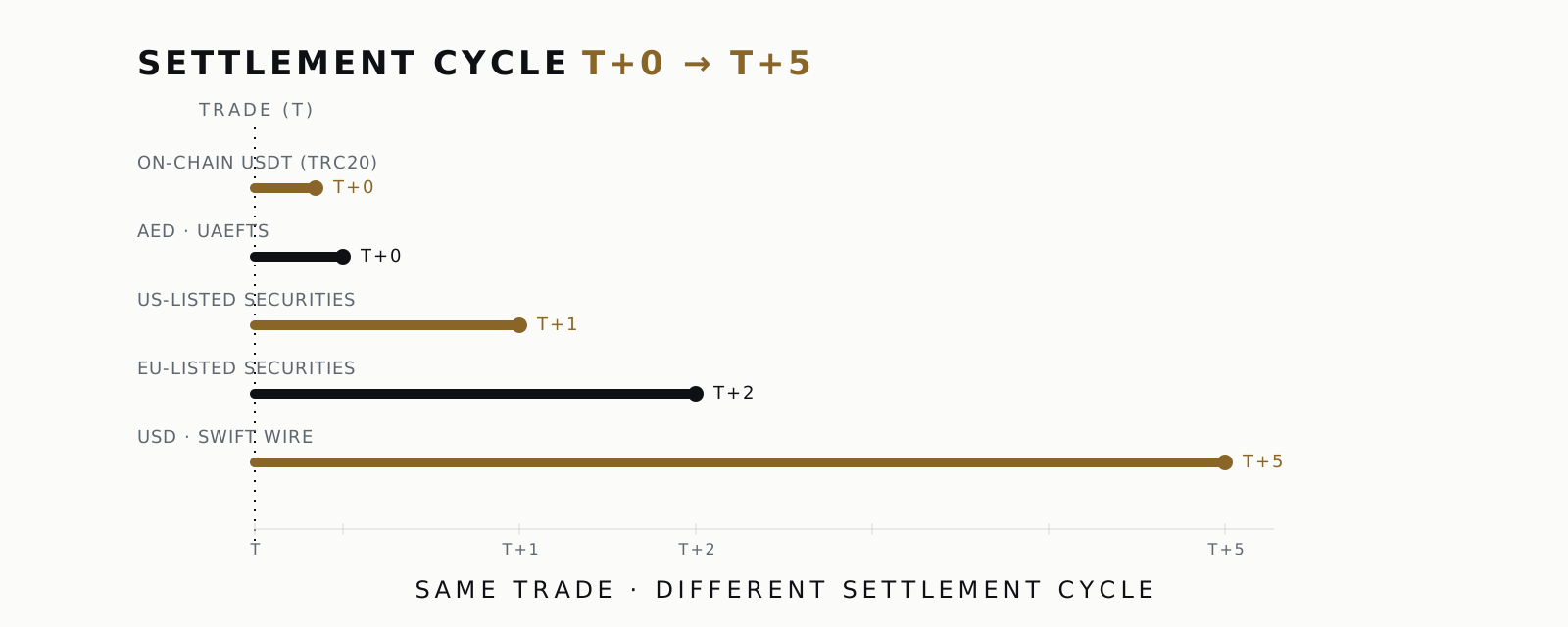
A settlement cycle is the time between a trade and its final, irreversible settlement. On-chain USDT transfers settle within minutes (T+0); AED pays out the same business day (T+0) through UAEFTS; a USD wire by SWIFT or a securities trade abroad can take T+1 to T+5.
KEY FACTS
| Term | Settlement cycle — trade date to final settlement, written T+0 to T+5 |
|---|---|
| On-chain USDT (TRC20) | T+0 — about 1 minute after confirmation |
| AED via UAEFTS | T+0 — same business day |
| USD via SWIFT | T+2 to T+5 — 2 to 5 business days |
| US-listed securities | T+1 — since 28 May 2024 |
| EU-listed securities | T+2 — T+1 planned for 11 October 2027 |
Source: SEC, European Commission and IWGT published settlement terms, as of October 2026.
What is a settlement cycle?
A settlement cycle is the span between the moment a trade is agreed and the moment both sides of it are final: the asset delivered, the payment made, neither side movable again. Market practice writes it as the trade date plus a number of business days — T+0 for same-day settlement, T+1 one business day later, up to T+5. Selling USDT through a licensed desk keeps settlement and finality close together; the length of the cycle itself varies far more by rail, as our guide to crypto-to-bank transfer timing in the UAE sets out.
Why does the settlement cycle vary by rail?
The settlement cycle is set by what has to happen between agreement and finality, not by how fast any single network runs. An on-chain USDT transfer has no separate clearing step: the network is the ledger, so its cycle is whatever block time and confirmation policy require. A bank wire adds a chain of correspondent accounts that a blockchain transfer skips entirely, which is why a cross-border SWIFT wire runs on business days rather than minutes.
A securities trade adds a central counterparty and a custodian on each side, so it settles in business days even though the trade itself executes instantly. The United States shortened its standard cycle from two business days to one (T+1) for most broker-dealer transactions, effective 28 May 2024, under a rule the SEC adopted on 15 February 2023. The European Union still runs T+2 under the Central Securities Depositories Regulation and has proposed 11 October 2027 for its own move to T+1.
Illustrative example
Illustrative example: a seller agrees a 300,000 USDT trade with a licensed desk on a Tuesday morning. The USDT settles on TRC20 within its own cycle, T+0, in about a minute; the desk's AED leg is also T+0, paid the same business day by UAEFTS. A separate sale of US-listed shares placed that same morning settles T+1, landing in the brokerage account the next business day — simply because securities clearing runs a different cycle from either rail above. Check the published spread bands for your own ticket size before sending.
FAQ
What does T+1 mean in a settlement cycle?
T+1 means settlement happens one business day after the trade date. The United States moved most broker-dealer securities trades to T+1 on 28 May 2024, down from the previous T+2 standard, under a rule adopted by the SEC.
Is an on-chain USDT transfer T+0 or instant?
It is T+0, not instant. The trade and its settlement fall on the same calendar day, but the transfer still needs its network's normal confirmation time — about a minute on TRC20 — before a desk treats it as settled.
Get a settlement cycle you can plan around
IWGT is a VARA-licensed Broker-Dealer in Dubai. All-in spread 0.08–0.40% by ticket size, published openly. AED settles T+0 by UAEFTS the same business day; USD follows the SWIFT cycle, 2 to 5 business days.
SOURCES
- U.S. Securities and Exchange Commission — "SEC Finalizes Rules to Reduce Risks in Clearance and Settlement" — T+1 standard settlement cycle, compliance date 28 May 2024, accessed 12 October 2026.
- European Commission — "T+1 settlement" — proposed CSDR amendment, migration date 11 October 2027, accessed 12 October 2026.
- Ethereum developer documentation — proof-of-stake finality, accessed 12 October 2026.
- Central Bank of the UAE — payment systems (UAEFTS), accessed 12 October 2026.
- IWGT published pricing bands and settlement terms — IWGT published pricing bands, October 2026.
This guide is informational and is not legal, tax or investment advice, nor an invitation to buy or sell any virtual asset. Rules and figures are as of October 2026 — re-check the sources before acting. Virtual assets may lose their value in full or in part and are subject to extreme volatility.